Quick answer: Yes. According to the City of Santa Ana’s 2025 Consumer Confidence Report, all 11,400 samples the city collected during the year were below state and federal maximum allowable levels, and the report lists no violations. That makes Santa Ana tap water safe to drink by the legal definition. It does not make it free of everything. The same report shows PFAS detected in city wells and in the distribution system, hardness of about 14 grains per gallon, a chlorine residual you can taste, and trace hexavalent chromium, arsenic and uranium that are legal but not zero. What reaches your faucet also depends on your own plumbing, which a free in-home test can see and the citywide report cannot.
What “meets all standards” does and doesn’t tell you
The EPA regulates more than 90 contaminants under the Safe Drinking Water Act, and California’s State Water Resources Control Board Division of Drinking Water layers its own, often stricter, limits on top. Santa Ana met every one in 2025. Three things are still worth knowing.
First, a Maximum Contaminant Level is a legal and economic line, not a zero-risk line. California publishes separate Public Health Goals that are far lower; Santa Ana’s report shows hexavalent chromium averaging 1.4 parts per billion against an MCL of 10 and a Public Health Goal of 0.02, for example. Legal, and also 70 times the health goal; the same pattern holds for arsenic (up to 2.6 ppb) and uranium (2.6 pCi/L) in city wells.
Second, the city tests at wells, reservoirs and about 50 distribution points, not at your kitchen sink. Santa Ana’s system has roughly 480 miles of pipe, and the last stretch, your service line and indoor plumbing, belongs to you. The city reports no lead service lines in its inventory, but older fixtures and solder in homes built before 1986 are outside the utility’s reach.
Third, a Consumer Confidence Report is about health standards. Hardness, chlorine taste, the mineral taste of imported Colorado River water and spotting on glassware are secondary or unregulated issues the utility is not required to fix, and doesn’t.
Where Santa Ana’s drinking water comes from
About 85 percent of Santa Ana’s supply is groundwater pumped from the Orange County Groundwater Basin through 21 city-owned wells. The remaining 15 percent is imported, treated surface water from the Metropolitan Water District of Southern California (MWD), delivered through its Diemer treatment plant in Yorba Linda and drawn from the Colorado River and the State Water Project. The city disinfects its well water with chlorine generated on site; MWD disinfects imported water with chloramine, so depending on your neighborhood and the month you may receive one, the other or a blend.
The Orange County Water District (OCWD) manages the basin and refills it with Santa Ana River flow, captured stormwater and purified recycled water from its Groundwater Replenishment System. The same basin supplies about 85 percent of the water for 2.5 million people across north and central Orange County, including Anaheim, Fullerton, Garden Grove, Westminster, Tustin, Orange, Huntington Beach, Costa Mesa and Newport Beach. South county cities such as Mission Viejo, Laguna Niguel and Laguna Beach sit outside the basin and rely almost entirely on imported MWD water. Here are the issues we actually see in Orange County homes, with figures from the utilities’ own reports.
1. PFAS in the groundwater basin
What homeowners notice: Nothing. PFAS have no taste, odor or color.
What causes it: Per- and polyfluoroalkyl substances are man-made chemicals from decades of industrial and consumer use. OCWD says they entered the Orange County basin primarily through the Santa Ana River, whose flows recharge the aquifer. OCWD reports that more than 100 of the basin’s roughly 200 production wells have been affected by state and federal PFAS limits, that 55 have been returned to service with treatment, and that the regional cost is estimated at 1.8 billion dollars over 30 years across 15 affected retail agencies.
Why it matters in Santa Ana: The city’s 2025 report shows PFOS in the distribution system averaging 4.2 parts per trillion (range not detected to 14), PFOA averaging 2.7 ppt (ND to 8.9) and PFHxS averaging 2.9 ppt (ND to 8.5). California lowered its notification levels on October 29, 2025, to 4.0 ppt for PFOA and PFOS and 3.0 ppt for PFHxS, so parts of the city’s range sit above those advisory thresholds even though no enforceable limit was exceeded. Well 38, near the Santiago Creek recharge basin, was taken out of service for PFAS in 2018 and has not returned. The city and OCWD are building a 13.8-million-gallon-per-day ion exchange treatment plant at the John Garthe Reservoir on North Bristol Street to treat five wells, with construction scheduled from summer 2026 to summer 2028. Fullerton brought its first PFAS plant online in 2021, Huntington Beach reported PFOS averaging 5 ppt in its wells, and IRWD reports only trace detections.
How to fix it: Culligan’s Aquasential® Smart Reverse Osmosis System with Total Defense is certified to reduce total PFAS by more than 99.99 percent at the kitchen tap. For every faucet in the house, the Whole Home PFAS Water Filter is certified to reduce total PFAS by more than 99 percent. Details are on our Santa Ana water filtration page.
2. Chlorine and chloramine taste
What homeowners notice: A swimming-pool smell from the tap or shower, and tea or coffee that tastes flat.
What causes it: Santa Ana targets a chlorine residual of 0.6 to 1.0 ppm in its pipes and measured a range of not detected to 2.9 ppm in 2025. MWD’s imported water carries chloramine, a more persistent chlorine-ammonia compound, with a running annual average of 2.5 ppm in its 2025 report. Homes near imported-water connections often get the stronger version.
Why it matters: Disinfection keeps bacteria out of 480 miles of pipe, so it belongs in the water, just not in your glass. Chloramine is harder to remove than free chlorine; a basic pitcher does little to it.
How to fix it: A reverse osmosis system removes both at the drinking tap. A whole-house carbon filter, or a softener with built-in carbon such as the Aquasential® Smart HE Water Filter, takes the chlorine taste and smell out of showers and laundry too.
3. Hard water
What homeowners notice: White spots on dishes, scale on the tankless water heater, film on the shower glass, dry skin, stiff towels.
What causes it: Calcium and magnesium picked up as water moves through the basin’s sediments and down the Colorado River.
Why it matters: Santa Ana’s 2025 report lists groundwater hardness at 239 ppm as calcium carbonate, about 14 grains per gallon, with wells ranging from 7.6 to 18 grains; imported MWD water tested at 236 ppm. That is very hard on the standard scale, and Fullerton, Huntington Beach and IRWD report similar ranges. Hardness is not a health issue, but it shortens the life of water heaters and dishwashers and raises energy and detergent costs.
How to fix it: A whole-home Aquasential® Smart High Efficiency Water Softener. In Irvine Ranch Water District’s service area, where self-regenerating softeners are prohibited, Culligan’s Portable Exchange Tank service is the compliant equivalent. See our Santa Ana water softeners page.
4. Total dissolved solids and the imported-water taste
What homeowners notice: A mineral or slightly salty taste, especially in summer; a white residue when water evaporates off a dark countertop.
What causes it: Colorado River water is high in dissolved minerals. Santa Ana’s groundwater averaged 396 ppm of total dissolved solids in 2025; MWD water averaged 545 ppm. Sodium follows the same pattern, 44 ppm in city wells versus 88 ppm imported.
Why it matters: All of this is under the 1,000 ppm secondary standard. It is a taste issue rather than a health one, and the reason so many Orange County households buy bottled water they don’t need.
How to fix it: Reverse osmosis is the only common home treatment that removes dissolved minerals and salts. The Aquasential® Tankless RO fits under a sink without a storage tank.
5. Lead from household plumbing
What homeowners notice: Nothing. Lead has no taste or smell.
What causes it: Santa Ana reports lead-free mains, no lead or galvanized service lines in its inventory, and no lead detected in its 2024 sampling at 66 homes. The remaining risk is inside houses built before 1986, when leaded solder and brass fixtures were standard, and Santa Ana’s central neighborhoods have a great deal of that housing.
Why it matters: Lead is a concern for infants, children and pregnant women at any level; California’s Public Health Goal is 0.2 ppb against a federal action level of 15.
How to fix it: Culligan’s Aquasential® Smart Reverse Osmosis System is certified to reduce lead by 99.7 percent. A certified lab test of your first-draw tap water tells you whether you need it.
How to check your tap water quality in Santa Ana
Read the report. Santa Ana’s annual Consumer Confidence Report and its full data tables are at SantaAnaCCR.org; the city also keeps a water quality page with PFAS updates at santa-ana.org/water-quality. Anaheim, Fullerton, Huntington Beach, IRWD, Mesa Water, El Toro and Moulton Niguel publish their own. OCWD posts basin-wide PFAS information at ocwd.com.
Look for the signs. Chlorine smell, spots on glassware, scale on fixtures, a mineral taste, a blue-green stain under a dripping faucet. None is a health alarm; each is a clue about what treatment should target.
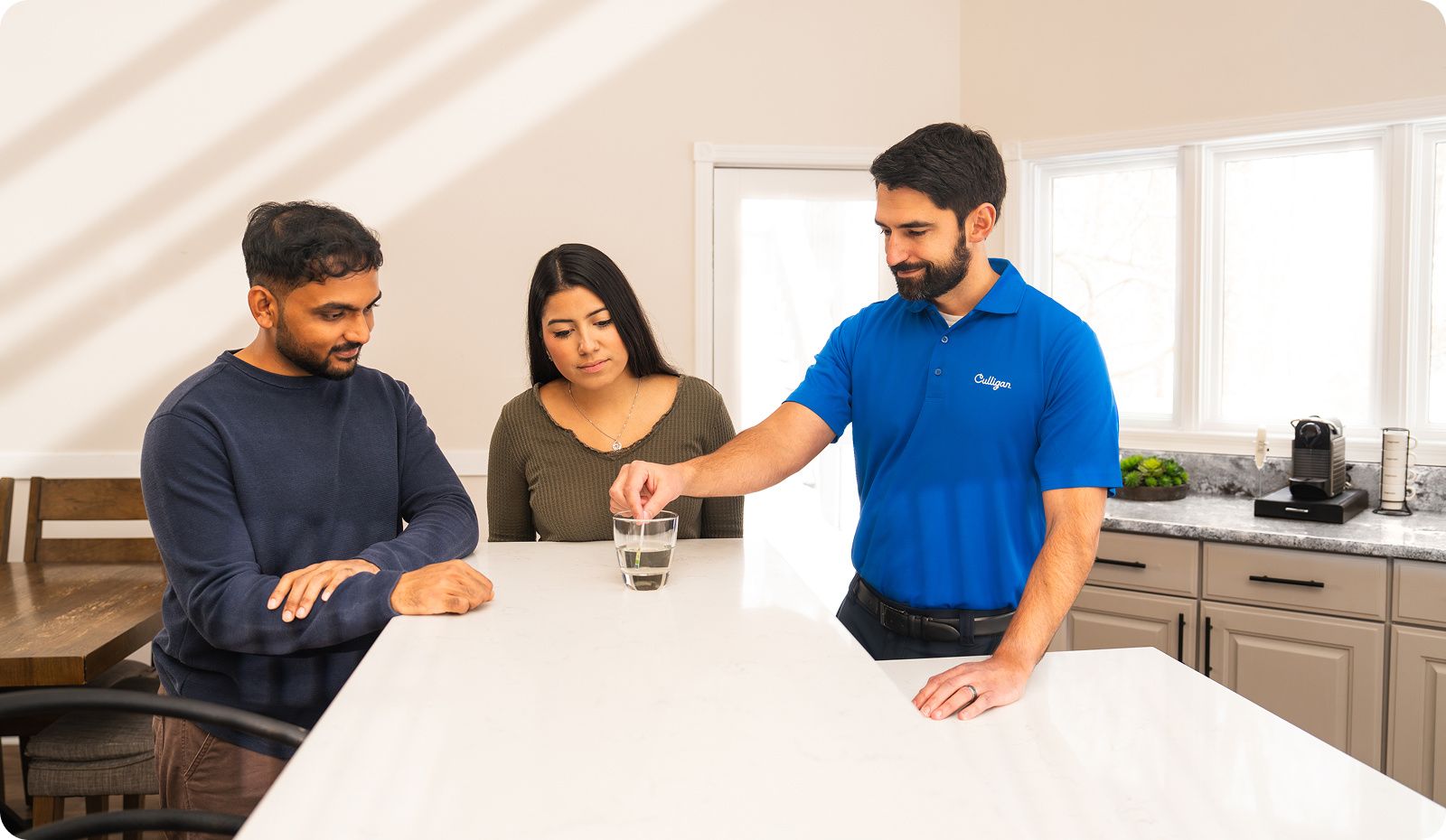
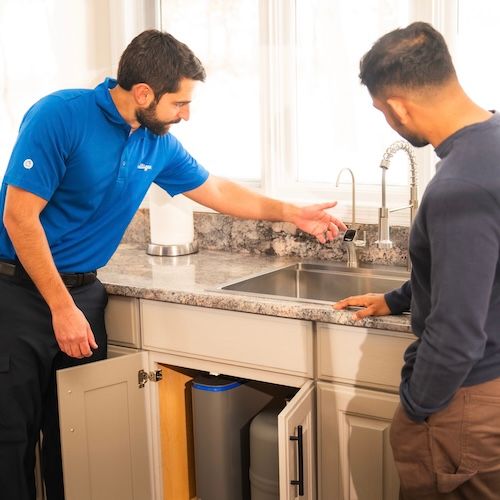
Test at the tap. Culligan of Santa Ana’s free in-home test measures hardness, chlorine, TDS, pH and iron in about 20 minutes; for lead, PFAS, arsenic, bacteria or nitrate we arrange certified laboratory testing. Testing matters most if your home predates 1986, if an infant or someone pregnant lives there, if the taste has changed, or if you want a number instead of a citywide average. Our Santa Ana water testing page explains both options.
Schedule your free water test with Culligan of Santa Ana
Culligan of Santa Ana has helped households and businesses across Santa Ana, Anaheim, Fullerton, Irvine, Huntington Beach, Newport Beach, Costa Mesa, Orange, Tustin, Garden Grove, Westminster, Mission Viejo, Laguna Niguel and Laguna Beach understand and improve their water for decades. We work on Santa Ana city water, OCWD basin water across the north county and imported MWD water in the south county every day. A local specialist will test your water, explain the results and, if treatment makes sense, lay out rental and purchase options with a written quote. If it doesn’t make sense, we will tell you that too.
Frequently asked questions about Santa Ana tap water
Is Santa Ana tap water safe to drink straight from the faucet?
By regulatory standards, yes. The city’s 2025 report shows no violations and all samples below legal limits. The report also shows PFAS detections in the single-digit parts per trillion, 14-grain hardness and trace chromium-6 that are legal but not absent, and it cannot see your home’s plumbing. A tap test fills in that gap.
Why does my Santa Ana tap water smell like chlorine or a pool?
The city maintains a chlorine residual of roughly 0.6 to 1.0 ppm to keep water safe in the pipes, and imported MWD water carries chloramine at about 2.5 ppm. Both are legal and intentional. Reverse osmosis removes them at the drinking tap; a whole-house carbon filter takes them out of showers and laundry.
Does Santa Ana add fluoride to the water?
Not directly. Santa Ana’s wells contain naturally occurring fluoride averaging 0.33 ppm, and the city does not add more. The imported MWD portion is fluoridated to about 0.7 ppm, so your tap level depends on the blend in your area. Reverse osmosis removes most fluoride if you prefer to.
Is there PFAS in Santa Ana’s water?
Yes, at low levels. The 2025 report shows PFOS averaging 4.2 ppt and PFOA 2.7 ppt in the distribution system, with ranges that reach above California’s revised notification levels but below any enforceable limit. The city has one well offline for PFAS and is building an ion exchange treatment plant at the Garthe Reservoir. An RO system with Total Defense reduces total PFAS by more than 99.99 percent at the tap.
Ready for better water? Schedule your free in-home water test with Culligan of Santa Ana today.