Quick answer: Yes. Homes across Pasco and Hernando counties draw on the Floridan Aquifer, a thick layer of limestone that dissolves into the water as calcium and magnesium. A U.S. Geological Survey study of Pasco County describes Upper Floridan water as generally hard to very hard, above 120 mg/L, which is about 7 grains per gallon and up. None of the local utilities soften the water at the plant, and none publish a finished-water hardness number, so a test at your own tap is the only way to learn your exact level.
Ask around Port Richey or Spring Hill and most people can describe hard water without knowing what it is called. It is the chalky ring that comes back on the faucet a week after you scrub it, the shower head that sprays sideways, the coffee maker that needs descaling every month and the dishwasher that leaves glasses cloudy. Those deposits are rock, carried up from the aquifer and left behind wherever water dries or heats.
This guide covers where the hardness comes from, how city water and well water compare across the two counties, what it does to a house, and how to find your own number.
Where does the hardness in Pasco and Hernando water come from?
The Floridan Aquifer sits under all of west-central Florida and feeds the wells behind most taps in our service area. Rainwater picks up a little carbon dioxide as it soaks through the soil, becomes mildly acidic and slowly dissolves the limestone it passes through. By the time it is pumped back up, it carries a load of dissolved calcium and magnesium. The USGS report on Pasco County water resources sums up the result plainly: water from the Upper Floridan aquifer is generally hard to very hard. That study dates from 1987 and describes the aquifer rather than any one tap, but the geology it describes has not changed.
Hardness is not a health standard, which is why utilities are not required to remove it and why it rarely appears in annual reports. It is an engineering and household problem: the minerals are safe to drink, but they build up in everything water touches.
Is municipal or well water harder around Port Richey and Spring Hill?
Usually well water, though the gap is smaller here than in many places, because none of the public systems in the area soften their water either.
Pasco County and New Port Richey
Pasco County Utilities buys about 95 percent of its regional supply from Tampa Bay Water, according to its 2023 report, and fills the rest from 15 of its own Floridan wells. Tampa Bay Water’s 2025 report shows its supply that year was 63.1 percent groundwater, 30.5 percent river water and 6.4 percent desalinated seawater. Because surface water and desalinated water are blended in, hardness on the Pasco regional system can rise and fall with the mix from season to season. Neither report lists a hardness figure.
The City of New Port Richey runs 10 Floridan Aquifer wells. Its 2025 report says the water is aerated to strip out hydrogen sulfide and then disinfected with chloramine; there is no softening step and no hardness value in the report.
Hernando County and Brooksville
Hernando County Utilities describes its deep-well aquifer water as needing little or no treatment other than disinfection, which means the minerals stay in. The City of Brooksville pumps from six wells about 600 feet deep, then chlorinates and aerates the water. Spring Hill and Brooksville customers are therefore getting aquifer hardness more or less as it comes out of the ground.
Private wells
About 1 in 5 Hernando County residents and about 1 in 7 Pasco residents rely on a household well, according to USGS county water-use data. A well delivers raw Floridan water with no aeration or blending at all, and it often carries iron and hydrogen sulfide on top of the hardness. Well owners in Hudson, Brooksville or the rural edges of Spring Hill tend to see the heaviest scale in the area.
Hard water problems Pasco and Hernando homeowners run into
1. Scale inside water heaters and appliances
Heat drives calcium out of solution, so the water heater takes the worst of it. Scale collects on the bottom of a tank heater and on the elements, insulating the water from the burner and forcing longer run times. You may hear popping or rumbling as water trapped under the scale boils. Tankless heaters, dishwashers, ice makers, coffee machines and washing machines all build up the same crust in their valves and heating parts, which shortens their service life and raises energy use.
2. Spots, film and soap scum
Hard water reacts with soap to form a sticky curd instead of a clean lather. That curd is the gray film on shower walls and tubs, and it is why you use more detergent and shampoo than the label suggests. When droplets dry on glass, tile or chrome, they leave white spots that come back almost as fast as you can wipe them.
3. Dry skin and dull hair
The same soap residue stays on skin and hair after rinsing. Many people notice tight, itchy skin after a shower and hair that feels coarse or looks flat, and color-treated hair can fade faster.
How to check your home’s water hardness
Because no utility in the area publishes a hardness number, you will have to measure it yourself. There are a few ways to do that.
Look for the signs. White crust on faucets, cloudy glasses and a rumbling water heater are reliable clues that hardness is high enough to matter.
Read your utility’s report anyway. The Pasco County, New Port Richey, Hernando County and Brooksville reports will not give you hardness, but they do tell you your source, your disinfectant and whether anything else in the water deserves attention.
Use test strips for a rough number. Hardness strips from a hardware store give a ballpark in grains per gallon or mg/L. To convert mg/L to grains per gallon, divide by 17.1.
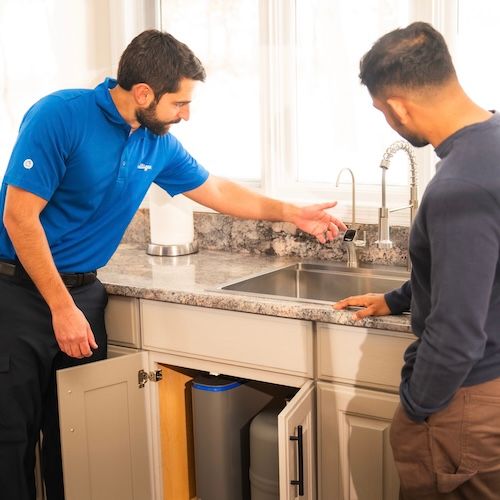
Get a professional test. Our free in-home test measures hardness along with chlorine, total dissolved solids, pH and iron in about 20 minutes.
What a water softener does about it
A softener removes calcium and magnesium through ion exchange: water passes through a bed of resin beads that trade sodium for the hardness minerals, and the unit periodically rinses itself with a salt solution to recharge. The result is water that no longer leaves scale, lathers properly and is easier on appliances.
For most homes on city or county water, the Aquasential® Smart High Efficiency Water Softener is a good match. It tracks how much water the household actually uses and regenerates only when needed, which keeps salt and water use down on hard Floridan water. The Aquasential® Select Series and Aquasential® Advantage Whole Home softeners suit homeowners who want a simpler setup. On a private well with iron or sulfur, we usually pair the softener with an Iron-Cleer® or Sulfur-Cleer® system so the resin is not fouled. You can see the options on our water softener page, and we offer salt delivery throughout the service area.
FAQs about hard water in Pasco and Hernando County
How hard is the water in Port Richey, FL?
No local utility publishes a finished-water hardness figure. The USGS describes Upper Floridan Aquifer water in Pasco County as generally hard to very hard, more than 120 mg/L, or about 7 grains per gallon and up. A test at your tap gives you the real number.
Does Pasco County Utilities soften the water?
No. Its regional water comes mostly from Tampa Bay Water and is disinfected with chloramine, but neither report describes a softening step or lists hardness. New Port Richey, Hernando County Utilities and Brooksville do not soften either.
Will a pitcher filter soften hard water in Spring Hill?
No. Pitcher filters improve taste and reduce some contaminants, but they do not remove enough calcium and magnesium to matter, and they never touch the water going to your heater, shower or dishwasher. That takes a whole-house softener.
Is well water harder than city water in Hernando County?
Usually. Wells deliver raw Floridan water with no aeration, blending or treatment, and they often add iron and hydrogen sulfide. A softener paired with iron or sulfur treatment is the common setup on Hernando County wells.
How do I know if hard water is damaging my water heater?
Popping or rumbling sounds, slower hot-water recovery and flakes of white sediment at faucets are typical signs. Flushing the tank helps for a while; softening the water stops new scale from forming.
Start with a free hard water test from Culligan of Port Richey
Culligan of Port Richey has been treating Floridan Aquifer water for homes and businesses in Port Richey, New Port Richey, Hudson, Holiday, Trinity, Spring Hill and Brooksville for decades. Our technicians work on Pasco County water, New Port Richey and Brooksville city water, Hernando County water and private wells every week, so we know how hardness and iron vary from one part of the area to another.
A free in-home test takes about 20 minutes. We measure your water at the tap, explain the results in plain terms, and if a softener makes sense, walk through rental and purchase options with a written quote. There is no obligation.
Ready for better water? Schedule your free in-home water test and consultation with Culligan of Port Richey today.