Quick answer: Partly, and it depends on your address. Tap water in Miami-Dade, south Broward and the Florida Keys all starts in the Biscayne Aquifer, a limestone formation whose raw water the Florida Keys Aqueduct Authority classifies as very hard. Miami-Dade Water and Sewer runs its three large plants through lime softening to take some of that calcium back out, but it does not publish a finished-water hardness figure, and its five South Dade plants do not soften at all. Private wells in the Redland, Southwest Ranches and western Davie pump the aquifer straight; USGS sampling shows 58 to 130 mg/L of calcium, roughly 8 to 19 grains per gallon of calcium hardness before any treatment. A free in-home test is the only way to learn the number at your own tap.
Most people in Miami do not ask whether their water is hard until something forces the question: a tankless water heater throwing an error code two years in, a glass shower enclosure in a Brickell condo that never looks clean, a Hialeah faucet aerator clogged with white grit, or a dishwasher in Pembroke Pines that leaves every wine glass cloudy. All of those are calcium carbonate coming out of solution when water is heated or evaporates. What makes South Florida unusual is that the utilities already do some of the softening for you, and how much depends on which plant your street is connected to.
Why Biscayne Aquifer water starts out hard
The Biscayne Aquifer sits only 50 to 200 feet below the surface, and it is made of highly porous limestone and sand. Rainwater percolates through that rock quickly, dissolving calcium as it goes. USGS sampled 30 public-supply wells tapping the aquifer at depths of 40 to 165 feet and measured calcium between 58 and 130 mg/L, with a median of 88.5 mg/L. Expressed the way a softener dealer measures it, that calcium alone works out to roughly 8 to 19 grains per gallon, hard to very hard on the USGS hardness scale. The Florida Keys Aqueduct Authority, which pumps the same aquifer from a wellfield west of Florida City, describes its raw water as very hard “due to the relatively high concentration of calcium.”
Which Miami utilities soften, and how much
Miami-Dade Water and Sewer Department (WASD). The county’s three largest plants, Alexander Orr Jr. in the south and Hialeah and John E. Preston in the north, all use lime softening, and the department’s annual water quality report says water at those plants “receives lime treatment to reduce hardness.” Lime softening precipitates calcium carbonate out of the water before it is filtered and disinfected with chloramine. It removes a large share of hardness, but it is a bulk process meant to protect miles of pipe, not a household softener, and some calcium always remains. The 2023, 2024 and 2025 reports give no finished-water hardness number, so nobody can tell you how many grains per gallon leave the Orr plant for Kendall and Coral Gables or the Preston plant for Doral and Miami Lakes without testing.
The South Dade plants and Homestead. WASD’s five smaller plants around Homestead and Cutler Bay are described as disinfecting and stabilizing the water for corrosion control. No softening is listed, and the City of Homestead’s own plants likewise chlorinate without softening. Customers there receive aquifer water with its hardness intact.
Hollywood, Broward County, Pembroke Pines and Fort Lauderdale. Hollywood lime-softens and membrane-filters its Biscayne water and runs reverse osmosis on deeper Floridan wells, and it also supplies Broward County’s Districts 3A and 3B/C. Broward County Water and Wastewater Services softens with lime and ferric chloride. Pembroke Pines reports its water is “softened, filtered, and chlorinated.” Fort Lauderdale’s Fiveash plant lime-softens while Peele-Dixie uses nanofiltration. None publishes a hardness figure.
Miramar and Cooper City. Both rely on membranes, nanofiltration and reverse osmosis at Miramar and membrane softening at Cooper City, which remove more hardness than lime does. Again, no number is published.
The Florida Keys Aqueduct Authority. FKAA is the one utility in our territory that describes the result: raw water very hard, finished water “moderately hard” after lime softening and filtration at the J. Robert Dean plant in Florida City. FKAA’s 2025 planning documents list a finished-water goal of 100 mg/L as calcium carbonate, about 5.8 grains per gallon. That water then travels 130 miles down a single transmission main through Key Largo, Islamorada and Marathon to Key West.
Is well water harder than city water around Miami?
Almost always. A private well in the Redland, on Homestead’s agricultural fringe, west of Kendall or in Southwest Ranches pulls the aquifer as it is, so the full 8 to 19 grains per gallon range applies, often with dissolved iron alongside. USGS’s most recent county estimate counts roughly 25,000 Miami-Dade residents and fewer than 8,000 Broward residents on their own wells; the Keys have none. Well hardness also varies from one property to the next with well depth and canal influence, so for well owners the test is the whole answer. Our well water page covers the issues that travel with hardness in these areas.
How hard water shows up in South Florida homes
Hardness is not a health concern and the utility is not required to fix it. It is a maintenance problem that gets expensive quietly, and on our service calls it surfaces in three ways.
1. Scale in water heaters and appliances
What you notice: a tankless heater flashing a flow or temperature error, a tank heater that rumbles, a dishwasher with white crust on the element. Why it happens: calcium carbonate is less soluble in hot water, so it deposits on the hottest surface available, and tankless units with their narrow passages are the most sensitive. Why it matters: scale raises energy use and shortens equipment life, and most tankless warranties specify a maximum hardness.
2. Film, spots and soap scum
What you notice: cloudy glassware, a haze on frameless shower glass that returns within days, chalky rings around faucet bases. Why it happens: hard water leaves its minerals behind when it dries, and calcium reacts with soap to form scum. Why it matters: it dulls fixtures and glass and drives up detergent use.
3. Dry skin, flat hair and stiff laundry
What you notice: skin that feels tight after a shower, hair that will not hold shine, towels that come out stiff and dingy. Why it happens: the same soap curd that sticks to tile sticks to skin, hair and fabric. Why it matters: it is the most common reason condo residents in Aventura and Miami Beach first ask us about their water.
An ion-exchange softener such as the Aquasential® Smart High Efficiency Water Softener removes calcium and magnesium before water reaches the heater, the dishwasher or the shower, which stops all three at the source.
How to find out how hard your water is
Read the report, then notice what is missing. Your utility’s annual report is worth reading for chloramine, lead and PFAS results, but it will not tell you hardness, because none of the local utilities reports it.
Look at the hot-water side first. Pull the aerator off a kitchen faucet and check for white grit, look at the dishwasher’s heating element, and ask when the water heater was last flushed.
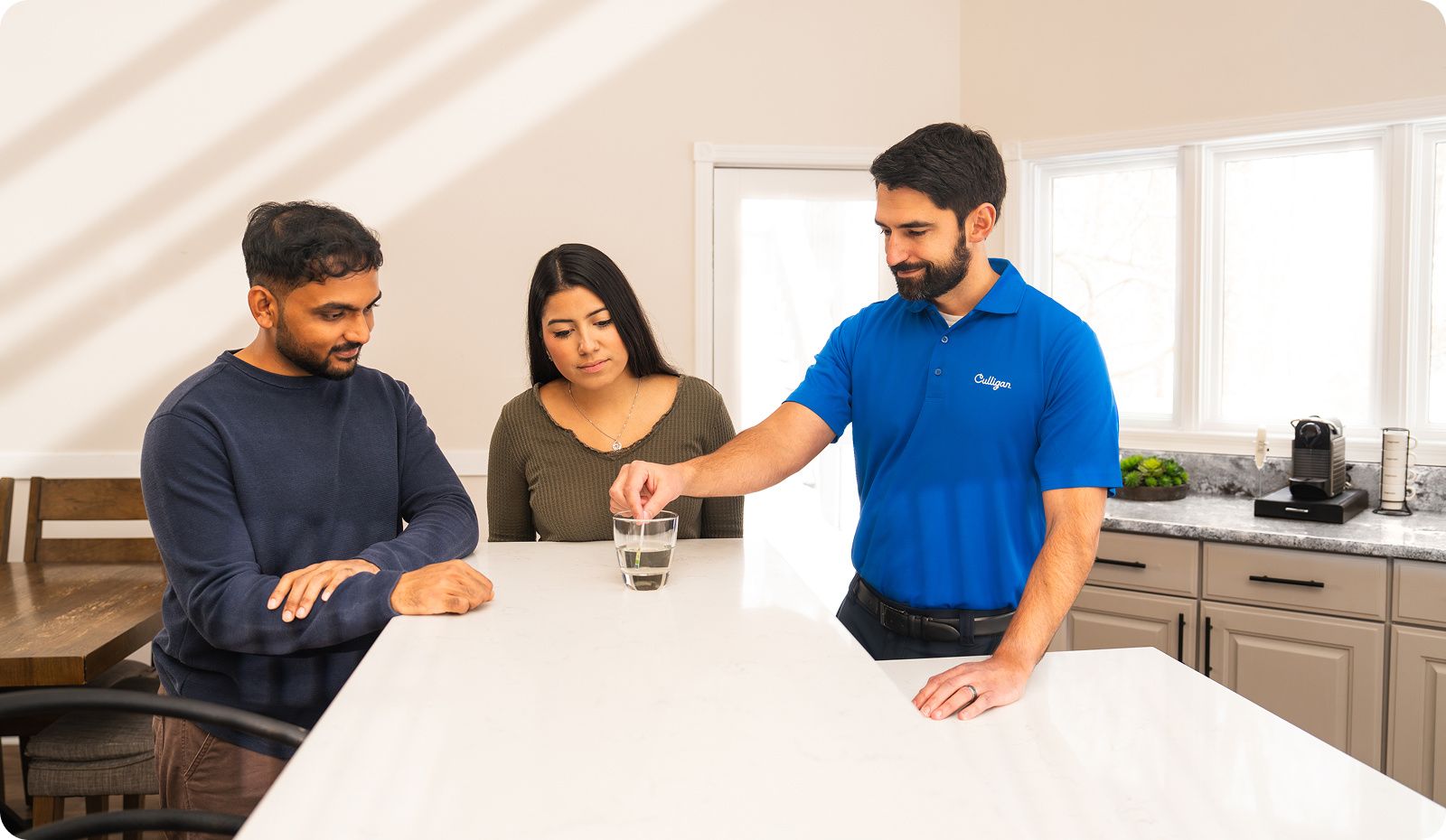
Test at your own tap. This is the only method that accounts for which plant feeds your street, what your building’s pipes add and, for well owners, what your particular well produces. Our technicians measure hardness in grains per gallon along with chlorine or chloramine, total dissolved solids, pH and iron in about 20 minutes, at no charge. If a softener makes sense we size it to the number and your household; if a different problem is behind what you are seeing, we tell you that instead. Details are on our water testing page.
FAQs about hard water in Miami
How many grains per gallon is Miami water?
Miami-Dade Water and Sewer does not publish a finished-water hardness figure, so there is no official number to quote. Its Orr, Hialeah and Preston plants lime-soften the water, which removes part of the calcium; its South Dade plants do not soften. A free in-home test gives you the grains per gallon at your tap.
Does Miami-Dade Water and Sewer soften the water?
Partially. Lime softening at the three large plants reduces hardness to protect the distribution system, but it is not designed to eliminate scale and spotting in homes, and the department does not report how much remains.
Is the water in the Florida Keys hard?
FKAA describes its finished water as moderately hard, with a treatment goal of 100 mg/L as calcium carbonate, about 5.8 grains per gallon. Moderately hard water still scales tankless heaters and spots glass; a softener handles it.
Will a shower filter or pitcher fix hard water in my condo?
No. Those products reduce chlorine, chloramine and some tastes, not calcium and magnesium. Softening requires ion exchange, which in a condo usually means a compact cabinet softener if the association allows it, or a reverse osmosis system under the sink for drinking water.
Start with a free hard water test from Culligan of Miami
Culligan of Miami has worked on South Florida water for decades from our office in Miramar, serving homes and businesses in Miami, Hialeah, Doral, Coral Gables, Kendall, Cutler Bay, Homestead, Aventura, Miramar, Pembroke Pines, Hollywood, Davie, Weston and Fort Lauderdale, and the full length of the Keys from Key Largo through Marathon to Key West.
Our technicians see every version of local water: lime-softened WASD water in a Coconut Grove bungalow, membrane-softened Miramar water in a new townhouse, FKAA water at the end of the pipeline in Key West, and raw aquifer water from a Redland well. That range is why we test before we recommend anything. If a softener is the right call, we show you the Aquasential models that fit your home, available to rent or buy, with salt delivery on a schedule.
Ready for better water? Schedule your free in-home water test and consultation with Culligan of Miami today.