Quick answer: Yes. Miami-Dade Water and Sewer’s 2025 water quality report shows no violations of federal drinking water limits, zero positive total coliform samples and lead at a 90th percentile of 3.2 parts per billion against a 15 ppb action level. The same report, though, lists PFOS at 33 parts per trillion and PFOA at 13 ppt in the main system, both well above the 4 ppt federal standard that becomes enforceable in 2029, chloramine readings as high as 4.0 ppm, and nitrate at 7 ppm in the South Dade system against a 10 ppm limit. Compliant water and water with nothing in it are two different things, and the report measures the plant, not your building’s pipes.
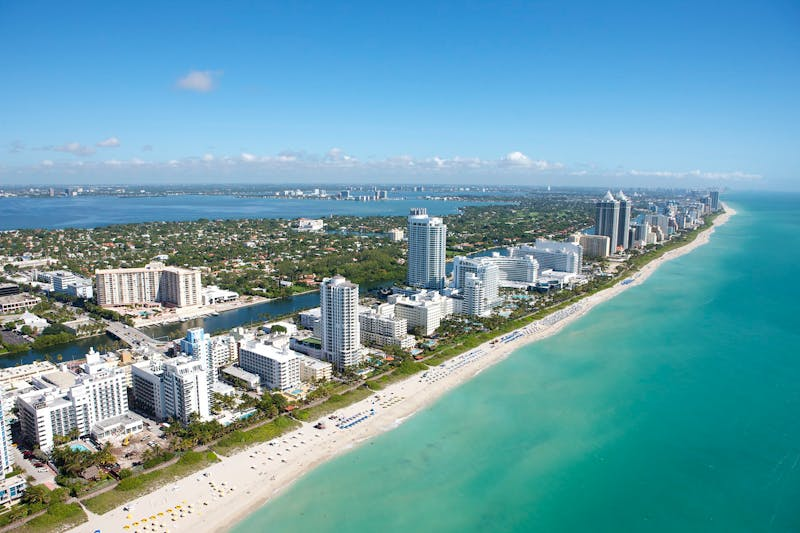
If you live in Miami, Hialeah, Doral, Kendall or anywhere else on Miami-Dade Water and Sewer Department water, your tap water is treated, tested daily and reported on every year, and the same goes for Hollywood, Miramar, Pembroke Pines, Fort Lauderdale and the Florida Keys Aqueduct Authority. People still ask us whether it is safe to drink, and the answer has layers. Federal standards weigh cost and treatment feasibility, not only health. Testing happens at the plant and at a sample of homes, not at your faucet. And several things the utilities report are either unregulated, below the limit but still noticeable, or regulated on a timeline that has not arrived yet.
What the Miami-Dade water quality report does and does not tell you
Miami-Dade Water and Sewer’s (WASD) annual water quality report covers two systems: the Main System fed by the Alexander Orr Jr., Hialeah and John E. Preston lime-softening plants plus a reverse osmosis plant in Hialeah, and the South Dade system of five smaller plants around Homestead and Cutler Bay that only disinfect and stabilize the water. Wholesale customers such as Opa-locka, Miami Beach and Bal Harbour receive Main System water.
The 2025 report is clean by regulatory measures: every row in the violation column reads no, and Cryptosporidium and Giardia were not found in the source water. What the report also shows, and the summary line does not:
Chloramine averaged 2.5 ppm in the Main System with readings from non-detect to 4.0 ppm, the maximum allowed. South Dade uses free chlorine, averaging 1.3 ppm.
Lead at the tap came in at a 90th percentile of 3.2 ppb in the Main System, with one of 102 sampled homes over the action level. South Dade was 1.1 ppb, with two of 37 homes over the copper action level.
PFAS in the Main System: PFOS 33 ppt, PFOA 13 ppt, PFHxS 7 ppt, PFNA 5 ppt. South Dade: PFOS 32 ppt, PFOA 13 ppt. The report notes that violations of the 4 ppt PFOS and PFOA limits will not be reported until 2029.
Disinfection byproducts: total trihalomethanes averaged 50 ppb (limit 80) and haloacetic acids 34 ppb (limit 60) in the Main System.
Nitrate was 0.3 ppm in the Main System but 7 ppm in South Dade, a reflection of the agricultural land around the South Dade wellfields. The limit is 10 ppm.
Fluoride stopped being added at the Orr, Preston and Hialeah plants on June 6, 2025; the report says natural levels now run 0.1 to 0.3 ppm.
Hardness does not appear anywhere in the report. The plants lime-soften, but the department does not publish what is left.
None of those is a violation. All of them are things a household might reasonably want to know about, and several are things a point-of-use or whole-house system can change.
The south Broward and Keys systems
Our service area crosses into Broward and runs the length of the Keys, and each utility there publishes its own report.
City of Hollywood draws from Biscayne wells about 100 to 200 feet down and Floridan wells about 900 feet down, lime-softens and membrane-filters the Biscayne water, runs reverse osmosis on the Floridan water and disinfects with chloramine, 2.47 ppm in its most recent published report. Hollywood also supplies Broward County’s Districts 3A and 3B/C, where the county’s 2024 report lists PFOS at 18 to 22 ppt; the county’s own District 2A measured 23.6 ppt. Hollywood’s 2023 report disclosed one reporting violation, a sample result submitted late to the state, with no contaminant detected.
City of Miramar, where our office sits, uses nanofiltration and reverse osmosis membranes and free chlorine, 2.14 ppm in 2024. Its report shows one secondary-standard exceedance: iron at 0.326 ppm against the 0.3 ppm aesthetic limit, enough to explain the orange toilet stains some Miramar residents ask about.
Pembroke Pines, Fort Lauderdale and Homestead all reported no violations. Pembroke Pines showed chloramine at 3.0 ppm with readings up to 4.4 ppm. Fort Lauderdale reported chloramine at 2.3 ppm and lead at 4.85 ppb with one of 55 sites over the action level, and resamples in summer 2026. Homestead, which chlorinates without softening, reported nitrate at 2.6 ppm and lead at 4.3 ppb.
Florida Keys Aqueduct Authority pumps Biscayne water from a wellfield west of Florida City, lime-softens it to what it calls moderately hard, disinfects with chloramine at 2.9 ppm, and sends it 130 miles down a single main to Key West, with a brackish Floridan reverse osmosis plant and two emergency seawater plants at Stock Island and Marathon as backup. FKAA has reported PFAS in its Biscayne source water and is building a nanofiltration and ion-exchange plant to remove it. Its 2025 report shows no violations; the Stock Island seawater plant produced water with 160 ppm chloride and 130 ppm sodium, which is why Lower Keys residents sometimes notice a saltier taste when the emergency plants run.
Municipal water vs. private wells in Miami-Dade and Broward
Every number above describes a public system. Roughly 25,000 Miami-Dade residents and fewer than 8,000 Broward residents, by USGS’s most recent county estimate, are on private wells, most of them in the Redland and Homestead farm country, on acreage west of Kendall, and in Southwest Ranches and western Davie. Those wells pump raw Biscayne water that nobody softens, disinfects or tests unless the owner does. The Florida Department of Health recommends testing wells for bacteria and nitrate at least once a year. Our well water page covers what those tests tend to find locally.
The water issues we see most in Miami homes
These are the complaints that come up most on our service calls from Aventura to Key West, and what the published data says about each.
1. Chloramine taste and smell
What homeowners notice: a flat chemical taste in tap water and a chlorine smell in the shower, strongest for about two weeks each September.
What causes it: WASD, Hollywood, Pembroke Pines, Fort Lauderdale and FKAA all disinfect with chloramine, chlorine bonded to ammonia, which stays active longer in long pipe runs. Every September WASD switches to free chlorine for roughly two weeks to scour the system; in 2024 that ran September 9 to 22, and Hollywood does the same during late-summer flushing.
Why it matters: chloramine does not dissipate from a pitcher on the counter the way chlorine does, and it is hard on aquarium fish and dialysis equipment.
How to fix it: an Aquasential® Smart Reverse Osmosis system at the kitchen sink, or an Aquasential® Smart HE Water Filter with catalytic carbon for every tap and shower.
2. PFAS
What homeowners notice: nothing. PFAS have no taste, odor or color.
What causes it: decades of use in firefighting foam, coatings and consumer products, now present in the shallow Biscayne Aquifer that every local utility depends on.
Why it matters: WASD’s 2025 figures of 33 ppt PFOS and 13 ppt PFOA are roughly eight and three times the federal limits that take effect in 2029, and Broward’s District 2A sits at 23.6 ppt PFOS. Utilities are planning treatment, FKAA most visibly, but those plants take years.
How to fix it: the Aquasential® Smart Reverse Osmosis with Total Defense is certified to reduce total PFAS by more than 99.99 percent at the tap. For every faucet, the Whole Home PFAS Water Filter is certified to reduce total PFAS by more than 99 percent.
3. Lead from building plumbing
What homeowners notice: nothing; lead is invisible and tasteless.
What causes it: water leaves the plant essentially lead-free but passes through service lines, solder and brass fixtures on the way to your glass. Buildings constructed before 1986, which describes much of Little Havana, Coconut Grove and older Hollywood and Fort Lauderdale neighborhoods, are the most likely to have lead solder.
Why it matters: one of 102 WASD homes and one of 55 Fort Lauderdale homes sampled exceeded the action level in the latest reports. The system average was fine; those houses were not.
How to fix it: the Aquasential® Smart Reverse Osmosis is certified to reduce lead by 99.7 percent. A lab test tells you whether your tap is one of the outliers.
4. Hard water
What homeowners notice: scale in tankless heaters, cloudy glassware, film on shower glass, stiff towels.
What causes it: Biscayne Aquifer water is very hard at the wellhead. Lime softening at the WASD, Hollywood, Fort Lauderdale and FKAA plants removes part of the calcium; membranes at Miramar remove more; the South Dade plants and Homestead remove none.
Why it matters: no local utility publishes a finished-water hardness figure, so the only way to know your number is to test. Scale shortens appliance life and raises energy and detergent use.
How to fix it: an Aquasential® Smart High Efficiency Water Softener, sized to the tested hardness and your household.
5. Nitrate in the South Dade system
What homeowners notice: nothing; nitrate is colorless and tasteless.
What causes it: fertilizer and septic influence on the shallow aquifer under the agricultural Redland, where the South Dade wellfields sit.
Why it matters: 7 ppm is under the 10 ppm limit but closer to it than any other regulated contaminant in the WASD report, and nitrate is a specific health concern for infants under six months.
How to fix it: reverse osmosis removes nitrate at the drinking-water tap, which is the conversation we most often have with families of infants in Homestead, Florida City and Cutler Bay.
How to check your own tap water in Miami
Read your utility’s report. The WASD reports page has the current year and the two before it; Hollywood, Miramar, Pembroke Pines, Fort Lauderdale, Homestead and FKAA post theirs on their own sites. Look for the PFAS table, the lead row and the disinfectant row, and remember the report describes the system, not your faucet.
Watch for signs at home. A pool smell in September, orange staining in a Miramar bathroom, white scale on a tankless heater, cloudy glassware, or a change in taste after plumbing work all point to something worth measuring.
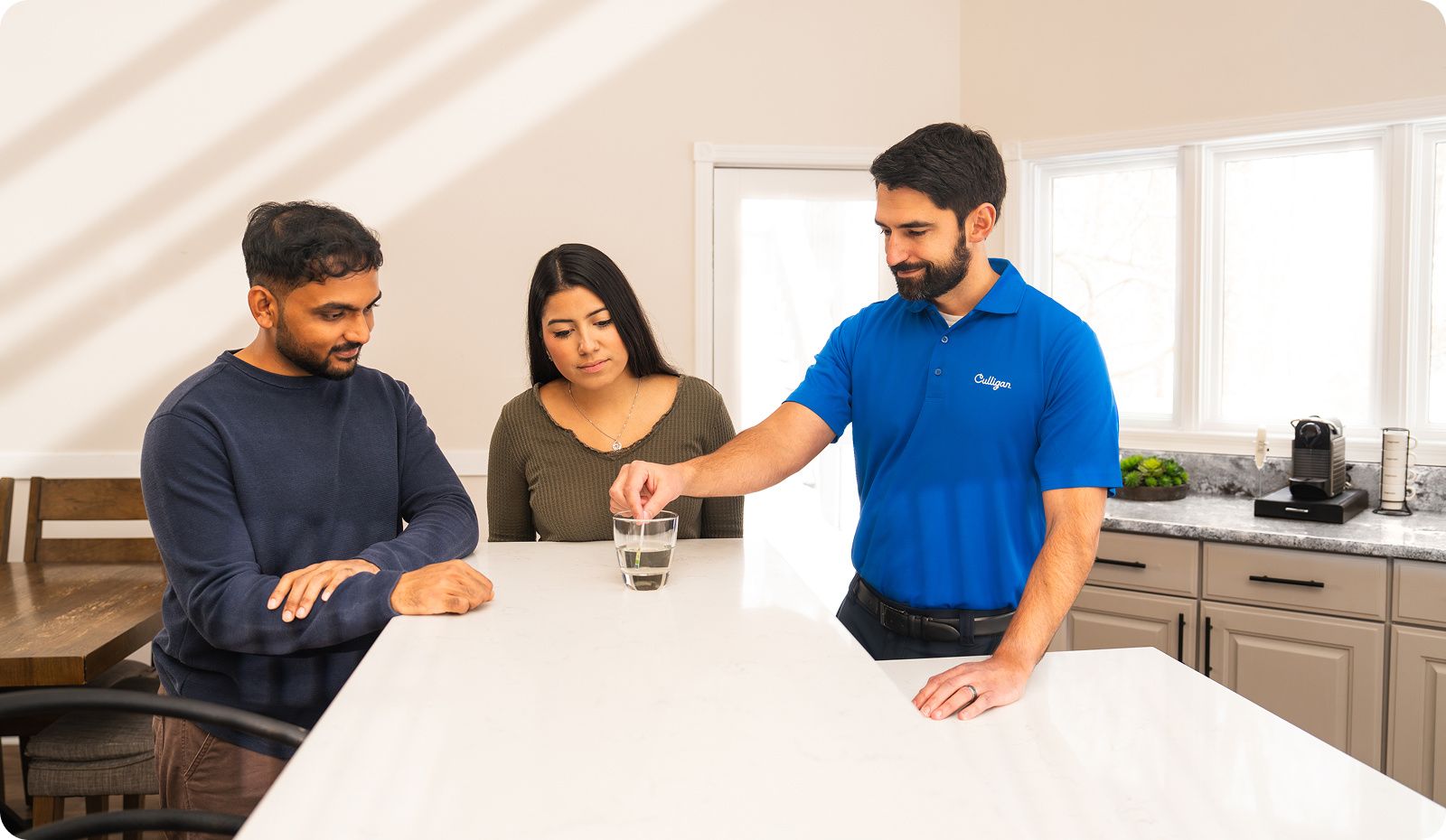
Test at your tap. Our free in-home test measures hardness, chlorine or chloramine, total dissolved solids, pH and iron in about 20 minutes. For lead, PFAS, nitrate, arsenic or bacteria, we send samples to a certified laboratory and go over the results with you. Testing matters most if your building predates 1986, you have an infant at home, you are on a private well, or something about the water has changed. Details are on our water testing page.
Frequently asked questions about Miami tap water
Can I drink Miami tap water straight from the faucet?
Yes. The 2025 WASD report shows full compliance with federal limits, no coliform positives and lead well under the action level. Whether you also want to remove chloramine, PFAS or hardness is a household decision, not a safety emergency.
Does Miami use chlorine or chloramine?
Chloramine for most of the year in the WASD Main System, with a switch to free chlorine for about two weeks every September. South Dade, Homestead and Miramar use free chlorine year-round.
How much PFAS is in Miami water?
WASD reported PFOS at 33 ppt and PFOA at 13 ppt in the Main System for 2025, and 32 and 13 ppt in South Dade. The federal limit for each is 4 ppt, enforceable from 2029. Reverse osmosis with Total Defense reduces total PFAS by more than 99.99 percent.
Is there still fluoride in Miami-Dade water?
Not added. WASD stopped fluoridating June 6, 2025, Homestead and FKAA on July 1, 2025, and Fort Lauderdale before July 2025. Natural fluoride in the WASD system now measures 0.1 to 0.3 ppm.
Schedule your free water test with Culligan of Miami
Culligan of Miami has helped households and businesses across Miami-Dade, south Broward and the Florida Keys understand their water for decades. From our office in Miramar we serve Miami, Hialeah, Doral, Coral Gables, Kendall, Cutler Bay, Homestead, Aventura, Pembroke Pines, Hollywood, Davie, Weston and Fort Lauderdale, and we run the Overseas Highway from Key Largo through Marathon to Key West.
Our technicians know the difference between Orr-plant water in Pinecrest, South Dade water in Homestead, membrane water in Miramar and pipeline water in Key West, and they test before recommending anything. If treatment makes sense, we lay out the options, rental or purchase, in writing.
Ready for better water? Schedule your free in-home water test with Culligan of Miami today.