Quick answer: Yes. Water in Indio is hard. Indio Water Authority’s 2023 water quality report lists total hardness averaging 148.5 mg/L, about 9 grains per gallon, with individual wells as high as 240 mg/L, about 14 gpg. Across the Coachella Valley the picture is similar or harder: Coachella Valley Water District wells average about 7 gpg and reach about 18 gpg, and Desert Water Agency groundwater in Palm Springs averages about 14 gpg. Private wells draw from the same mineral-rich basin and are often hard as well. The only way to know your home’s number is to test at the tap.
If you live in Indio, you probably did not need a report to tell you the water is hard. The white crust on the shower door, the ring in the pasta pot, the kettle that needs descaling, the clogged aerators and the skin that feels tight after a shower are the everyday evidence of calcium and magnesium. The desert climate makes it worse: water evaporates fast off glass and tile here, and every drop that dries leaves its minerals behind.
How hard is Indio water, by the numbers?
Hardness is measured in milligrams per liter of calcium carbonate or in grains per gallon, where one grain equals 17.1 mg/L. Water above 7 gpg is hard, and above roughly 10.5 gpg very hard. Three public agencies serve the area around Indio, and all three publish hardness.
Indio Water Authority (IWA) serves most of the city of Indio from 20 production wells. Its 2023 water quality report lists total hardness averaging 148.5 mg/L as calcium carbonate, which works out to about 9 gpg, with a range across wells that reaches 240 mg/L, or about 14 gpg. Total dissolved solids were 210 mg/L.
Coachella Valley Water District (CVWD) serves La Quinta, Palm Desert, Indian Wells, Rancho Mirage, Thousand Palms and portions of Indio, Bermuda Dunes and Cathedral City through its Cove Communities system, and Indio Hills and Sky Valley through its ID No. 8 system. Its 2024 water quality summary puts Cove Communities hardness at an average of 120 mg/L, about 7 gpg, with wells as high as 310 mg/L, about 18 gpg. ID No. 8 averaged 140 mg/L, about 8 gpg, and reached 240 mg/L. Total dissolved solids ranged up to 680 mg/L.
Desert Water Agency (DWA) serves Palm Springs and parts of Cathedral City and Desert Hot Springs. Its 2025 report lists groundwater hardness averaging 240 mg/L, about 14 gpg, with wells up to 340 mg/L, about 20 gpg, and total dissolved solids averaging 420 mg/L.
Two homes a few miles apart can differ by five or six grains per gallon depending on which wells feed them. A system average is a starting point, not your number.
Is municipal or well water harder in Indio?
In the Coachella Valley the distinction is smaller than in most places, because both come from the same groundwater. No river or reservoir supplies Indio taps; every utility customer and every private well owner is drinking from the Coachella Valley Groundwater Basin, a deep fill of sand, gravel, silt and clay washed down from the San Jacinto, Santa Rosa and Little San Bernardino mountains. The United States Geological Survey reports that public supply wells in the valley are typically 490 to 900 feet deep.
As runoff soaks through that sediment, it dissolves calcium and magnesium from the rock it passes. The basin is also replenished with imported Colorado River water, which carries its own mineral load, one reason the valley’s wells vary so much.
Utility customers in neighborhoods like Shadow Hills, Terra Lago and Indian Palms receive water that IWA has disinfected with chlorine and tested for regulated contaminants. None of the valley’s utilities soften the water; hardness is not a health standard, so the calcium and magnesium are left in. Private well owners in Thermal, Mecca, Oasis, Sky Valley and the Indio Hills get the same groundwater with no treatment at all, and the USGS found dissolved solids moderate to high in about a third of the valley’s domestic-well resource. Well water is frequently as hard as or harder than the municipal supply, but the only way to know is to test.
Hard water problems around an Indio home
Hardness is not a health concern. It is a maintenance and cost concern, and in a hot climate with heavy water use the costs add up faster than people expect.
1. Scale inside water heaters and appliances
What you notice: A water heater that rumbles or takes longer to recover, a tankless unit that throws error codes and needs descaling, a dishwasher with a white film on the interior, and an ice maker that produces cloudy cubes or slows down.
Why it happens: When hard water is heated, calcium carbonate drops out of solution and bonds to the hottest surfaces: heating elements, tank bottoms, heat exchangers. At 9 to 14 gpg, the layer builds quickly.
Why it matters: Scale insulates the heating surface, so the appliance burns more energy and wears out sooner. Pool heaters and misting systems, both common in the valley, suffer the same way.
2. Crust on fixtures and film on glass
What you notice: White or gray crust around faucet bases and shower heads, cloudy shower doors that will not clear, spotted glassware out of the dishwasher, and a chalky ring in pots and the coffee maker.
Why it happens: Every drop that evaporates leaves its minerals behind, and in Indio’s dry air that happens almost immediately. Calcium and magnesium also react with soap to form the scum that collects on tile.
Why it matters: Surfaces take more cleaning product and scrubbing, aerators and shower heads clog, and the residue is hard on fixture finishes.
3. Dry skin, dull hair and stiff laundry
What you notice: Skin that feels tight after showering, hair that is hard to rinse clean, towels that come out of the dryer stiff and faded.
Why it happens: Minerals keep soap and detergent from lathering and rinsing fully, leaving a film on skin, hair and fabric.
Why it matters: Households use more soap and detergent to compensate, and the residue aggravates the dryness the desert already causes.
A whole-house softener such as Culligan’s Aquasential® Smart High Efficiency Water Softener solves all three at the source by exchanging calcium and magnesium for a trace of sodium before the water reaches the heater, the fixtures or the laundry. You can read about the options on our water softeners page.
Hard water and chromium-6 are separate questions
Indio residents hear a lot about chromium-6, and a softener does not address it. Chromium-6 occurs naturally in valley groundwater, and California’s 10 parts per billion limit took effect in October 2024. IWA reported a 2023 average of 10.61 ppb across its wells; CVWD reported Cove Communities wells up to 21 ppb in 2024. The household technology for chromium-6 is reverse osmosis at the kitchen tap, which also removes the mineral taste that hard, high-TDS water gives drinking water and ice. Many valley homes end up with both a softener and an RO system, each doing a different job. Our water filtration page covers the drinking water side.
How to check your home’s water hardness in Indio
Read your utility’s report. IWA, CVWD and DWA all publish hardness as a range and average in their annual reports, linked above, usually in mg/L; divide by 17.1 to get grains per gallon.
Look at the evidence in your home. Scale on the shower head, spots on glasses and a water heater that needs flushing are reliable signs you are above 7 gpg.
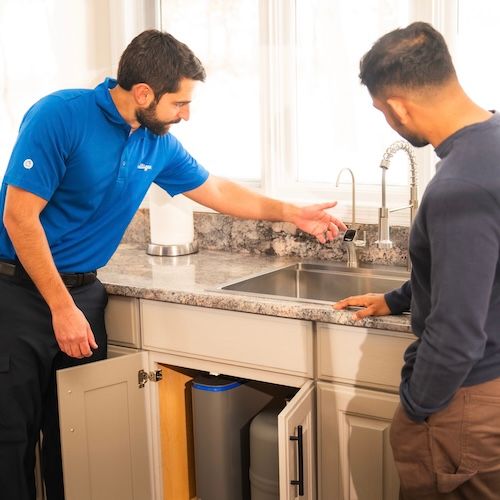
Have the water tested at your tap. Because the valley’s wells vary so widely, the system average may be several grains off from what reaches your house. A professional test gives the precise figure and lets a technician size a softener correctly; undersized units regenerate too often and waste salt, oversized ones cost more than they need to. Our free in-home test measures hardness, chlorine, total dissolved solids, pH and iron in about 20 minutes, and lab testing is available for chromium-6, arsenic and other concerns. Details are on our water testing page.
FAQs about Indio water hardness
How hard is the water in Indio, California?
Indio Water Authority reported an average of 148.5 mg/L, about 9 gpg, in its 2023 report, with wells up to about 14 gpg. CVWD wells serving La Quinta, Palm Desert and Indian Wells averaged about 7 gpg and reached 18 gpg in 2024; Desert Water Agency groundwater in Palm Springs averaged about 14 gpg in 2025. All are hard to very hard.
Does Indio Water Authority soften the water?
No. IWA, CVWD and DWA disinfect with chlorine and treat for regulated contaminants, but none of them removes the calcium and magnesium that cause hardness. Softening is left to the homeowner.
Is well water in the Coachella Valley hard too?
Usually. Private wells in Thermal, Mecca, Sky Valley and the Indio Hills draw from the same groundwater basin as the utilities, and the USGS found moderate to high dissolved solids in about a third of the valley’s domestic-well resource. Hardness varies by well, so test rather than assume. See our well water page.
Will a refrigerator or pitcher filter soften Indio water?
No. Carbon filters improve taste and reduce chlorine but leave calcium and magnesium in place. Only ion-exchange softening, or reverse osmosis for drinking water, actually removes hardness minerals.
Start with a free hard water test from Culligan of Indio
Culligan of Indio has worked on Coachella Valley water for decades, from Indio, Coachella and La Quinta to Palm Desert, Rancho Mirage, Palm Springs and Desert Hot Springs, and on private wells from Thermal to Sky Valley. We size every softener to the hardness we measure at your tap rather than a system average. Rentals and purchase are both available, salt delivery runs valley-wide, and seasonal residents can have service timed to their return.
Ready for better water? Schedule your free in-home water test and consultation with Culligan of Indio today.