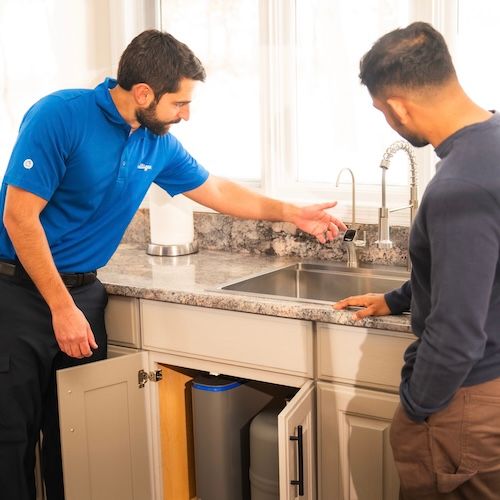
Quick answer: Indio’s public water supply met state and federal drinking water standards in the most recent reports from its utilities. Indio Water Authority reported no maximum contaminant level violations in its 2023 water quality report, Coachella Valley Water District none for 2024, and Desert Water Agency none for 2025. The local wrinkle is chromium-6: California adopted a 10 parts per billion limit effective October 1, 2024, and several valley systems, including Indio Water Authority and CVWD, have wells above it while treatment is built out. The water is also hard, chlorinated and high in dissolved minerals, with naturally occurring fluoride and uranium below their limits. Meeting standards and being free of everything you might prefer not to drink are two different things.
Indio is a groundwater town. There is no river running through it and no reservoir on a hill, so every glass of tap water from Shadow Hills to Indian Palms was pumped from a well a few hundred feet below the valley floor, chlorinated and sent through the mains. That makes the water quality story here a geology story, and the Coachella Valley’s geology produces a particular set of issues: hardness, dissolved solids, chromium-6, fluoride, uranium and, in the lower valley, arsenic.
What utility testing does and does not tell you
Public water systems in California are regulated by the State Water Resources Control Board’s Division of Drinking Water under standards that are in several cases stricter than federal rules. Indio Water Authority samples its 20 wells throughout the year, and CVWD reports analyzing more than 17,000 samples annually. Compliance with those standards is real and meaningful.
Three things keep compliance from being the whole story. Maximum contaminant levels balance health against the cost and feasibility of treatment, which is why California’s chromium-6 limit sits at 10 ppb while the state’s public health goal is 0.02 ppb. Samples are taken at wells and in the distribution system, not at your faucet, so your home’s plumbing is not reflected. And the standards address health; they say nothing about hardness, mineral taste or chlorine smell, which are the problems most Indio households actually notice.
Where Indio’s drinking water comes from
Indio Water Authority pumps from 20 production wells in the Indio Subbasin of the Coachella Valley Groundwater Basin. CVWD serves La Quinta, Palm Desert, Indian Wells, Rancho Mirage, Thousand Palms and parts of Indio, Bermuda Dunes and Cathedral City from wells in the same basin, with a separate system for Indio Hills and Sky Valley. Desert Water Agency supplies Palm Springs from 27 wells plus a little creek water. Mission Springs Water District serves Desert Hot Springs and the Coachella Water Authority serves Coachella, both from wells.
The basin is a deep fill of sand and gravel eroded from the surrounding mountains, recharged by mountain runoff and by imported Colorado River water spread in percolation ponds. That recharge keeps the aquifer stable but adds Colorado River minerals to the native groundwater. The result is water that is clean by regulatory measures but mineral-heavy, with a few naturally occurring trace elements that deserve attention.
Common water quality issues in Indio
1. Chromium-6
What you notice: Nothing. Chromium-6 has no taste, odor or color.
What causes it: Chromium-bearing rock in the valley’s sediments weathers naturally, and in the oxygen-rich conditions of the aquifer some of the chromium takes the hexavalent form. It is a natural condition of Coachella Valley groundwater, not an industrial spill.
Why it matters: California readopted the nation’s only chromium-6 drinking water standard, 10 ppb, in April 2024, effective October 1, 2024. Indio Water Authority, which began treating chromium-6 in 2015, reported a 2023 systemwide average of 10.61 ppb with wells ranging from 0.41 to 19 ppb, and submitted its compliance plan to the state in January 2025. CVWD’s 2024 report shows Cove Communities wells from not detected to 21 ppb and ID No. 8 wells from 13 to 23 ppb; about a third of its Cove wells exceed 10 ppb, and its plan calls for new wells and treatment plants. Desert Water Agency reported 1.5 ppb for 2025. Mission Springs Water District told Desert Hot Springs customers in February 2026 that its rolling average had edged above the limit and a treatment project is under way. The utilities say the water is safe to use while they comply; the standard addresses long-term exposure rather than immediate risk.
How to fix it: Reverse osmosis is the household technology for chromium-6. Culligan’s Aquasential® Smart Reverse Osmosis System treats drinking and cooking water at the kitchen sink and can be plumbed to the refrigerator and ice maker.
2. Hard water
What you notice: White crust on faucets and shower doors, spots on glassware, scale in the kettle and water heater, dry skin and stiff laundry.
What causes it: Calcium and magnesium dissolved from the basin’s sediments and from imported Colorado River recharge water.
Why it matters: IWA’s 2023 report lists hardness averaging 148.5 mg/L, about 9 gpg, with wells up to about 14 gpg. CVWD Cove Communities wells averaged about 7 gpg and reached about 18 gpg in 2024, and DWA groundwater averaged about 14 gpg in 2025. That is hard to very hard, and in a dry climate the deposits form fast. Our water softeners page covers the fix.
How to fix it: A whole-house Aquasential® Smart High Efficiency Water Softener removes hardness minerals before water reaches fixtures and appliances.
3. Dissolved solids and mineral taste
What you notice: A flat or slightly salty taste, white residue in pots and the coffee maker, cloudy ice.
What causes it: Total dissolved solids, the sum of all minerals in the water. IWA reported 210 mg/L in 2023; CVWD Cove Communities wells ranged from 110 to 680 mg/L in 2024; DWA groundwater averaged 420 mg/L in 2025. The secondary standard is 1,000 mg/L, so all are compliant, but anything over a few hundred mg/L is noticeable in a glass.
Why it matters: Taste is the main reason Indio households buy bottled water or install a drinking water system.
How to fix it: Reverse osmosis removes most dissolved solids from drinking water, and the Aquasential® Tankless RO fits under a sink with limited cabinet space.
4. Chlorine
What you notice: A swimming pool smell in a hot shower or a chemical edge to a glass of cold water.
What causes it: IWA, CVWD and DWA all disinfect with free chlorine, maintaining residuals that averaged 0.82, 0.6 and 0.56 mg/L respectively in their latest reports, well under the 4.0 mg/L limit. None uses chloramine.
Why it matters: The residual protects the water in the pipes, but it also dries skin and hair and affects taste.
How to fix it: A whole-house carbon filter such as the Aquasential® Smart HE Water Filter removes chlorine at the point of entry; an RO system removes it from drinking water.
5. Fluoride and uranium, naturally occurring
What you notice: Nothing; both are undetectable by the senses.
What causes it: Both leach naturally from the valley’s rock and sediment. The utilities do not add fluoride; DWA states this explicitly.
Why it matters: IWA reported fluoride averaging 0.55 mg/L (range 0.28 to 0.78) against a 2.0 mg/L limit, and uranium averaging 5.3 pCi/L (range 3 to 8.6) against a 20 pCi/L limit. CVWD reported fluoride up to 1.0 mg/L and uranium up to 13 pCi/L in Cove Communities wells; DWA reported uranium up to 15 pCi/L. All are within standards. Some households simply prefer less of either, and private wells in parts of the valley exceed the fluoride limit.
How to fix it: Reverse osmosis reduces both fluoride and uranium in drinking water.
6. Lead from home plumbing
What you notice: Nothing; lead has no taste or odor.
What causes it: Older fixtures and solder inside a home, not the utility supply. IWA’s 2022 lead and copper sampling found lead not detected at the 90th percentile of 32 homes, DWA’s 2024 sampling found the same across 30 homes, and CVWD reports it has no lead or galvanized service lines requiring replacement.
Why it matters: Most Indio housing postdates lead plumbing, but older homes in Palm Springs, Cathedral City and central Indio can have brass fixtures or solder that add lead at the tap.
How to fix it: The Aquasential® Smart Reverse Osmosis System is certified to reduce lead by 99.7%.
PFAS in Coachella Valley water
PFAS have not been a headline issue in the Coachella Valley the way chromium-6 has. Desert Water Agency’s 2025 report lists a PFOS detection of 5.5 parts per trillion, below California’s notification level of 6.5 ppt, and says it is sampling quarterly in 2026. IWA’s and CVWD’s latest reports do not list PFAS results, and the USGS detected no PFAS in its 2020 sampling of valley domestic wells. For households that want certainty regardless, Culligan’s Aquasential® Smart Reverse Osmosis with Total Defense is certified to reduce total PFAS by more than 99.99%, and the Whole Home PFAS Water Filter is certified to reduce total PFAS by more than 99%.
Municipal water versus private wells in the valley
Roughly 20,000 Coachella Valley residents rely on private domestic or small-system wells, according to the USGS, mostly around Thermal, Mecca, Oasis and North Shore and in Sky Valley, Indio Hills and the Desert Hot Springs area. Those wells are tested by no one but the owner. The USGS found arsenic above the federal limit in 27 percent of the valley’s domestic-well groundwater and fluoride above the state limit in 24 percent, and Riverside County Environmental Health reports lower valley wells from 0 to 100 ppb arsenic. If you are on a well, the testing conversation is more urgent; our well water page covers it.
How to check your water quality in Indio
Read the report for your system. Indio Water Authority posts its annual reports on its water quality page, CVWD publishes its water quality summary online, and Desert Water Agency posts its report at dwa.org/wqr. Look for the chromium-6, hardness and TDS lines.
Notice what your home is telling you. Crust on fixtures, spotted glasses, cloudy ice, a chlorine smell in the shower, or a water heater that needs flushing are all clues.
Test at the tap. Our free in-home test measures hardness, chlorine, total dissolved solids, pH and iron in about 20 minutes. Chromium-6, arsenic, uranium, nitrate, lead, bacteria and PFAS require a certified laboratory; we collect those samples and explain the results. See our water testing page.
Frequently asked questions about Indio tap water
Is Indio tap water safe to drink straight from the tap?
Indio Water Authority reported no violations in its 2023 report. The chromium-6 limit that took effect in October 2024 is the open issue; IWA and CVWD have wells above 10 ppb and are implementing compliance plans, and say the water remains safe to drink meanwhile. Households that want to act now use reverse osmosis.
Why does my Indio tap water taste like chlorine?
IWA disinfects with free chlorine and maintains a residual averaging 0.82 mg/L in the distribution system. A whole-house carbon filter or an RO system removes it.
Does Indio Water Authority soften the water?
No. None of the valley’s utilities remove hardness. A home softener is the only way to address 9 to 14 gpg water.
Is there arsenic in Indio tap water?
IWA reported arsenic not detected in 2023 and CVWD Cove Communities wells ranged from not detected to 4.4 ppb in 2024. Arsenic is a private-well and small-system issue in the lower valley, not an Indio utility issue.
Does a refrigerator filter remove chromium-6?
Standard carbon refrigerator and pitcher filters are not designed for chromium-6. Reverse osmosis is the household technology that reduces it.
Schedule your free water test with Culligan of Indio
Culligan of Indio has served the Coachella Valley for decades, from Indio, Coachella and La Quinta to Palm Desert, Rancho Mirage, Cathedral City, Palm Springs and Desert Hot Springs, on water from every utility in the valley and on private wells in the east valley. Our technicians can tell you what your water contains, explain what matters, and lay out rental and purchase options for softening, drinking water and whole-house filtration without pressure.
Ready for better water? Schedule your free in-home water test with Culligan of Indio today.