Quick answer: The Columbia City Water Department does not print a hardness number in its annual report, but the geology under Whitley County leaves little doubt that hardness minerals are in the water. The city pumps groundwater from three wells on East Van Buren Street, and the U.S. Geological Survey reports that Indiana groundwater is usually very hard, above 180 mg/L, or about 10.5 grains per gallon. The state’s main glacial and limestone aquifers have median hardness between 286 and 340 mg/L, roughly 17 to 20 grains per gallon. Churubusco, South Whitley and the private wells in between draw from the same formations. A free in-home test tells you where your own tap falls.
Most people in Columbia City do not need a lab to tell them their water carries minerals. They see it in the white crust around the kitchen faucet, the film on drinking glasses, the showerhead that sprays sideways, and the water heater that starts popping after a few winters. Hardness is not a health problem. It is an expense, and it shows up slowly in appliances, fixtures, soap use and energy bills. This guide covers where Whitley County water comes from, what the published data says about hardness, how to recognize it, and how to get a number for your own house.
Is city water or well water harder around Columbia City?
The short version is that both start from the same kind of ground, so neither gets a pass. The Columbia City Water Department pumps Wells 7, 8 and 9 near its treatment facility at 920 E. Van Buren Street. Its 2025 Consumer Confidence Report lists the source as groundwater and describes chlorine as the additive used to control microbes. The report does not describe a softening step and does not list a hardness figure, so the calcium and magnesium that come out of the aquifer travel through the mains to your tap.
The Indiana Department of Natural Resources has mapped what lies beneath the county. Its study of Whitley County’s unconsolidated aquifers describes 70 feet of glacial sediment in the south of the county thickening to as much as 385 feet in the north, with buried sand-and-gravel layers that most wells tap at 70 to 155 feet. Under that, the bedrock report describes Silurian and Devonian limestone and dolomite extending under nearly all of the county. Limestone and dolomite are calcium and magnesium carbonate, which is exactly what makes water hard.
Private wells around Churubusco, Tri-Lakes and the farm townships draw from those same sand-and-gravel layers or from the limestone below. South Whitley’s town wells sit in the outwash deposits along the Eel River, according to the same DNR study. Two wells a mile apart can test differently, and a single well can change after a drought or heavy pumping. What does not change much is the overall picture: the USGS summary of Indiana ground-water quality reports median hardness of 340 mg/L in glaciofluvial aquifers, 320 mg/L in till aquifers, 286 mg/L in outwash aquifers and 333 mg/L in the Silurian-Devonian carbonates. On the USGS hardness scale, anything above 180 mg/L is very hard.
How hardness shows up in Whitley County homes
1. Scale in water heaters and appliances
When hard water is heated, calcium carbonate comes out of solution and settles as a solid. In a tank water heater that means a layer of scale on the bottom that the burner or element has to heat through, which costs energy and eventually shortens the life of the tank. The same deposits build inside dishwashers, coffee makers, washing machines and boilers.
2. Spots, film and crust on fixtures
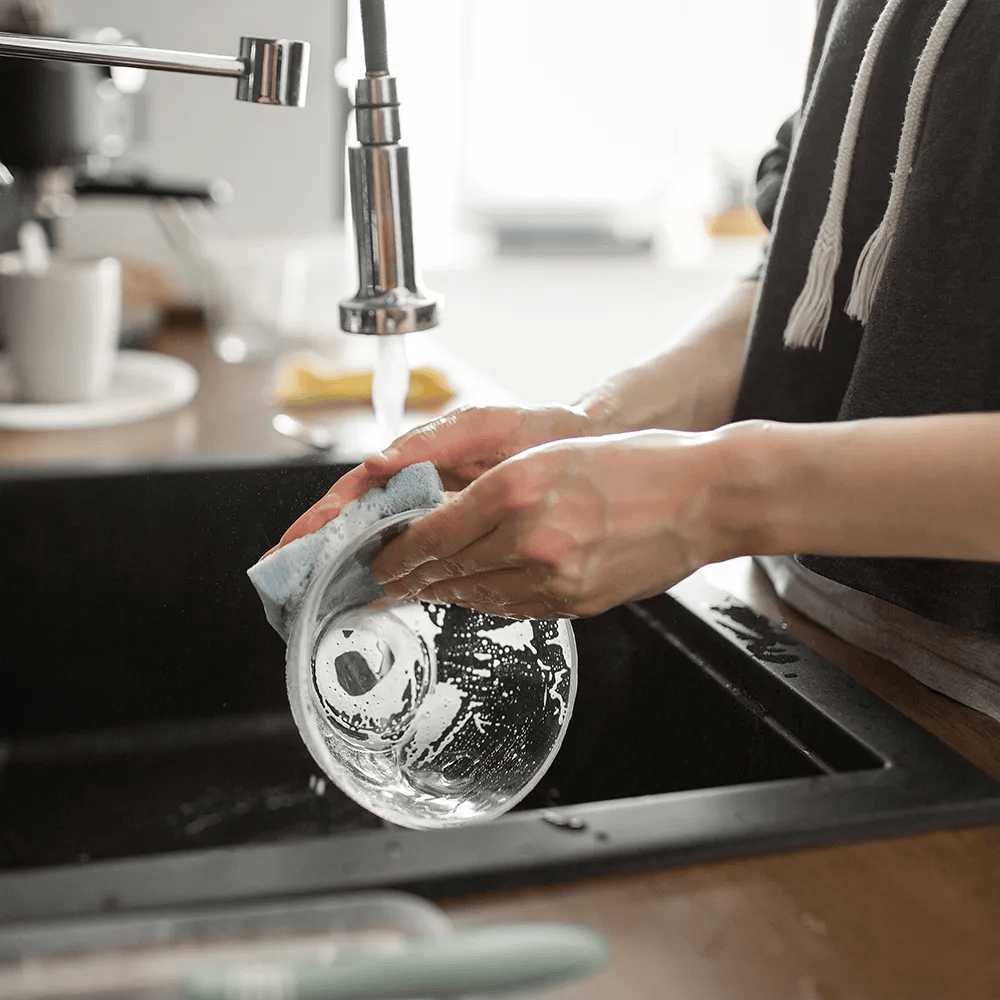
White rings around faucets, cloudy spots on shower glass and a rough film on glassware are minerals left behind as water evaporates. They are cosmetic, but they take more scrubbing and stronger cleaners to remove, and on chrome and stone they can etch over time.
3. Soap that does not lather
Calcium and magnesium react with soap to form curd, the gray ring in the tub and the stiffness in towels after washing. People on hard water tend to use more detergent, shampoo and dish soap to get the same result.
4. Iron riding along with hardness
In this part of Indiana hardness rarely travels alone. The USGS reports median iron of 900 micrograms per liter in outwash aquifers, 1,900 in till aquifers and 1,100 in the Silurian-Devonian carbonates. The agency’s Ground Water Atlas notes that iron above 300 micrograms per liter stains laundry and porcelain. That is the orange ring in the toilet and the rust tint on white shirts that many well owners near Churubusco and South Whitley know well. Iron changes how a softener should be set up, which is one more reason to test before choosing equipment.
Does a softener make sense on Columbia City water?
A water softener works by ion exchange. Water passes through a tank of resin beads that hold sodium or potassium; the beads grab calcium and magnesium and release the sodium or potassium in their place. When the resin is full, the softener rinses it with brine from the salt tank and starts over. The result is water that no longer forms scale, lathers easily and rinses clean.
Whether you need one comes down to your measured hardness and how much the symptoms bother you. If your tap tests in the very-hard range that USGS data suggests is typical for Indiana groundwater, a softener protects the water heater and plumbing and cuts cleaning time. Homes that also carry iron may need a softener sized for it or a dedicated iron filter ahead of the softener. Our technicians sort that out from your test results. Learn more on our water softeners page.
Equipment we install in Whitley County includes the Aquasential® Smart High Efficiency Water Softener, the Aquasential® Select Series Water Softeners and the Aquasential® Advantage Whole Home Water Softener, with Iron-Cleer® or Iron-OX5 filtration added when iron is part of the picture. Rental and purchase are both available, and we deliver salt across our service area.
How to check the hardness of your own water
Start with the utility. Columbia City posts its annual water quality reports on the water department page, and you can call the department to ask whether it has system hardness data that is not in the report. Churubusco and South Whitley customers can contact their town utilities the same way.
Next, look at the clues around the house: scale in the kettle, crust on the showerhead, spots on dishes, and how quickly the water heater starts making noise. Those signs tell you minerals are present but not how much.
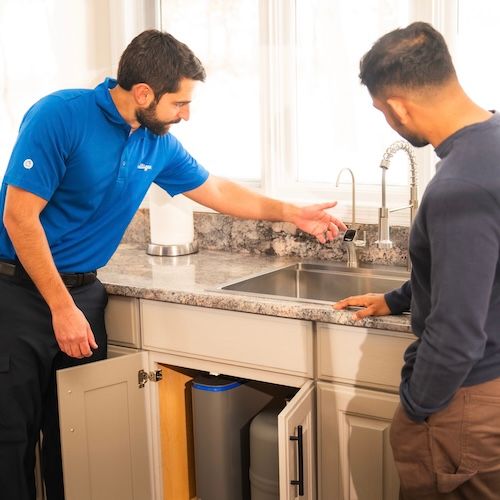
For a number, schedule a free in-home test. A Culligan Water Conditioning of Columbia City technician measures hardness, iron, chlorine, pH and total dissolved solids at your tap in about 20 minutes and explains each result. If you are on a well, we can also arrange certified lab testing for bacteria, nitrate and arsenic. Visit our water testing page for details.
Frequently asked questions about hard water in Columbia City
How hard is the water in Columbia City, Indiana?
The Columbia City Water Department does not list a hardness figure in its 2025 annual report. The city pumps groundwater, and USGS data shows Indiana groundwater usually runs above 180 mg/L, about 10.5 grains per gallon, with aquifer medians around 17 to 20 grains per gallon. A free in-home test gives you your own number.
Does Columbia City soften its water before it reaches my house?
The city’s report describes chlorine as the additive used to control microbes and does not describe a softening step. Homeowners who want softened water throughout the house install a softener where the water line enters the home.
Is Churubusco or South Whitley water different from Columbia City?
Both towns pump groundwater from the same glacial deposits and limestone that underlie Columbia City. South Whitley’s wells sit in the outwash along the Eel River. Neither town’s report that we could read lists a hardness figure, so testing your tap is the reliable way to compare.
Will a filter pitcher fix hard water in Columbia City?
No. Pitcher and faucet filters are built to improve taste and reduce certain contaminants in drinking water. They do not remove calcium and magnesium, and they do nothing for the water heater, dishwasher or shower, where hardness does its damage.
Can I put a softener on a Columbia City-area well with iron?
Often, yes, but the setup depends on how much iron and what form it takes. Low iron can sometimes be handled by a softener sized for it; higher levels call for a dedicated iron filter first. See our well water solutions page or ask for a test.
Start with a free hardness test from Culligan Water Conditioning of Columbia City
Culligan Water Conditioning of Columbia City has served Columbia City, Churubusco, South Whitley, Tri-Lakes and the townships of Whitley County for decades. We work on city water and private wells every week, and we see how much they can vary from one road to the next.
When you schedule a free in-home test, we measure what is in your water, explain what it means for your plumbing and appliances, and tell you plainly whether a softener is worth it for your home. If it is, we go over rental and purchase options, installation and salt delivery so you can choose what fits.
Ready for better water? Schedule your free in-home water test and consultation with Culligan Water Conditioning of Columbia City today.