Quick answer: Well water around Columbia City can be perfectly good to drink, but nobody checks it unless you do. Private wells are not covered by the testing rules that apply to city systems, and the Indiana Department of Health recommends testing at least once a year. In Whitley County the most common issues are hardness and iron, which the U.S. Geological Survey finds at high levels across Indiana’s glacial and limestone aquifers, followed by sulfur odor. The less visible risks are bacteria, nitrate and arsenic. A lab test tells you which of these apply to your well, and the treatment follows from there.
Drive a few minutes out of Columbia City in any direction and you are in well country: farmhouses along the county roads, lake homes around Tri-Lakes, newer houses on acreage outside Churubusco and South Whitley. The USGS estimated that 25 percent of Indiana residents, about 1.68 million people, supplied their own household water in 2015, and the Indiana Department of Environmental Management notes that a large percentage of Hoosiers drink residential well water. This guide covers where Whitley County well water comes from, the problems that show up most often, how to test, and what treatment fixes each one.
City water vs. private well water: what is different
City customers in Columbia City, Churubusco and South Whitley get water that is chlorinated, sampled on a state schedule and reported every year. A private well has none of that. The owner is the water utility, responsible for testing, maintenance and treatment. The Indiana Department of Health puts it simply: private well owners should test at least annually, with additional tests based on identified risk.
The source water is often the same. Columbia City’s wells and the domestic wells around it draw from the same glacial aquifers, which means a well owner can expect similar hardness and minerals. What the well owner does not get is disinfection, and what the city does not have to worry about is a septic system 50 feet from the wellhead.
Where Whitley County well water comes from
The Indiana Department of Natural Resources has mapped the county’s aquifers in detail. Its unconsolidated aquifer study describes glacial sediment ranging from about 70 feet thick in the south of the county to as much as 385 feet in the north, holding sand-and-gravel layers that supply most wells. The Bluffton/Auburn Complex system covers most of the county, with wells commonly 70 to 155 feet deep yielding 10 to 30 gallons per minute. The Bluffton/Auburn Till system, mapped mainly in the southern half, has wells typically 80 to 170 feet deep. Both are protected by thick clay and are described as not very susceptible to surface contamination.
Along the Eel River in the west-central part of the county, including the South Whitley area, the Wabash River and Tributaries Outwash system is different. Where no clay or silt covers it, DNR rates it highly susceptible to contamination. Below everything, the bedrock study describes Silurian-Devonian limestone and dolomite under nearly all of the county, with bedrock wells typically 210 to 290 feet deep. Areas near the Eel River carry moderate to high contamination risk even in bedrock.
Common well water problems around Columbia City
1. Iron and manganese
Iron is the problem well owners in this area mention most, usually because of orange stains in toilets, sinks and laundry. The USGS summary of Indiana ground-water quality reports median iron of 900 micrograms per liter in outwash aquifers, 1,900 in till aquifers and 1,100 in the Silurian-Devonian carbonates, with some areas as high as 3,000. The USGS Ground Water Atlas notes that iron above 300 micrograms per liter can stain laundry and porcelain. Manganese, which leaves black or brown staining, reaches as much as 1,000 micrograms per liter in some Indiana groundwater. Iron-Cleer® and Iron-OX5 filters remove both. Iron can also feed iron bacteria, which leave a slimy orange film in toilet tanks.
2. Hydrogen sulfide (rotten egg smell)
The Indiana Department of Health explains that hydrogen sulfide can be produced by bacteria that consume sulfate in water or by decaying plant material. It is not typically considered a health risk, but it causes odor and bad taste and corrodes metal fixtures and pipes. If the smell appears only from the hot tap, the water heater’s magnesium anode rod is often the source, and replacing it with an aluminum rod usually helps. Because odor can also signal wastewater contamination, the department suggests a bacteria test as well. Sulfur-Cleer® and Sulfur-OX3 systems treat sulfur for the whole house.
3. Hardness
USGS reports that Indiana groundwater is usually very hard, above 180 mg/L, with medians of 286 to 340 mg/L, roughly 17 to 20 grains per gallon, across the major aquifers. Scale in the water heater, spots on dishes and soap that will not lather follow. A softener removes the minerals, and on a well it is often installed after an iron filter. See our water softeners page.
4. Bacteria
Bacteria get into wells through cracked casings, loose caps, poor seals and floodwater. The Indiana Department of Health names failing septic systems, livestock and landfills as typical sources of both bacteria and nitrate. Total coliform is the standard indicator test, and a positive result means a pathway exists for surface water to reach the well. Purdue Extension recommends shock chlorination when a well tests positive. For ongoing protection, UV disinfection treats water as it enters the house, and reverse osmosis with the Advanced Post Tank Filter is certified NSF P231 to reduce bacteria by more than 99.9999 percent at the kitchen tap.
5. Nitrate
Nitrate comes from fertilizer, manure and septic systems and is a particular concern for infants. Purdue Extension’s nitrate fact sheet reports that studies found 3.5 to 4.5 percent of Indiana private wells above the 10 ppm drinking water standard, and that depth matters: in one study, 12.2 percent of wells under 50 feet exceeded the standard compared with 0.9 percent of wells over 100 feet. Most Whitley County wells are deeper than 70 feet under thick clay, but shallow wells, older wells and wells near fields or septic fields deserve a yearly check. A Nitrate Reduction Conditioner or reverse osmosis reduces nitrate.
6. Arsenic
The Indiana Department of Health notes that arsenic occurs in glacial deposits throughout Indiana. It has no taste, color or odor, so the only way to know is a lab test. The state health laboratory offers arsenic testing for private well owners, and reverse osmosis is a common treatment for drinking water when levels are elevated.
7. Sediment
Sand and silt can enter a well from the aquifer itself, from a worn screen or after a pump replacement. Sediment clogs aerators, wears out valves and fouls softeners and filters. A sediment prefilter protects the rest of the system.
After storms and flooding
Heavy rain and high water along the Eel River, the Blue River and low ground around the county’s lakes can push surface water into wells with damaged caps or poor grading. The Indiana Department of Health notes that sanitization may be needed after flooding. If floodwater reached your wellhead, use bottled water for drinking and cooking, have the well disinfected, and do not go back to the tap until a lab test comes back clear. Check any UV system and filters as well, because floodwater can foul them. Drought can matter too; the department notes that extreme drought can concentrate contaminants and reduce well output.
How to check your well water quality
Test at least once a year for bacteria and nitrate, as the Indiana Department of Health recommends, and test for arsenic and lead at least once and again if anything changes. Purdue Extension recommends testing for bacteria, nitrate and lead when you move into a home with a well. The state health laboratory and other certified labs accept samples, and the department’s well water page links to both.
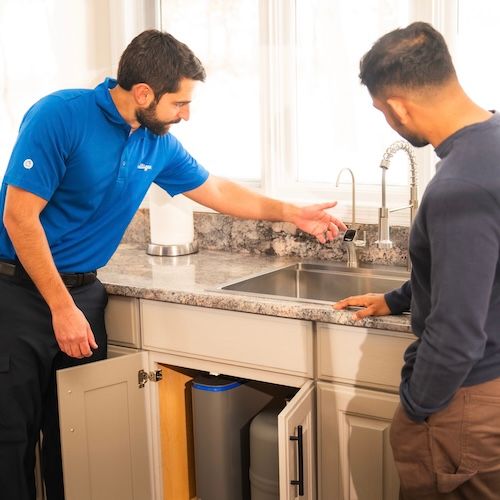
For the everyday problems, our free in-home test measures hardness, iron, pH, total dissolved solids and chlorine in about 20 minutes. We can also arrange certified lab testing for bacteria, nitrate, arsenic, lead and PFAS, so you have the whole picture in one visit. Learn more on our water testing page and our well water solutions page.
Frequently asked questions about private wells near Columbia City
Is well water around Columbia City safe to drink?
Many wells are, but you only know after testing. The Indiana Department of Health recommends testing at least once a year, with bacteria, nitrate and arsenic among the main concerns for Indiana wells.
Why is my Columbia City well water staining everything orange?
That is iron. USGS reports median iron of 900 to 1,900 micrograms per liter in Indiana’s major aquifers, well above the 300 microgram level where staining starts. An iron filter removes it.
Are wells near South Whitley riskier than around Columbia City?
Wells in the Eel River outwash deposits can be. The Indiana DNR rates that aquifer system highly susceptible to contamination where no clay layer covers it. Yearly bacteria and nitrate testing is a good habit there.
How deep are wells around Columbia City?
The Indiana DNR reports that wells in the county’s main sand-and-gravel system are commonly 70 to 155 feet deep, and bedrock wells typically 210 to 290 feet. Your well log, if you have one, gives the exact depth.
What if my Columbia City well tests positive for bacteria?
Stop drinking the water untreated, use bottled water, and have the well shock chlorinated, as Purdue Extension recommends. Retest afterward. If bacteria returns, look for the entry point and consider UV disinfection.
Get your well tested by Culligan Water Conditioning of Columbia City
Culligan Water Conditioning of Columbia City has worked on private wells across Whitley County for decades, from the farms around Churubusco to the lake homes at Tri-Lakes and the Eel River country near South Whitley. We test, explain what we find, and match treatment to the results, whether that is an iron filter, a softener, UV, reverse osmosis or a combination. Rental and purchase are both available, along with salt delivery and bottled water delivery.
Ready for better water? Schedule your free in-home water test and consultation with Culligan Water Conditioning of Columbia City today.