Quick answer: Yes, well water in Mobile and Baldwin counties can be safe to drink, provided it is tested regularly and treated for whatever the test finds. No utility monitors a private well, and the groundwater here has a particular personality: the U.S. Geological Survey describes the regional sand-and-gravel aquifer as low in dissolved solids but acidic, with pH near 6.0 and locally as low as 4.5, carrying dissolved iron as high as 4,300 micrograms per liter in places, and turning salty in some wells near the coast and the bays. Bacteria and nitrate are the health questions, and only a laboratory can answer them. Culligan of Mobile tests wells free and arranges certified lab work for the rest.
Roughly 67,000 people in the two counties rely on their own wells, according to the Alabama Office of Water Resources, which puts the self-supplied share at about 14 percent in Baldwin County and 9 percent in Mobile County. That is the countryside north of Saraland toward Creola, Citronelle and Mount Vernon, the land west of Semmes, Grand Bay and Bayou La Batre, and much of Baldwin County outside the Daphne, Fairhope and Foley systems, from Bay Minette and Loxley down to Elberta and Lillian. If one of those wells is yours, this guide covers what the groundwater tends to contain, which problems matter for health and which are nuisances, and what to do about each.
City water and well water are regulated differently
A public system like MAWSS or Daphne Utilities samples constantly, reports annually and answers to the Alabama Department of Environmental Management. A private well answers to no one but its owner. Alabama regulates how wells are drilled, not what comes out of them afterward. The Alabama Department of Public Health puts it plainly: well owners are responsible for the safety of their water, and routine testing is strongly recommended even when the water seems fine, because most of what matters cannot be seen or tasted.
Water quality also varies over short distances. The USGS notes that the Pliocene-Miocene aquifer and the shallower alluvial-coastal aquifer above it are hydraulically connected, and that all of Mobile and Baldwin counties is susceptible to surface contamination because sandy sediments let rainfall infiltrate quickly. A shallow well near Creola, a deep well north of Semmes and a well a few feet above sea level in Gulf Shores draw three different waters.
The well water problems we see most in Mobile and Baldwin counties
1. Acidic water
What you notice: Blue-green stains in sinks and tubs, a metallic taste, pinhole leaks in copper pipe, green crust on fittings.
Why it is there: Sandy, low-carbonate sediments have little capacity to neutralize the carbon dioxide that rainwater carries into the ground. The USGS reports a typical pH around 6.0 in this aquifer and readings as low as 4.5 in places.
Why it matters: Acidic water dissolves copper and, in older plumbing, lead from solder and brass; the Alabama Cooperative Extension System notes it also mobilizes aluminum. The stain is cosmetic; the metals it signals are not.
How to fix it: A neutralizing filter raises pH as water enters the house, protecting the plumbing and making any downstream softener or iron filter work properly.
2. Iron
What you notice: Orange-brown stains on toilets, tubs and laundry, a rusty taste, water that comes out clear and turns cloudy orange in a glass or a pitcher.
Why it is there: Iron-bearing sands and clays dissolve into groundwater under the oxygen-poor conditions below the water table. The USGS calls dissolved iron in this aquifer “objectionable” and reports concentrations up to 4,300 micrograms per liter, more than fourteen times the 300 microgram aesthetic standard. A 1996 USGS survey of Baldwin County wells lists iron first among the problems that affect groundwater there.
Why it matters: Iron is not a health hazard at these levels, but it ruins fixtures and clothing and feeds iron bacteria that leave slime in tanks.
How to fix it: An Iron-Cleer® or Iron-OX5 filter oxidizes and traps iron at the main line. Wells with both iron and hardness can often use a single Softener-Cleer unit.
3. Hydrogen sulfide
What you notice: A rotten-egg smell from the tap, sometimes only when the hot water runs.
Why it is there: The USGS lists sulfur with iron, turbidity and color as the common nuisance problems in Baldwin County groundwater. Hydrogen sulfide forms as organic matter decays in the aquifer or as sulfur bacteria work inside a well or a water heater. If cold water is fine and hot water stinks, the heater’s anode rod is the likely source.
Why it matters: The gas is unpleasant rather than dangerous at household levels, but it corrodes metal and makes water nobody wants to drink.
How to fix it: A Sulfur-Cleer® or Sulfur-OX3 filter oxidizes the gas and removes it for the whole house. For heater-only odor, service to the anode rod may be all that is needed.
4. Bacteria
What you notice: Usually nothing. Coliform bacteria have no taste or odor.
Why it is there: Coliforms live in soil and on the surface, and they reach a well through a cracked casing, a loose cap, a shallow or old well that draws from near the surface, a nearby septic system or floodwater over the wellhead. The rapid infiltration the USGS describes in this region’s sands makes the path short.
Why it matters: Total coliform signals that a route exists for disease-causing organisms. E. coli signals that human or animal waste is already in the water. ADPH’s guidance after a positive test is to stop drinking untreated water, disinfect the well and retest.
How to fix it: Correct the physical problem first. ADPH’s procedure is to chlorinate the well, run every faucet until chlorine is detected, let the system stand about 12 hours, flush and retest. If coliform keeps returning, a UV disinfection system treats water as it enters the house, and the Aquasential® Smart Reverse Osmosis system with the Advanced Post Tank Filter is certified under NSF P231 to reduce bacteria by more than 99.9999 percent for drinking water.
5. Nitrate
What you notice: Nothing. Nitrate is colorless, odorless and tasteless.
Why it is there: Fertilizer, septic drain fields and livestock. A 2024 Auburn University study of private wells in Mobile and Baldwin counties found a statistically significant link between agricultural land use and nitrate, and an inverse relationship between nitrate and pH, meaning the wells with the most nitrate also tended to be the most acidic.
Why it matters: Nitrate above the 10 mg/L limit is a serious risk to infants under six months and to pregnant women.
How to fix it: The Aquasential® Smart Reverse Osmosis system reduces nitrate in drinking water, and the Nitrate Reduction Conditioner treats the whole house when levels call for it.
6. Saltwater near the coast and bays
What you notice: A brackish or salty taste, white crust on fixtures that is not hardness, corrosion.
Why it is there: Along the Gulf, Mobile Bay and Perdido Bay, freshwater in the aquifer meets seawater. The USGS reports chloride above 1,000 mg/L in some wells in that transition zone, and a 2025 USGS study of southern Baldwin County found that storm surge from Tropical Storm Claudette in 2021 pushed the saltwater boundary substantially inland with effects lasting about nine months, while a 50 percent increase in pumping moved it roughly 320 meters landward. Water levels near Gulf Shores and Orange Beach sit less than five feet above sea level. The Extension System flags the East Gulf Coastal Plain specifically for intrusion risk where coastal aquifers are heavily pumped.
Why it matters: Chloride at those levels corrodes plumbing and makes water unpalatable, and it can appear after a storm and linger.
How to fix it: Reverse osmosis is the practical household tool for dissolved salts in drinking water. If chloride is high throughout the house, the conversation usually turns to a deeper well or a public connection.
7. PFAS near Foley
What you notice: Nothing.
Why it is there: Firefighting foam used historically at the Navy’s Outlying Landing Field Barin in Foley reached groundwater. The Navy’s sampling program has tested 267 private wells around the field since 2021: 119 had no PFAS, 102 had detections below Department of the Navy interim action levels, 40 were at or above those levels and 6 had PFOA or PFOS above 70 ppt. Seventy-five wells required action, and several properties have been connected to public water.
Why it matters: The federal limit for PFOA and PFOS in public water is 4 ppt, and private wells are not covered by it.
How to fix it: The Aquasential® Smart Reverse Osmosis system with Total Defense reduces total PFAS by more than 99.99 percent; the Whole Home PFAS Water Filter reduces it by more than 99 percent at every tap.
How to keep a well safe in Mobile and Baldwin counties
Test on a schedule. The Alabama Cooperative Extension System recommends testing every year for total coliform, E. coli, nitrate, total dissolved solids and pH, and every two to three years for chloride, fluoride, sulfate, lead, copper, hardness, iron and manganese. Your county health department’s environmental staff can collect a bacteriological sample or supply the bottles; ADPH explains how on its well water page.
Test after events. After a hurricane or any flooding that reaches the wellhead, ADPH says to assume the well is contaminated: use boiled or bottled water, disinfect the well and do not drink from it until a bacteria test comes back clean. Also test after work on the well or pump, after a change in taste, color or odor, and before an infant or pregnant family member drinks the water.
Treat what the test finds, in order. Sediment first, then pH correction, then iron and sulfur, then softening if hardness is present, then drinking-water treatment at the sink.
Local well water expertise from Culligan of Mobile
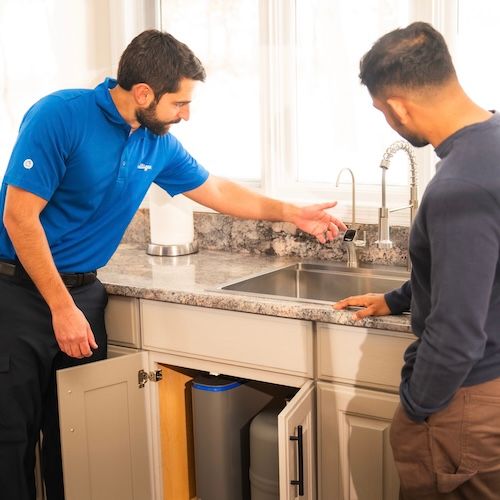
Culligan of Mobile has served private wells across Mobile and Baldwin counties for decades, from Citronelle and Mount Vernon to Bay Minette, Loxley, Foley and the back-bay neighborhoods of Gulf Shores and Orange Beach. Every well is its own case, and our technicians start with a free in-home test of pH, iron, hardness, total dissolved solids and chlorine, then arrange certified lab testing for coliform, nitrate, lead, arsenic or PFAS when the situation calls for it. Treatment is matched to results, from a single neutralizer to a full well water system, and our Saraland office handles installation, filter media changes, salt delivery and service afterward.
Ready for better well water? Schedule your free in-home water test and consultation with Culligan of Mobile today.
Frequently asked questions about well water in Mobile and Baldwin counties
What aquifer do wells around Mobile draw from?
Most private wells in both counties tap the Miocene-Pliocene sand-and-gravel aquifer, including the Citronelle Formation, which the USGS calls the primary source for Baldwin County and the supply for rural Mobile County. Shallow wells along the Mobile River and the coast draw from the overlying alluvial-coastal deposits.
How often should a well in Baldwin County be tested?
Annually for coliform bacteria, nitrate, total dissolved solids and pH, per the Alabama Cooperative Extension System, with metals, chloride, sulfate and hardness every two to three years, and immediately after flooding or any change in the water.
Why is my well water near Bay Minette eating my copper pipes?
Acidic water. The USGS reports pH near 6.0 and as low as 4.5 in this aquifer, which is corrosive to copper and solder. A neutralizing filter at the point of entry stops the damage and protects against lead and copper reaching your tap.
Can a hurricane make my well salty?
In southern Baldwin County, yes. A 2025 USGS study found storm surge pushed the saltwater boundary inland with effects lasting about nine months. A chloride test after a storm tells you whether it reached your well.