Quick answer: Yes, by the federal measure. MAWSS’s latest water quality report, covering testing from January through December 2025, shows Mobile’s public water meeting every health-based drinking water standard, including the new limits for PFOA and PFOS. The same report discloses that the utility failed to monitor for disinfection byproducts during a required period in spring 2025 and expects further monitoring violations into 2026, that trihalomethanes averaged as high as 67.25 ppb against an 80 ppb limit, and that one home tap tested at 33 ppb lead while the system-wide figure was 1.5 ppb. Meeting the standards and being free of concerns are two different things, and the gap between them is what this article is about.
If you live in Mobile, Saraland, Semmes, Theodore or anywhere else on the MAWSS system, your water is treated, tested and chlorinated before it leaves the plant. People still ask whether it is safe. Here is what the MAWSS report and the state’s records say, how the Eastern Shore utilities compare, and what no report can tell you about your own faucet.
What a passing report does and does not mean
The Safe Drinking Water Act sets enforceable limits for roughly 90 contaminants. A utility that stays under all of them is in compliance, and MAWSS was for every health-based standard in its latest report. But the limits are set with treatment cost and technology in mind, not just health, and a result just under a limit is still a result. MAWSS’s highest running average for total trihalomethanes was 67.25 ppb, about 84 percent of the way to the 80 ppb maximum, and haloacetic acids reached 36.68 ppb against a 60 ppb limit. Those byproducts form when chlorine meets the organic matter that a lake source carries, and Big Creek Lake carries plenty.
Compliance monitoring also measures the system, not your house. It does not account for the service line to your meter, the pipes under your slab or a water heater that has not been flushed in a decade. The lead result makes the point: a 90th percentile of 1.5 ppb describes the system well, yet a single sampled tap read 33 ppb, more than twice the 15 ppb action level. MAWSS has confirmed through its 2024 inventory that it has no lead or galvanized service lines of its own, so a result like that comes from plumbing inside a home.
Finally, utility treatment targets health, not comfort. Chlorine taste, earthy notes from the reservoir and scale in a water heater are outside the utility’s job description.
City water versus private wells in Mobile and Baldwin counties
Everything above applies to a public system. About 9 percent of Mobile County residents and 14 percent of Baldwin County residents, by the Alabama Office of Water Resources’ most recent count, draw their own water from private wells, and for them there is no annual report, no monitoring and no compliance. The well owner tests, maintains and treats.
Groundwater in the regional sand-and-gravel aquifer is generally suitable for drinking, according to the U.S. Geological Survey, but it tends to be acidic, often carries high dissolved iron and can turn salty near the coast and bays. Bacteria and nitrate are the health questions no field kit can answer. Our well water page covers this in detail; the short version is that a well should be lab-tested every year and after any flooding.
Where Mobile’s drinking water comes from
Mobile is unusual on the Gulf Coast: most of its neighbors, including Baldwin County, drink groundwater, while Mobile drinks lake water. MAWSS pumps from Converse Reservoir, locally called Big Creek Lake, a reservoir west of the city fed by springs, streams and rainfall that the utility says provides all of its drinking water. Raw water goes to the Stickney and Myers treatment plants for clarification, filtration, pH adjustment, fluoridation and chlorination, then into the mains. The report notes that Giardia and Cryptosporidium are occasionally found in raw lake water and never in finished water, and that source-water E. coli reached 81 MPN per 100 mL while finished water was zero. That is treatment doing its job, and a reminder of what the lake brings in.
Across the bay, Daphne Utilities, the City of Fairhope and Riviera Utilities in Foley each operate wells in the Miocene-Pliocene aquifer, disinfect with chlorine and fluoridate. Their reports read differently from MAWSS’s: more iron and manganese, and in two cases PFAS detections that deserve attention. Here are the issues we encounter most often.
1. Chlorine taste and odor
What you notice: A pool-like smell from the shower, a flat chemical taste in a glass of water, especially in summer.
Why it is there: MAWSS disinfects with free chlorine, not chloramine, and its report shows a residual between 0.29 and 2 ppm in the distribution system against a 4 ppm maximum. Daphne, Fairhope and Riviera also chlorinate. Homes near a plant or on a recently flushed main get the strongest dose.
Why it matters: Chlorine keeps bacteria out of the pipes and also forms trihalomethanes and haloacetic acids when it meets organic carbon from the lake. Both were within limits in 2025, but not by a wide margin.
How to address it: Activated carbon removes free chlorine and most byproducts. The Aquasential® Smart Reverse Osmosis system handles drinking water at the sink; a whole-house carbon filter takes it out of every shower and tap.
2. Lead from household plumbing
What you notice: Nothing. Lead has no taste, smell or color.
Why it is there: MAWSS found no lead service lines in its system, and its 90th percentile result was 1.5 ppb. The 33 ppb maximum came from a home, which means solder, brass fittings or fixtures installed before lead limits tightened. Mobile’s older neighborhoods, from Oakleigh and Midtown to parts of Prichard, have the housing stock where that is most likely.
Why it matters: Lead has no safe level for children, and a system-wide pass says nothing about one house.
How to address it: A lab test tells you whether lead is present at your tap. The Aquasential® Smart Reverse Osmosis system is certified to reduce lead by 99.7 percent.
3. PFAS
What you notice: Nothing. PFAS are undetectable by sense.
Why it is there: MAWSS has reported PFAS in Big Creek Lake water since 2022. Its latest report lists PFOA at 2.0 ppt and PFOS at 1.6 ppt, each under the 4.0 ppt federal limit, plus detections of PFBS, PFBA, PFHxA and PFPeA. In Foley, Riviera Utilities’ 2024 report shows 2023 sampling with PFOS as high as 0.0430 ppb, which is 43 ppt, and total PFAS up to 73 ppt in at least one sample; utilities have until 2029 to comply with the new limits. Fairhope reported a detection in one well in 2022. Daphne’s 2026 report shows no detections. Near the Navy’s Outlying Landing Field Barin in Foley, the Navy has sampled 267 private wells since 2021 and found 46 at or above its action levels.
Why it matters: PFAS persist in the body, and the federal limits reflect health effects at very low concentrations.
How to address it: The Aquasential® Smart Reverse Osmosis system with Total Defense is certified to reduce total PFAS by more than 99.99 percent. For every tap in the house, the Whole Home PFAS Water Filter is certified to reduce total PFAS by more than 99 percent.
4. Iron and manganese on the Eastern Shore
What you notice: Orange or brown tint after a main break or hydrant flushing, rust rings in toilets, gray or black specks.
Why it is there: Groundwater in Baldwin County carries dissolved iron and manganese. Fairhope’s 2022 report lists iron up to 0.852 mg/L against a 0.3 mg/L aesthetic standard and a manganese result at one well above the 0.05 mg/L secondary limit, which the city reported to ADEM as an isolated case. Daphne’s 2026 report shows iron at 0.26 ppm, just under the standard. MAWSS’s lake water, by contrast, showed no detectable iron.
Why it matters: These are aesthetic standards, not health limits, but staining and metallic taste are real.
How to address it: A whole-house Iron-Cleer® or Select Series filter removes iron and manganese before they reach fixtures.
5. Hardness
What you notice: Spots on glassware, scale on the water heater element, soap that will not lather.
Why it is there: Dissolved calcium and magnesium, present in different amounts in lake water, Eastern Shore well water and private wells. Utilities list hardness without a limit because it is not a health standard, and the useful number is the one measured at your tap.
How to address it: When a test confirms hardness, the Aquasential® Smart High Efficiency Water Softener removes it at the point of entry.
Systems with documented problems: Prichard
Not every system reads like MAWSS. The Alabama Department of Environmental Management’s 2024 compliance report lists the Prichard Water Works and Sewer Board, which serves about 29,000 people, with trihalomethane violations above the federal maximum in three consecutive quarters of 2024, the only health-based violation among Mobile and Baldwin County systems in that report. ADEM placed 5.8 million dollars with the system’s court-appointed receiver in March 2024 after documenting water loss that sometimes exceeded 60 percent of production, leaks costing about 75,000 dollars a month and corroded storage tanks. A reverse osmosis system is the practical way for Prichard households to reduce trihalomethanes in drinking water while the system is rebuilt.
How to check the water at your own tap
Read the report. MAWSS posts its annual water quality report on its water quality page; Daphne Utilities, Fairhope and Riviera Utilities publish theirs online as well. Look at the range, not just the average, and read the footnotes, where violations and sampling problems are disclosed.
Notice the signs. Chlorine smell, earthy taste after heavy rain, spotting on glass, orange staining, blue-green stains from acidic water. None is a health finding, but each points to something a test can confirm.
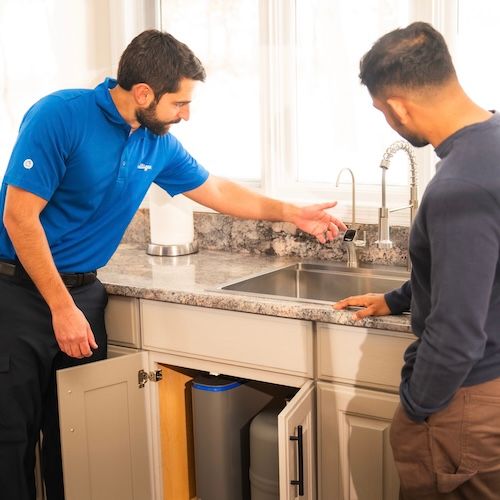
Test. Culligan of Mobile’s free in-home test measures hardness, chlorine, total dissolved solids, pH and iron in about 20 minutes. For lead, PFAS, bacteria, nitrate or arsenic we collect a sample for a certified laboratory. Testing is especially worthwhile if your home predates 1986, if you are on a well, or if an infant drinks the water. Our water testing page explains the options.
Frequently asked questions about Mobile tap water
Can I drink Mobile tap water straight from the faucet?
MAWSS’s latest report shows the public supply meeting every health-based standard for the 2025 reporting year. It also discloses a disinfection byproduct monitoring violation, trihalomethanes within about 84 percent of the limit, and a single tap at 33 ppb lead. Most residents drink it without incident; a home test answers the question for your address.
Why does my water in Mobile smell like chlorine some days and not others?
MAWSS uses free chlorine, which varies with distance from the plant, water temperature and main flushing. The report shows a residual range of 0.29 to 2 ppm, which is wide enough to notice. Carbon filtration removes it.
Is there PFAS in Mobile’s water?
Yes, at low levels. The latest MAWSS report lists PFOA at 2.0 ppt and PFOS at 1.6 ppt, both under the 4.0 ppt limit. Reverse osmosis with Total Defense reduces total PFAS by more than 99.99 percent.
Does Mobile add fluoride?
Yes. MAWSS adds fluorosilicic acid and reported fluoride as high as 1.813 ppm, below the 4 ppm federal maximum. Reverse osmosis reduces fluoride for households that prefer less in their drinking water.
Schedule a free water test with Culligan of Mobile
Culligan of Mobile has helped households across Mobile and Baldwin counties understand and improve their water for decades, from Saraland and Semmes to Spanish Fort, Fairhope, Foley and Orange Beach. Our technicians test your water in your kitchen, explain each result in plain language and recommend treatment only when the numbers call for it. If a filter or softener makes sense, you get a written quote with rental and purchase options.
Ready for better water? Schedule your free in-home water test with Culligan of Mobile today.