Quick answer: Yes, well water around Ocala can be safe to drink, with regular testing and, where the test calls for it, treatment. No utility checks a private well, so the owner is responsible for knowing what is in it. Marion County wells draw from the Floridan Aquifer, which means hardness is nearly universal, sulfur odor and iron staining are common, and nitrate from septic systems, livestock and fertilizer is a documented concern across the Silver Springs and Rainbow Springs springsheds. Bacteria can enter a well after heavy rain or flooding. The Florida Department of Health recommends testing for bacteria and nitrate at least once a year; the right treatment depends on what those tests find.
Private wells are a bigger part of life in Marion County than most newcomers expect. The U.S. Geological Survey estimates about 139,000 county residents, roughly four in ten, get their water from a domestic well, and the Florida Department of Health’s parcel inventory counts more than 34,000 known well parcels. Head out from Ocala in any direction and the share rises: north through Anthony, Citra and Reddick toward Micanopy, east through Silver Springs and Ocklawaha toward the Ocala National Forest, south toward Summerfield, and west past Dunnellon into Levy County, where Williston and Chiefland sit and about eight in ten residents are on wells.
A private well draws from groundwater on your own property, independent of the City of Ocala, Marion County Utilities or any other system, and nobody treats, tests or monitors it before it reaches your tap. So is it safe? With the right habits, yes, for drinking, cooking, bathing and everything else. But wells are exposed to issues city customers never think about, from odor and staining to a few that can affect health. Here is what Ocala-area well owners should know, and how the common problems get fixed.
Municipal water vs. private well water: what is the difference?
Public systems are governed by federal drinking water rules and tested on a schedule the state enforces. Private wells are not. Florida regulates how wells are built, and in Marion County the Florida Department of Health issues well construction permits under delegation from the Southwest Florida and St. Johns River water management districts. Once the well is in, water quality is the owner’s job.
Even along a single road, well water differs from one property to the next. Depth matters most: a shallower well picks up more of what is happening at the surface, such as septic drainfields, pasture runoff and floodwater, while a deeper Floridan well carries more of the limestone’s minerals and dissolved hydrogen sulfide. Casing condition and the wellhead seal play a part too.
Well water also changes over time. Summer storms and the occasional hurricane can push surface water into a wellhead; a dry spring can concentrate minerals; a new septic system or horse operation next door can change the nitrate picture. Because many of these issues have no taste, smell or color, annual testing matters even when the water seems unchanged.
Culligan of Ocala treats well homes across Marion, Levy, Citrus, Sumter and Alachua counties every week. These are the problems we encounter most, roughly in the order we see them.
Common well water problems around Ocala
1. Hard water
What homeowners notice: Chalky buildup on fixtures and showerheads, spotted glassware, stiff laundry, dry and itchy skin after bathing.
What causes it: The Floridan Aquifer is limestone, and water sitting in it dissolves calcium and magnesium. Utilities on the same aquifer that publish a hardness figure, such as the Villages systems, report 137 to 176 mg/L, about 8 to 10 grains per gallon. Private wells get that water with no plant softening and often test harder.
Why it matters: Scale builds inside water heaters, dishwashers and plumbing, cutting efficiency and shortening appliance life. On a well, hardness rarely arrives alone; iron, sulfur or both usually come with it, which changes the equipment you need.
How to fix it: An Aquasential® Smart High Efficiency Water Softener handles hardness at the point of entry. For wells with iron as well, the Softener-Cleer treats both in one system. See well water options for Ocala.
2. Nitrate
What homeowners notice: Nothing. Nitrate is colorless, odorless and tasteless.
What causes it: Septic systems, livestock waste and fertilizer. Marion County is horse country, and the Florida Department of Environmental Protection attributes 32 percent of the nitrogen reaching groundwater in the Silver Springs and Rainbow Springs basins to septic systems, 23 percent to livestock including cattle and horse farms, 20 percent to urban turf fertilizer and 9 percent to farm fertilizer. Marion County holds about 60 percent of the Silver Springs springshed and 65 percent of the Rainbow Springs springshed.
Why it matters: FDEP’s 2021 to 2024 groundwater nitrate medians were 0.76 mg/L in the Silver Springs springshed and 1.44 mg/L in the Rainbow Springs basin, against a 0.35 mg/L restoration target. Those are basin-wide medians; wells near septic clusters or pasture run higher, and Marion County Utilities’ own West Side system reported a raw-water maximum of 6.22 ppm, more than half the 10 ppm drinking water limit. Elevated nitrate is a serious health risk to infants under six months, and only a lab test detects it.
How to fix it: Reverse osmosis reduces nitrate in drinking water, and the Nitrate Reduction Conditioner treats the whole house where levels warrant it.
3. Hydrogen sulfide (rotten-egg odor)
What homeowners notice: A sulfur smell from faucets and showers, strongest in hot water and first thing in the morning.
What causes it: Hydrogen sulfide gas occurs naturally in Floridan groundwater as organic matter breaks down in the limestone. Utilities aerate it out; a private well delivers it to the house as is. Sulfur bacteria in the well or a reaction with the water heater’s anode rod can add to it. If the smell is only in hot water, the heater is the likely source.
Why it matters: It makes water unpleasant to drink and cook with, tarnishes silverware and corrodes plumbing over time. It is one of the most frequent calls we get from Dunnellon, Ocklawaha and the Forest.
How to fix it: When testing confirms hydrogen sulfide in the source water, a Sulfur-Cleer® or Sulfur-OX3 system removes it throughout the home.
4. Iron
What homeowners notice: Rust-colored stains in toilets, tubs and sinks, orange laundry and a metallic taste. The water often looks clear from the tap and turns orange as it sits.
What causes it: Groundwater moving through iron-bearing sand and rock dissolves it. Shallower wells in the sandy soils north and east of Ocala see it most.
Why it matters: Iron stains everything it touches and feeds iron bacteria that slime up plumbing and fixtures. It also fouls a standard softener’s resin, which is why iron and hardness are usually treated together.
How to fix it: An Iron-Cleer® or Iron-OX5 filter at the point of entry, or the Softener-Cleer combination when hardness is also high.
5. Bacteria (total coliform and E. coli)
What homeowners notice: Usually nothing, which is exactly why annual coliform testing is recommended.
What causes it: Coliform bacteria live in soil and surface water and reach a well through a cracked or shallow casing, a poor cap seal, runoff after heavy rain or flooding, or a nearby septic drainfield. Low-lying wells near the Ocklawaha and Withlacoochee rivers and in the Forest are most exposed after tropical weather.
Why it matters: Total coliform itself is usually harmless, but it signals a pathway for germs to enter the well. E. coli indicates contamination from human or animal waste. If E. coli is detected, stop using untreated well water for drinking and cooking and contact the Florida Department of Health for guidance.
How to fix it: Correct the source with a well professional, shock-disinfect the well and plumbing, and retest. For ongoing protection, UV disinfection treats water as it enters the home. For drinking water, Culligan’s Aquasential® Smart Reverse Osmosis System with the Advanced Post Tank Filter is certified under NSF Protocol P231 to reduce bacteria by more than 99.9999 percent.
6. Elevated dissolved solids
What homeowners notice: A flat, mineral or slightly salty taste and white crust on fixtures that is not quite the same as hardness scale.
What causes it: Total dissolved solids are everything the water picks up from the limestone: calcium, magnesium, bicarbonate, sulfate, some chloride and sodium. Marion County Utilities’ West Side system reported 560 ppm at one source, above the 500 ppm secondary limit, and private wells nearby can read similarly.
Why it matters: Secondary limits concern taste and appearance rather than health, but high TDS is why so many well households drink bottled water. A softener does not lower TDS.
How to fix it: Reverse osmosis removes dissolved solids. Culligan’s Aquasential® Smart Reverse Osmosis System or the Aquasential® Tankless RO handles drinking and cooking water.
How to check your well water quality
Look for the signs. Orange stains, a sulfur smell, chalky buildup, a flat taste or cloudy water each point to something specific and treatable.
Use the state and county resources. The Florida Department of Health’s private well page explains recommended tests and how to find a state-certified laboratory, and the Marion County health department handles well permits and can advise on bacteria testing.
Test every year, and whenever conditions change. The Florida Department of Health recommends testing private well water for bacteria and nitrate at least once per year and for lead every three years. Around Ocala, add hardness, iron, hydrogen sulfide and total dissolved solids. Test again if your well has never been tested, if the water changes in taste, smell or appearance, after flooding or work on the well, and before an infant or pregnant household member drinks the water. Our Ocala water testing page explains what the free test covers and what goes to the lab.
Get local well water expertise from Culligan of Ocala
Understanding your well is the first step to fixing it. Culligan of Ocala has helped private well owners across Marion, Levy, Citrus, Sumter and Alachua counties, from Citra, Reddick and Micanopy to Dunnellon, Williston, Chiefland, Inverness and Summerfield, turn hard, sulfurous, iron-stained water into water they are glad to drink, for decades.
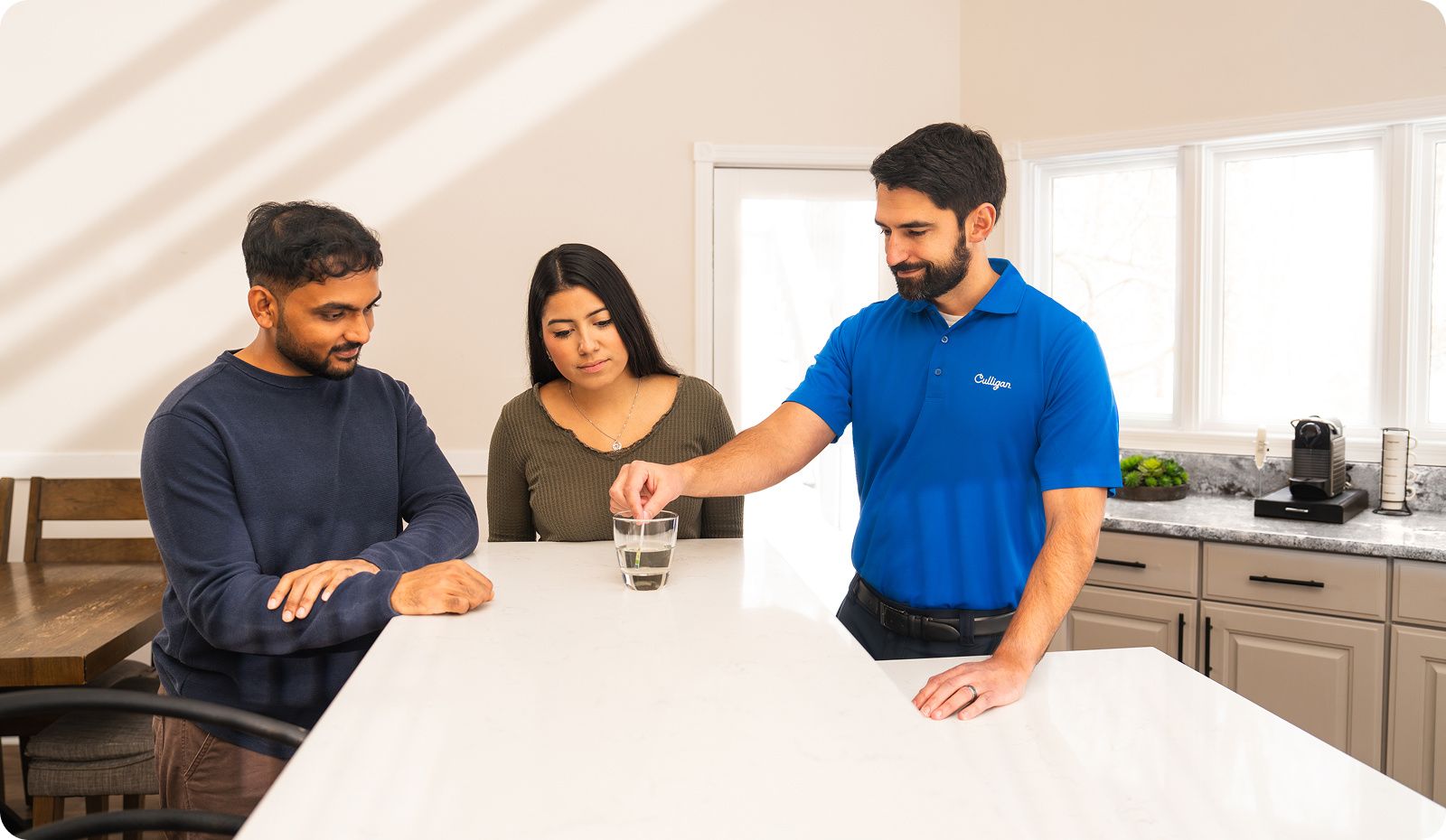
Every well is different, even next door to another. Our free in-home test covers hardness, iron, pH, chlorine and TDS on the spot, and we send samples to a certified lab for bacteria, nitrate, arsenic and PFAS when needed. We explain the results, tell you plainly whether treatment is needed, and handle installation, salt delivery and ongoing service.
Ready for better well water? Schedule your free in-home water test and consultation with Culligan of Ocala today.
Frequently asked questions about private wells around Ocala
Where does Ocala-area well water come from?
Nearly all private wells here draw from the Floridan Aquifer, the limestone formation that also supplies the City of Ocala, Marion County Utilities and The Villages and that surfaces at Silver Springs and Rainbow Springs. Depth shapes what is in the water: deeper wells carry more hardness and sulfur, shallower wells more iron and more influence from septic systems and pasture.
How often should I test my private well in Marion County?
The Florida Department of Health recommends bacteria and nitrate testing at least once a year and lead every three years. Locally, add hardness, iron and sulfur. Test again after flooding, after any work on the well or if the water changes.
Why does my well water near Ocala smell like rotten eggs?
Hydrogen sulfide, which occurs naturally in Floridan groundwater and is also produced by sulfur bacteria in wells and water heaters. If the smell is only in hot water, the heater is the likely source; if it is in both, the well is.
Is my well at risk after a hurricane or flooding in Marion County?
Yes, especially in low-lying areas near the Ocklawaha and Withlacoochee rivers and in the Ocala National Forest. Floodwater can carry bacteria and surface contaminants into the wellhead. Test for bacteria and nitrate as soon as the water recedes and before drinking untreated water again.