Quick answer: Yes, by the standard that counts legally. The City of Ocala’s most recent published water quality report shows the public supply met every federal drinking water requirement with no violations, and Marion County Utilities, The Villages systems and Gainesville Regional Utilities reported no health-based violations either. Meeting the standard is not the same as being free of concerns, though. Ocala’s own report lists PFOS at 45 ng/L and PFHxS at 49 ng/L in 2022 sampling, above the limits the EPA finalized in 2024 but not yet enforceable. The water is chlorinated and naturally hard, and nitrate in the surrounding springsheds is a documented state concern. Testing at the tap is how you learn what you are actually drinking.
If you are on city water in Ocala, it is treated and tested before it enters the distribution system. Yet “is the tap water safe?” is one of the first questions new residents ask us, whether they have moved into a downtown historic-district home, a new build off SW 49th Avenue or a villa in The Villages. Here is what homeowners across Marion County and the surrounding area should know.
What utility testing does, and does not, tell you
The EPA regulates more than 90 contaminants in public drinking water under the Safe Drinking Water Act, and the City of Ocala, Marion County Utilities and the other local systems test against those standards on a set schedule. That is real protection. But a clean report and a clean glass of water are two different things, for three reasons.
First, federal limits are not set on health alone. They also weigh treatment cost and what utilities can reasonably achieve, which is why new limits such as the 2024 PFAS rule phase in over years. Ocala’s PFAS numbers are a case in point: reportable today, out of compliance only after 2029 at the earliest.
Second, utilities test at the plant and at monitoring points, not at your kitchen sink. Between a city well field and a home in Shady Glynn or Fort King, water travels through miles of main and then your own plumbing, where it can pick up copper, lead from older fixtures or sediment from a repair. The city’s June 2026 precautionary boil-water notice in Shady Glynn, after a contractor damaged a main, is a reminder that the system between the plant and your tap is not static.
Third, treatment is built around health thresholds. It is not designed to fix what you notice every day: the chlorine smell in the shower, the chalky taste in coffee, the scale on the faucet.
Municipal water vs. private well water around Ocala
Marion County has one of the larger private-well populations in Florida. The U.S. Geological Survey counts about 139,000 county residents, roughly four in ten, on domestic wells, and the share climbs toward Levy County, where Williston and Chiefland sit and about eight in ten residents are on wells.
A private well is not treated, tested or monitored by anyone but its owner. Around Ocala, well water quality turns on depth, nearby septic systems and livestock, and the condition of the casing and cap. Hardness, sulfur odor, iron and nitrate are the regulars, and bacteria can show up after heavy rain. Because most of those have no taste or smell, the Florida Department of Health recommends testing a private well for bacteria and nitrate every year. We have a separate guide to well water around Ocala.
Where does Ocala’s drinking water come from?
All of it is groundwater from the Floridan Aquifer, the same limestone that surfaces at Silver Springs and Rainbow Springs. The City of Ocala pumps from six wells in the Upper Floridan and, according to its water quality report, softens and chlorinates the water. Marion County Utilities draws from 24 interconnected wells on its East Side system and 23 on its West Side system, chlorinating, aerating and filtering for sediment without softening. The Village Center Community Development District runs several Floridan systems for The Villages, and GRU lime-softens Floridan water for Gainesville.
Aquifer water is clean in the ways that matter most, but limestone and land use leave a signature. These are the issues we see most often in Ocala-area homes.
1. Hard water
What homeowners notice: White spots on dishes and shower doors, crust on faucets, soap that will not lather, dry skin, stiff towels.
What causes it: Calcium and magnesium dissolved from the aquifer’s limestone.
Why it matters: Area systems that publish hardness report 137 to 176 mg/L, about 8 to 10 grains per gallon, classified as hard. Ocala’s plant softening helps city customers somewhat; Marion County Utilities customers get the full dose. Scale shortens appliance life and is the most common complaint we hear.
How to fix it: An Aquasential® Smart High Efficiency Water Softener removes hardness where water enters the home. See softener options for Ocala.
2. PFAS (forever chemicals)
What homeowners notice: Nothing. PFAS have no taste, odor or color.
What causes it: PFAS are man-made chemicals used for decades in firefighting foam, nonstick coatings and industrial processes. They reach groundwater from training sites, landfills, airfields and wastewater.
Why it matters: The City of Ocala tests for PFAS voluntarily, and its most recent published report lists August 2022 results of PFOS 45 ng/L, PFHxS 49 ng/L, PFHxA 13 ng/L, PFOA 6.3 ng/L, PFHpA 9.0 ng/L and PFBS 6.3 ng/L. The EPA’s 2024 national limits are 4 ng/L for PFOS and PFOA and 10 ng/L for PFHxS; utilities must comply by 2029, with an extension to 2031 and a rescission of the PFHxS limit both proposed. The numbers are reportable now and the rules are still moving. Marion County Utilities is completing its required monitoring, and GRU reports its samples came back below reportable limits.
How to fix it: Culligan’s Aquasential® Smart Reverse Osmosis System with Total Defense is certified to reduce total PFAS by more than 99.99 percent at the kitchen sink. For every tap in the house, the Whole Home PFAS Water Filter is certified to reduce total PFAS by more than 99 percent. See filtration options for Ocala.
3. Chlorine and disinfection byproducts
What homeowners notice: A pool-like smell in the shower or from a freshly poured glass.
What causes it: Every local system disinfects with free chlorine. Ocala reported a residual of 1.09 ppm, Marion County Utilities about 1.0 ppm, The Villages 1.4 to 1.5 ppm and GRU 0.98 ppm, all under the 4 ppm federal maximum. None use chloramine. Chlorine reacting with natural organic matter forms trihalomethanes (TTHMs).
Why it matters: The chlorine is doing its job. TTHMs are the part to watch: Ocala reported 18.05 ppb and The Villages 3.7 ppb, well under the 80 ppb limit, but GRU’s 57.8 ppb running average in Gainesville is closer to the line.
How to fix it: A whole-home carbon filter removes chlorine and TTHMs from every tap and shower; a reverse osmosis system handles drinking water. Many Ocala homes pair a softener with chlorine filtration in one installation.
4. Nitrate
What homeowners notice: Nothing. Nitrate is colorless, odorless and tasteless.
What causes it: Septic systems, fertilizer and livestock waste leach nitrogen into the aquifer. The Florida Department of Environmental Protection traces 32 percent of the nitrogen reaching groundwater in the Silver Springs and Rainbow Springs basins to septic systems, 23 percent to livestock including horse farms, and 20 percent to urban turf fertilizer. Marion County holds most of both springsheds, and the City of Ocala spans both.
Why it matters: FDEP’s 2021 to 2024 groundwater medians were 0.76 mg/L in the Silver Springs springshed and 1.44 mg/L in the Rainbow Springs basin, against a 0.35 mg/L restoration target. Public systems are under the 10 ppm drinking water limit: Ocala reported 1.7 ppm, The Villages 2.3 ppm, Marion County’s East Side 3.03 ppm maximum and its West Side 6.22 ppm maximum, more than half the limit and from the same aquifer private wells use. Elevated nitrate is a serious risk to infants under six months.
How to fix it: Reverse osmosis reduces nitrate in drinking water. For whole-house treatment on a well with elevated nitrate, the Nitrate Reduction Conditioner is the tool.
5. Lead and copper from household plumbing
What homeowners notice: Nothing. Lead cannot be seen, smelled or tasted.
What causes it: Water leaves the plant essentially lead-free: Ocala’s 90th-percentile lead result was 0.7 ppb, GRU’s 0.7 ppb and the Village Center Service Area’s 0.6 ppb, all far below the 15 ppb action level. But older homes in Ocala’s historic districts, Belleview and Dunnellon can still have lead solder, brass fixtures or galvanized pipe, and one Villages system reported a single home above the action level in 2023 even though the system as a whole passed.
Why it matters: Lead comes from the last few dozen feet of pipe, which is why results differ house to house on the same system. Infants, young children and pregnant women are most at risk.
How to fix it: Culligan’s Aquasential® Smart Reverse Osmosis System is certified to reduce lead by 99.7 percent. If your home predates 1986, a lab test for lead is worth doing.
How to check your home’s water quality in Ocala
Read the report. The City of Ocala’s annual water quality report summarizes source, treatment and test results for the whole system. Marion County Utilities posts separate reports for its East Side and West Side systems, The Villages posts one for each of its utilities and GRU publishes at gru.com/waterreport. None of them describe the water at your faucet.
Watch for the signs. White buildup on faucets and showerheads, spots on glassware, a chlorine smell in the shower, a flat or chalky taste in coffee, dry skin after bathing and, on wells, a sulfur odor or orange staining.
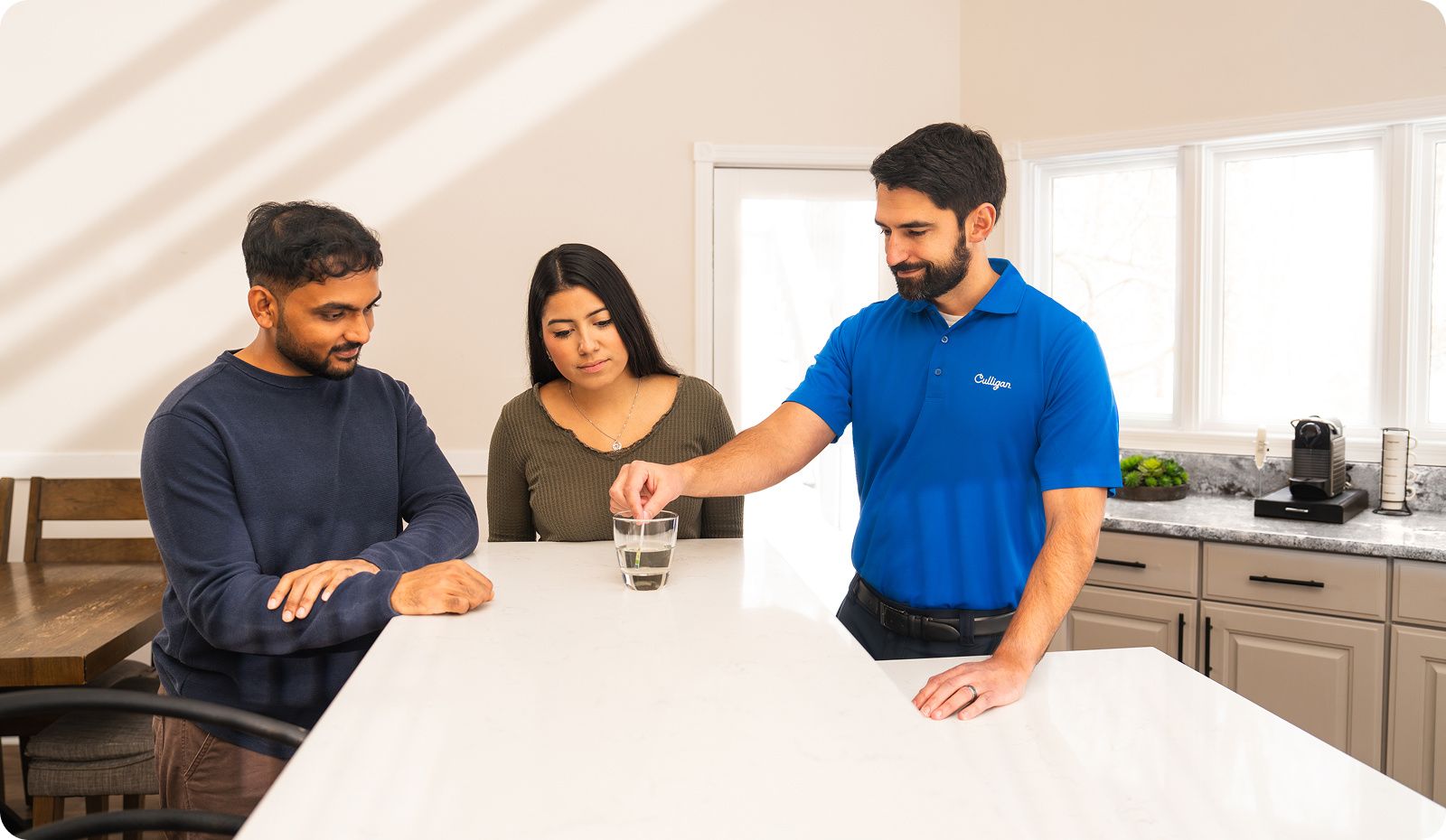
Test at the tap. A free in-home test from Culligan of Ocala measures hardness, chlorine, total dissolved solids, pH and iron in about 20 minutes. For lead, nitrate, bacteria, arsenic or PFAS, we send a sample to a certified laboratory. Testing is especially worthwhile if you are on a private well, live in a pre-1986 home, have an infant or pregnant household member, or have noticed a change in taste, smell or appearance. See our Ocala water testing page.
Schedule your free water test with Culligan of Ocala
You should not have to guess. Culligan of Ocala has helped homeowners across Ocala, Belleview, Dunnellon, Silver Springs, Summerfield, The Villages, Lady Lake, Leesburg, Gainesville, Williston, Crystal River and Inverness understand and improve their water for decades, from our office on SW 37th Avenue. Our local water experts test your water, explain the results clearly and, if treatment makes sense, walk you through rental and purchase options.
Ready for better water? Schedule your free in-home water test with Culligan of Ocala today.
Frequently asked questions about Ocala tap water
Is Ocala tap water safe to drink straight from the tap?
According to the City of Ocala’s most recent published water quality report, the public supply met all applicable federal requirements with no violations. That does not mean it is free of everything: the same report lists PFAS above the EPA’s 2024 limits, the water is chlorinated and hard, and plumbing can add lead or copper before water reaches your glass.
Why does my Ocala tap water smell like chlorine?
The City of Ocala, Marion County Utilities and The Villages all disinfect with free chlorine at roughly 1 to 1.5 ppm. A whole-home carbon filter or a reverse osmosis drinking-water system removes it. No local system uses chloramine.
Does Ocala tap water have PFAS?
The city’s most recent published report lists 2022 sampling results of PFOS 45 ng/L, PFHxS 49 ng/L and PFOA 6.3 ng/L. The EPA’s 2024 limits are 4 ng/L for PFOS and PFOA, with compliance deadlines of 2029 or later. Reverse osmosis with Total Defense is the most effective home treatment.
Does the City of Ocala soften its water?
Partially. The city’s report says the water is softened at the plant, but it does not publish a finished hardness value, and the limestone aquifer starts around 8 to 10 grains per gallon. Marion County Utilities does not soften. A home softener is the way to get fully soft water.