Quick answer: Yes. According to the City of Lompoc’s 2025 Water Quality Report, the city’s drinking water met all federal and California health standards, with lead not detected at the 90th percentile in 32 homes tested and PFOA and PFOS not detected in treated water. Vandenberg Village CSD, Mission Hills CSD and the Santa Ynez River Water Conservation District ID No.1 reported no violations for 2025 either. Meeting standards does not mean the water is free of everything. Lompoc water carries about 817 ppm of dissolved solids and 17 grains per gallon of hardness, Solvang reported a perchlorate exceedance in 2024, and ID No.1 has taken two wells out of service for hexavalent chromium. What reaches your tap depends on which system serves you and what is in your plumbing.
Residents of Lompoc, Vandenberg Village, Mission Hills, Buellton, Solvang, Santa Ynez and Los Olivos still ask us whether the water is safe, usually because of how it tastes, the crust it leaves on fixtures, or something they read about Vandenberg and PFAS. Here is what the utilities’ own reports say.
What municipal water testing does, and does not, tell you
The EPA regulates more than 90 contaminants under the Safe Drinking Water Act, and California’s State Water Resources Control Board Division of Drinking Water enforces those plus stricter state standards. Every public system here publishes an annual Consumer Confidence Report. Three things it cannot tell you: first, standards balance health against cost, and secondary standards for taste and appearance, such as California’s 1,000 ppm limit for total dissolved solids, are not health based at all, so Lompoc at 817 ppm and Solvang’s wells at a 998 ppm average both pass. Second, utilities sample at the plant and a few distribution points, not inside a 1960s house on Burton Mesa where plumbing can add lead or copper. Third, treatment targets health, not hardness, the sulfate and sodium taste of Lompoc Plain groundwater, or the chlorine used to keep water safe in the pipes.
Municipal water vs. private well water
A private well gets none of this oversight. Santa Barbara County Environmental Health Services permits well construction, but testing and treatment are the owner’s job. Wells in the Santa Ynez subbasin, around Buellton and in the Lompoc uplands draw from the same aquifers as the public systems, and regional sampling has found nitrate, arsenic and hexavalent chromium above limits in a meaningful share of them, none of which can be tasted. If you are on a well, see our Lompoc well water page and plan on a certified lab test every year.
Where does Lompoc’s drinking water come from?
The City of Lompoc pumps everything from ten wells in the Lompoc Plain Sub-Basin of the Santa Ynez River Valley groundwater basin, with a handful of customers in Miguelito Canyon served by Frick Springs. The water goes through a conventional plant with coagulation, sedimentation, filtration, a softening step and chlorine disinfection. Lompoc is groundwater only; it is not connected to the State Water Project.
Vandenberg Village CSD and Mission Hills CSD pump their own wells in the Lompoc Upland aquifer. In the Santa Ynez Valley, ID No.1 operates sixteen wells in the Santa Ynez Upland basin and the shallow river alluvium and blends them with State Water Project water treated at the Central Coast Water Authority’s Polonio Pass plant; Solvang blends its own wells with ID No.1 and State Water. Vandenberg Space Force Base runs four wells plus CCWA water. Across all of them, these are the issues we see most.
1. Hard water and heavy mineral content
What homeowners notice: White crust on faucets and shower glass, spotted dishes, scale in kettles and water heaters, a flat or faintly salty taste, and skin that feels dry.
What causes it: Lompoc Plain and Santa Ynez Upland groundwater is rich in calcium, magnesium and sulfate. Lompoc’s 2025 report lists hardness at 293 ppm (17 gpg), total dissolved solids at 817 ppm, sulfate at 424 ppm and sodium at 134 ppm. Vandenberg Village reports 21 gpg and 717 ppm TDS; Solvang’s wells averaged 616 ppm of hardness, roughly 36 gpg.
Why it matters: Not a health issue, but a steady cost in appliance life, cleaning and detergent. The sulfate and sodium give Lompoc water its taste.
How to fix it: A Culligan Portable Exchange Tank delivers soft water without brine discharge, which matters because Lompoc Municipal Code Chapter 13.16 prohibits self-regenerating softeners from draining to the city sewer and Vandenberg Village CSD limits them too. Where rules allow, the Aquasential® Smart High Efficiency Water Softener is the alternative. For taste, a reverse osmosis system at the kitchen sink removes most dissolved solids.
2. Chlorine and chloramine
What homeowners notice: A pool-like smell from the tap or in the shower, and tea or coffee that tastes off.
What causes it: Lompoc, Vandenberg Village and Mission Hills disinfect with free chlorine at average residuals of about 1.0, 0.7 and 1.2 ppm respectively. State Water Project water delivered by CCWA to Santa Ynez, Los Olivos, Solvang and Vandenberg SFB is disinfected with chloramine, so ID No.1 and Solvang customers get a changing mix.
Why it matters: Disinfection keeps the water safe; taste, odor and disinfection byproducts are the side effects. ID No.1’s 2025 report shows total trihalomethanes at a highest running average of 47.4 ppb in its system and 56 ppb on the CCWA supply, against an 80 ppb limit.
How to fix it: The Aquasential® Smart Reverse Osmosis System removes chlorine and chloramine from drinking water. A whole-home carbon filter such as the Aquasential® Smart HE Water Filter handles it in the shower and laundry; for chloraminated supplies we configure catalytic carbon.
3. Lead and copper from household plumbing
What homeowners notice: Nothing. Lead has no taste, color or smell.
What causes it: Lompoc’s 2025 sampling found lead not detected at the 90th percentile, as did Vandenberg Village, Mission Hills, ID No.1 and Solvang in their latest rounds. Lead enters water inside older homes, from solder, brass fixtures and fittings, especially where water sits overnight. Mission Hills’ report also classes its water as “moderately aggressive” on the corrosivity index, meaning it can pull metal from plumbing over time.
Why it matters: Lead is a health risk for infants, children and pregnant women at any level, and only a test from your own tap shows what your pipes add.
How to fix it: The Aquasential® Smart Reverse Osmosis System is certified to reduce lead by 99.7 percent. Culligan of Lompoc can also arrange a certified lab lead test if your home predates 1986.
4. PFAS
What homeowners notice: Nothing; PFAS cannot be tasted or smelled.
What causes it: PFAS come from firefighting foam, industrial processes and consumer products. Vandenberg Space Force Base is listed by the State Water Resources Control Board among California military facilities with a known or suspected PFAS release, and the base’s environmental restoration program reports five PFAS sites under remedial investigation.
Why it matters: So far the finished water is clean. Lompoc’s 2025 report shows PFOA, PFOS, PFBS and PFHxS not detected in treated water, with trace PFBS and PFHxS in one raw well. Vandenberg Village’s Well 1B tested clean in 2022, the base’s own water system reported PFOA and PFOS not detected in all four wells in 2023, and CCWA’s State Water tested clean in 2025. The federal limits for PFOA and PFOS are 4 parts per trillion, so monitoring matters, and private wells near the base have none.
How to fix it: The Aquasential® Smart Reverse Osmosis System with Total Defense is certified to reduce total PFAS by more than 99.99 percent. For every tap in the house, the Whole Home PFAS Water Filter is certified to reduce total PFAS by more than 99 percent.
5. Hexavalent chromium, perchlorate and other local detections
What homeowners notice: Nothing; these are tasteless and invisible.
What causes it: Hexavalent chromium occurs naturally in the Santa Ynez Upland formations. ID No.1’s 2025 report shows groundwater from not detected to 24 ppb, with two wells above California’s 10 ppb standard removed from service while the district studies treatment. Solvang’s 2024 report records a perchlorate exceedance of the 0.006 mg/L standard in March 2024, after which the city shut down the affected well and began flushing and continuous testing. Lompoc, Vandenberg Village and Mission Hills all report arsenic well under the 10 ppb limit, Lompoc averaging 3.75 ppb.
Why it matters: Public systems take wells offline when a contaminant climbs. Private wells in the same formations have no one watching them, and a 2019 Regional Water Board staff study found roughly 40 percent of sampled Santa Ynez subbasin wells above 10 ppb of hexavalent chromium.
How to fix it: Reverse osmosis at the kitchen sink reduces hexavalent chromium, perchlorate and arsenic in drinking and cooking water. A certified lab test tells you whether you need it.
How to check your home’s water quality in Lompoc
Review your utility’s report. The City of Lompoc posts its annual Water Quality Report at cityoflompoc.com. Vandenberg Village CSD, Mission Hills CSD, Solvang and ID No.1 publish theirs, and Buellton residents can request the city’s report from Public Works. These describe the system, not your faucet.
Look for signs around the house. White mineral crust, spotted glassware, a salty or flat taste and a chlorine smell are the common ones here. Blue-green stains point to copper corrosion; rust staining on a well suggests iron.
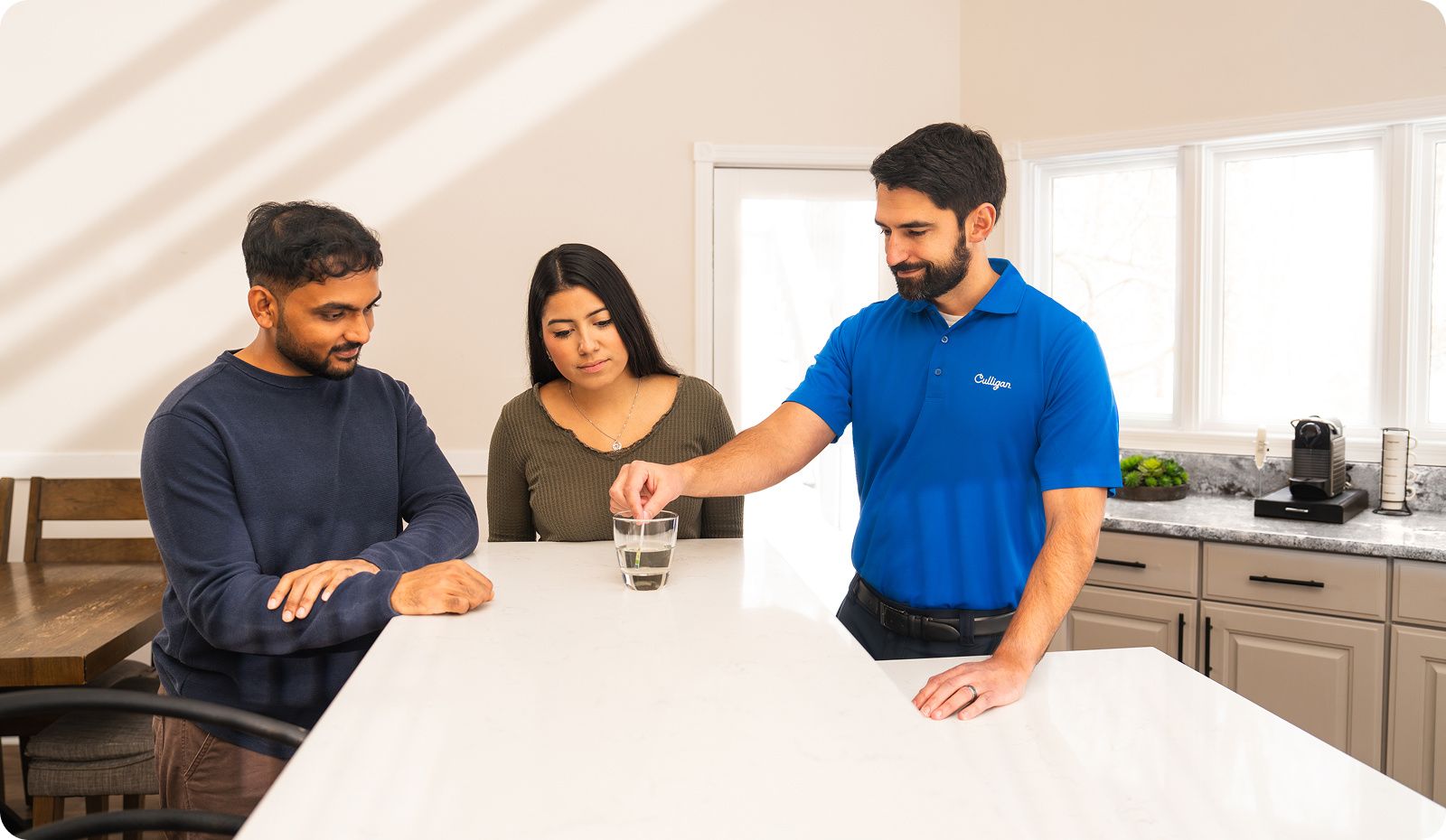
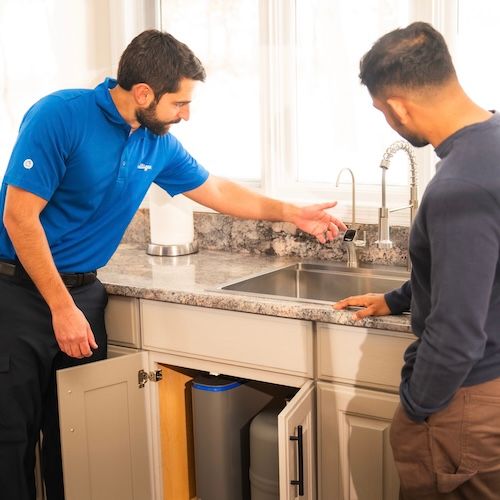
Test the water at your tap. Culligan of Lompoc’s free in-home test measures hardness, chlorine, total dissolved solids, pH and iron in about 20 minutes. For lead, nitrate, arsenic, hexavalent chromium, bacteria or PFAS, we collect a sample for a certified laboratory. Testing matters most if you are on a well, live in a pre-1986 home, have noticed a change in taste or smell, or have an infant or pregnant household member drinking the water. See our Lompoc water testing page and Lompoc water filtration page.
Frequently asked questions about Lompoc tap water
Is Lompoc tap water safe to drink straight from the tap?
According to the City of Lompoc’s 2025 Water Quality Report, the water met all applicable federal and state health standards, with no violations listed. It is high in dissolved minerals and hardness, which affect taste and your home rather than your health, and your own plumbing can add lead or copper that the city cannot test for.
Why does my Lompoc tap water taste salty?
The city’s report lists sodium at 134 ppm, chloride at 96 ppm, sulfate at 424 ppm and total dissolved solids at 817 ppm. All are within limits, but together they produce a flat, mineral, slightly salty taste. A reverse osmosis system removes most of the dissolved solids from drinking and cooking water.
Does Lompoc use chlorine or chloramine?
Lompoc, Vandenberg Village CSD and Mission Hills CSD use free chlorine. State Water Project water delivered through CCWA to Santa Ynez, Solvang and Vandenberg SFB is treated with chloramine, so customers of those systems receive a mix that varies with the blend.
Is there PFAS in Lompoc water?
Not in the finished water as of the 2025 report, which shows PFOA, PFOS, PFBS and PFHxS not detected. Trace PFBS and PFHxS were measured in one raw well. Vandenberg Space Force Base’s water system reported PFOA and PFOS not detected in its wells in 2023, while the base continues remedial investigation of five PFAS sites on its property.
Does the City of Lompoc soften the water?
Partly. The plant includes a softening step, but finished water still tests at 14 to 19 grains per gallon, and because the city prohibits brine discharge from self-regenerating softeners, homes that want soft water generally use a Portable Exchange Tank service.
Schedule your free water test with Culligan of Lompoc
Culligan of Lompoc has helped homeowners across Lompoc, Vandenberg Village, Mission Hills, Vandenberg Space Force Base, Buellton, Solvang, Santa Ynez, Los Olivos and Los Alamos understand and improve their water for decades. Our technicians know the difference between Lompoc Plain groundwater, Lompoc Upland CSD water and the Santa Ynez Valley blend, and which sewer districts restrict softener brine. A local expert will test your water, explain the results clearly and, if treatment makes sense, lay out rental and purchase options in a written quote.
Ready for better water? Schedule your free in-home water test with Culligan of Lompoc today.