The cost of a well water filtration system depends on the water itself. Private wells don’t receive municipal water treatment, so homeowners are responsible for testing their water and, when needed, treating it. Most private wells draw from groundwater, which can contain naturally occurring substances from the surrounding soil and geology, as well as contaminants from nearby land use.
Because of this, depending on local conditions, well water may contain unwanted substances such as iron, hydrogen sulfide, nitrates or arsenic.
With conditions differing by region, and even from home to home due to well depth and nearby land use, treatment needs vary. Below, we cover the most common types of well water filtration systems and the factors that affect the cost of each.
How much does whole house well water filtration cost?
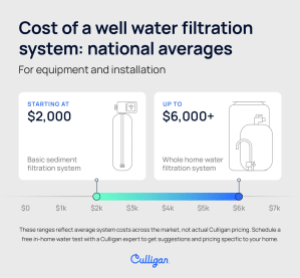
Based on national market cost data (not Culligan’s own prices), a basic home water filtration system costs between $2,000 and $6,000 on average. However, more advanced or specialty systems may be priced higher, up to $10,000 or more. Additionally, well water often requires multiple systems, with each additional system increasing the total cost.
Combining systems for homes with well water, like whole home filtration, a water softener and/or a drinking water solution, can drive your total cost above $6,000. Your cost also depends on the issues or contaminants identified in your water test, the systems recommended to address them and your home’s plumbing, as well as the features and quality of the systems you choose.*
Worried about your well water?

How we calculated average costs
To estimate average costs, we reviewed national cost data from HomeAdvisor, which is based on project costs reported by its customers, as of June 2026, as well as internal Culligan data.
The single-system range reflects the average for a whole home water filtration system, which can include professional installation. The multi-system range reflects reported costs for individual system types commonly used together on private wells, including well water filters, water softeners and reverse osmosis systems.
Averages for specific contaminant-based filtration solutions were gathered from HomeSense and reflect national averages, not Culligan prices.
All figures are in U.S. dollars and reflect U.S. market data, so costs in Canada may differ. They’re intended for general budgeting only and don’t represent Culligan prices or quotes. For a recommendation and pricing specific to your home, schedule a free in-home water test with a local Culligan water expert.
Well water filtration system costs by type
A water test helps identify which issues or contaminants are affecting your water and which systems can address them. Below are the most common well water filtration systems and what influences the cost of each.
Sediment filtration
A sediment filtration system targets the solid particles suspended in your well water, such as sand, silt, clay and rust flakes. It’s often the simplest system in a well water setup. A sediment filter can work on its own or as the first stage in a larger configuration, where it helps protect the equipment that follows.
There’s a cost difference depending on which type of system you choose:
- Cartridge systems: The filter unit is installed directly into the main water supply line, which keeps upfront costs lower. However, the cartridge fills with particles over time and gradually restricts water flow, so you may notice a drop in water pressure before it’s replaced. Cartridges need to be changed manually, and wells with heavy sediment can clog them quickly, sometimes within a few months. Ongoing cartridge replacements add to the lifetime cost of the system.
- Tank-based systems: Similar in appearance to water softeners, these units require a more involved installation process. However, they use automated rinse cycles to clear trapped debris without manual intervention, making them a worthwhile long-term investment for wells with moderate to heavy sediment levels.
UV disinfection
UV disinfection systems use ultraviolet (UV-C) light to neutralize microorganisms without altering the water’s taste or chemical makeup. Total installed costs depend on the system’s NSF/ANSI 55 classification.
Class A systems are designed to disinfect water that may contain bacteria, viruses and parasites. They also include a UV sensor and alarm that signal when light intensity drops. Class B systems deliver a lower dose of UV and are intended only as supplemental treatment for water already considered acceptable to drink, so they typically cost less.
UV light has to pass through the water to reach microorganisms, so it works best with clear water. Sediment can shield microorganisms from the light, and iron, manganese and hardness can build up on the sleeve that protects the UV lamp.
A water test shows whether your water needs pre-treatment, such as a sediment filtration system or water softener, before a UV system can work effectively. Adding pretreatment increases the overall cost.
Iron and sulfur filtration
Iron can stain fixtures and laundry, while hydrogen sulfide can cause rotten-egg odors. Some filtration systems are designed to address one of these issues, while others address both. Whether you need one or both systems in your home depends on your water test results.
A water test is the only way to know which forms of iron and hydrogen sulfide are present and at what levels. These results help determine the type and size of system your home needs. Higher concentrations can call for a larger or two-tank system, and a home with high levels of both may need a separate system for each.
Water test results are only part of what drives cost, though. The way a system works also affects price. Culligan’s iron and sulfur filtration systems, for example, use aeration to oxidize iron and hydrogen sulfide into particles that a bed of filter media can capture.
They also automatically recondition that media to flush out what it collects. Systems that clean themselves typically cost more upfront than cartridge-based options but require less hands-on maintenance.
Quality and longevity matter as well. Higher-quality filter media and durable components can last for years before needing replacement, which affects long-term costs as well as the upfront price. Features add to cost too. Culligan’s Aquasential® Smart High Efficiency iron and sulfur filtration systems connect to the Culligan Connect™ app for monitoring and maintenance alerts and offer an optional external leak sensor.
Nitrate filtration
Nitrate can reach well water from fertilizer, manure and septic systems, making it more common in agricultural areas. Nitrate filtration systems typically use an ion exchange process to reduce the contaminant from well water. As water flows through a bed of resin beads inside the tank, the beads capture nitrate and exchange it for chloride ions. Because a nitrate filtration system regenerates with a brine solution, like a water softener, regular salt replenishment adds to its operating costs.
Nitrate reduction systems must use nitrate-selective resin. Standard resin attracts sulfate more than nitrate, so in water with sulfate it can become less effective and release captured nitrate back into the water. Nitrate-selective resin is designed to prevent this. Cost depends on your nitrate and sulfate levels, your household water use and the system’s features.
Culligan’s Aquasential® Smart High Efficiency Nitrate Reduction Conditioner is the only whole-house nitrate filtration system certified by the Water Quality Association (WQA) to reduce nitrate.¹
Arsenic filtration
Arsenic occurs naturally in some bedrock and can dissolve into groundwater. Because it doesn’t affect the taste, odor or appearance of water, laboratory testing is needed to confirm its presence and level.
It can occur in two forms, Arsenic III or Arsenic V, and some treatment methods are more effective on one form than the other. Some systems require an additional pre-treatment stage to convert Arsenic III before filtration, increasing costs. Culligan’s arsenic reduction filtration system is certified to reduce both forms.
Arsenic levels and water pH can also affect cost because they influence how long the filter media lasts before it needs replacement.
Reverse osmosis
Reverse osmosis (RO) systems often include multiple stages of filtration. For the reverse osmosis stage, water is forced at pressure through a semipermeable membrane to reduce a broad range of dissolved contaminants. When additional filtration stages are available, this number grows even more. For example, Culligan’s Aquasential® Smart Reverse Osmosis System is certified to reduce more than 90 contaminants.
For well owners, an under-sink RO system is the most common choice. It treats water for drinking and cooking at a dedicated kitchen faucet, and some systems can address specific well water concerns, like nitrate or arsenic.
RO system costs depend on the number of filtration stages and filter options, the contaminants a system is certified to reduce, how efficiently it uses water and features such as smart monitoring. Culligan RO systems offer up to seven stages of filtration and 14 filter options, so you can customize your system to your needs.
With an optional advanced post-filter, they can address issues including bacteria, viruses and arsenic. The Aquasential® Smart Reverse Osmosis System is 3 to 5 times more efficient than other leading ROs. That typically means less water usage and lower water bills.² Through the Culligan Connect™ app, you can also check filter life and get filter change alerts.
Whole home reverse osmosis systems exist, and in some cases they’re the best option. These systems for residential wells are typically adapted from commercial equipment, so availability and design vary by dealer. Recommendations are also made on a case-by-case basis.
However, most well water concerns can be addressed with an under-sink RO system for drinking water, paired with whole home filtration that targets any additional specific issues identified in a water test.
Water softeners
Water softeners work differently from the systems above because they’re not a filtration system. A water softener uses resin beads in a process called ion exchange to replace the calcium and magnesium that make water hard with sodium ions.
Cost depends on the system’s features, efficiency and design as well as its grain capacity, which is how much hardness the water softener can address before it regenerates. During regeneration, a brine solution rinses the captured minerals from the resin beads and flushes them from the system.
Capacity is based on your household’s water use and your water hardness, measured in grains per gallon (gpg). Well water is often harder than municipal water, so a larger household on a well with high hardness may need a higher-capacity system.
What affects the cost of a well water filtration system
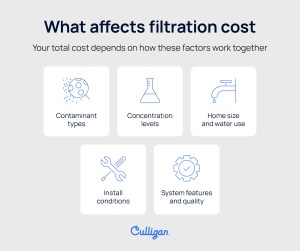
Well water filtration quotes vary because water quality is different from one property’s well to the next. The factors below influence which systems a dealer recommends and how large each should be.
- Contaminant types: The contaminants identified in your water quality test help determine how many systems your home may need, which typically has a greater impact on cost.
- Concentration levels: Higher concentrations of a given contaminant can require larger equipment and, in some cases, an additional pre-treatment stage.
- Home size and water use: The number of bathrooms and fixtures affects the flow rate the system must support, and total daily use impacts the capacity it needs.
- Install conditions: Systems generally require access to the main water line, a drain and an electrical outlet. Homes without these nearby may need additional plumbing or electrical work.
- System features and quality: Build quality, efficiency, smart monitoring and certifications for specific contaminants all affect cost, and premium systems typically cost more upfront.
Why well water filtration system prices vary so widely
National market cost data covers everything from basic equipment a homeowner installs to professionally installed systems with advanced features. This is why costs vary widely.
Averages based on reported project costs may also lean toward lower-cost and DIY systems without professional installation. Like most home systems, the cost of water treatment depends on more than just its size and the issues it addresses. The features below are what typically separate a premium system from a basic one:
- Build quality and materials: Tank construction, control valves and media quality affect how long a system lasts. For example, the Quadra-Hull® tank available for Culligan’s Aquasential® Smart High Efficiency systems has a four-layer design that resists UV rays, rust and corrosion.
- Efficiency: Basic water softeners regenerate on a fixed schedule whether they need to or not. Culligan’s Aqua-Sensor® technology monitors the condition of the resin and regenerates only as needed, which uses less salt and water.
- Smart monitoring: Wi-Fi-enabled systems connect to an app, like the Culligan Connect™ app, so you can track water use, get maintenance alerts and set the system to bypass remotely.
- Optional accessories: Culligan water softeners may include a salt level monitor showing how many days of salt remain, and an external leak sensor that can detect leaks around the system and nearby water-using appliances.
- Dealer monitoring and service: With connected Culligan systems, your local Culligan team can monitor your system remotely and reach out when service is needed.
- Certifications: Systems certified by independent organizations such as the NSF or WQA to reduce specific contaminants have been tested to meet those standards.
Installation costs
Installation is priced separately from equipment and can vary based on how many systems your home needs, the available space and the plumbing and electrical work needed to connect them. More complex situations, like needing a drainage connection for a system or having a home on a septic system, also increase total cost.
Where the system goes also matters. Many systems are installed in a basement, garage or utility room, but homes without these areas may need equipment in a shed or outdoors. Culligan offers outdoor models of many of its systems, and any outdoor installation needs protection from freezing temperatures.
Water treatment systems must also be installed according to local plumbing codes, with some areas requiring a licensed professional or a permit to connect equipment to a home’s water supply. A professional installer also sizes and programs the system based on your water test results and household water use.
Ongoing maintenance and operating costs
Annual maintenance costs vary depending on the specific equipment installed, and many homeowners rely on professional service plans to more easily and reliably handle routine maintenance and monitoring.
In general, recurring operating expenses fall into the following categories:
- Replacement media and cartridges: Filter media captures particles and contaminants until it reaches its capacity and needs replacement. Cartridge filters may need changing every few months, while tank-based systems that clean their media through automatic reconditioning cycles can go several years between media replacements.
- Salt: Water softeners and nitrate filtration systems regenerate with salt, which needs to be refilled periodically. How often depends on the system’s efficiency, your water hardness and your household’s water use.
- Component replacement: UV lamps typically need replacement about once a year, and components such as ballasts and control valves wear out over the system’s lifetime.
- System sanitation and service: Tanks and plumbing may require periodic sanitation. Your local Culligan dealer likely offers service plans that cover scheduled maintenance, and connected systems can send maintenance alerts to both you and your dealer so service needs are caught early.
- Regular water testing: Periodic testing helps confirm that systems continue to perform as intended, since some systems show no visible sign when their media is nearing capacity.
Why your quote starts with a water test
An accurate recommendation and quote start with understanding your water. Well water quality can vary significantly from one property to the next, and testing helps identify the specific issues or contaminants present and their levels.
Testing also matters because many contaminants, including nitrate and arsenic, can’t be detected by taste, odor or appearance. As a result, water can seem completely normal and contain contaminants at levels that may affect your health. Private wells aren’t covered by federal regulations governing municipal water supplies, so monitoring water quality is entirely the homeowner’s responsibility.
However, government and health agencies do recommend establishing a regular screening routine. The Environmental Protection Agency (EPA) advises annual testing for bacteria and nitrates, while Health Canada recommends checking for bacteria every six months.
Wells near agricultural operations or industrial sites may also warrant additional testing for substances such as pesticides or industrial solvents. Additional testing also may be recommended based on local water conditions or concerns.
Start with a free well water test
Your water test results and your household’s usage help determine the right combination of systems for your home. A free in-home water consultation with a local Culligan water expert is a practical first step. Your water expert will test your water for common issues such as hardness, pH and total dissolved solids. They’ll also inspect your plumbing and discuss your water use and concerns.
For contaminants linked to health concerns, such as arsenic or nitrate, your water expert can send a sample to Culligan’s IL EPA-certified lab for in-depth testing at an additional cost. From there, they’ll recommend a solution designed for your home and your water.
Schedule a free water test to start your well water assessment.

Schedule your free water test.
FAQs
Learn more about well water filtration system cost and more below.
Does a whole house filtration system treat hard water?
No, a whole house filtration system targets issues such as sediment, iron, hydrogen sulfide and specific contaminants, but it isn’t designed to reduce hardness. Hard water is caused by dissolved calcium and magnesium ions, which a water softener removes through ion exchange. Many well owners use both because well water can be hard and also contain other issues that call for filtration.
What is the most common contaminant in well water?
Well water quality varies across the U.S. and Canada, and almost any contaminant can occur in any region. Some of the most common well water problems are ones you can see, smell or taste, like hardness, iron, hydrogen sulfide and changes in appearance. Others, such as bacteria, nitrate and arsenic, can’t be detected without testing.
The EPA recommends testing private wells every year, and a water test is the most reliable way to understand an individual well.
Is a well water filtration system worth the cost?
A well water filtration system is worth the cost when a water test identifies contaminants above recommended levels, since well water is not treated by a municipal utility before reaching the home.
How long do well water filtration systems last?
Well water filtration systems last up to 15 years with regular maintenance, although filter media, cartridges and UV lamps need replacement at shorter intervals.
*Contaminants may not be present in your water.
¹Certified to WQA ORD-2301 for reduction of nitrate as of 8/1/2023.
²Efficiency is based on 3rd party testing to NSF/ANSI standards for a tanked RO system.