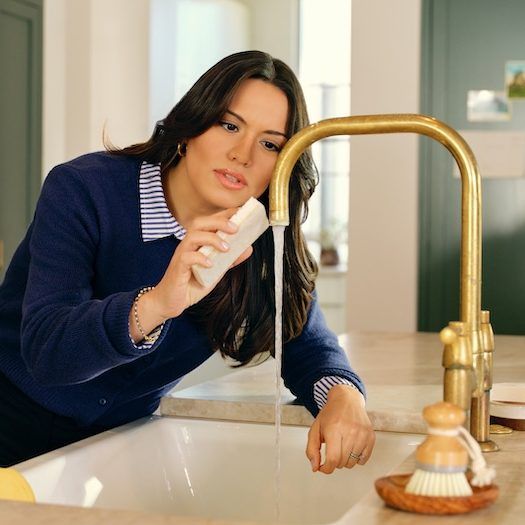
Are you wiping away chalky residue around your faucet only to find it back a few days later? Hard water could be the reason. As water dries, it can leave behind mineral deposits that gradually form scale.
Here’s how to clean the existing scale and choose a method suited to your faucet’s finish, and for a longer-term solution, how addressing hard water at the source can help prevent new buildup from coming back.
What hard water scale looks like on a faucet
Hard water contains dissolved minerals, mainly calcium and magnesium. As water droplets evaporate, those minerals can remain on the surface and gradually form scale. Similarly, the U.S. Geological Survey also notes that hardness minerals can accumulate inside pipes and water-using appliances.
On a faucet, look for:
- White, crusty residue around the spout or handles
- Cloudy mineral buildup near the base
- Deposits around the faucet aerator
- Water spots that return soon after cleaning
These hard water stains and deposits aren’t limited to kitchen faucets. You may also notice them on bathroom faucets, sinks, showerheads and glass shower doors. If the same deposits keep coming back, a water test can help confirm whether you have hard water.

Before you clean hard water scale from a faucet
Before reaching for the vinegar, check your faucet manufacturer’s cleaning instructions. Some finishes tolerate diluted vinegar, while others require gentler care. Commercial descalers and abrasive cleaners can damage certain metals or coatings.
Test approved products on a small, inconspicuous area first. Avoid scouring pads and metal tools, and never mix vinegar, bleach or other cleaning products.
You’ll need:
- White vinegar, if approved for the finish
- Microfiber cloth or soft paper towel
- Soft toothbrush
- Small bowl for removable aerator parts
- Compatible limescale cleaner for stubborn deposits
For light residue, a clean cloth and warm water may be enough. It’s worth starting with the gentlest method before moving to stronger cleaners.
Choose the right cleaning method
Not sure which cleaning method to try? Start with the type of buildup you’re seeing.
| What you’re seeing | Recommended method | What to know before cleaning |
|---|---|---|
| Fresh water spots or loose residue | Wipe with a damp microfiber cloth and dry thoroughly | A cleaning solution may not be necessary |
| Light, chalky mineral buildup around the spout, base or handles | Apply diluted white vinegar with a soft cloth | Check that vinegar is safe for the finish and follow the manufacturer’s dilution and contact time |
| Thick, crusty or stubborn calcium deposits | Use a compatible commercial limescale cleaner | Check material restrictions and application times; avoid scraping with metal tools |
| Reduced water flow or an uneven stream | Remove and clean the faucet aerator | Deposits inside the screen may restrict flow; some aerators require a special removal tool |
How to remove hard water scale from a faucet with white vinegar
For many common faucet finishes, diluted white vinegar can help dissolve calcium deposits without hard scrubbing. Check that vinegar is safe for your faucet material before following these steps.
- Wipe away loose residue: Start with a damp cloth to clear soap residue and debris from the faucet.
- Apply the vinegar solution: If your manufacturer approves a 50/50 solution, mix equal parts white vinegar and water and dampen a soft cloth.
- Let the vinegar work: Leave the vinegar mix on the affected area for the time recommended by your faucet manufacturer. Avoid prolonged soaking, particularly on specialty finishes.
- Wipe away loosened scale: Use the cloth to clean the affected area. A soft toothbrush can help around handles and other crevices if the finish permits it. Avoid scraping or aggressive scrubbing.
- Rinse and dry: Rinse thoroughly with clean water, then buff dry with a microfiber cloth. Removing water droplets helps limit new spots as the surface dries.
Some deposits may need another application.
How to remove stubborn hard water scale from a faucet
Thicker deposits that have accumulated over time can be harder to loosen with vinegar alone. A commercial limescale cleaner may help, provided it’s suitable for your faucet’s material and finish.
Use a limescale cleaner only if both its label and your faucet manufacturer’s care instructions allow it. Follow the cleaner’s directions for dilution, application time and rinsing.
These products may also have restrictions for materials such as brass, copper, natural stone and painted or coated surfaces. Check both the product label and your faucet manufacturer’s care instructions before using it.
You may also see baking soda paste suggested for hard water stains. While it can help with some surface residue, it’s mildly abrasive and doesn’t dissolve mineral scale the same way vinegar or a descaler does. Skip it unless your faucet manufacturer permits that type of cleaning. (For more advice on other household surfaces, see how to remove hard water stains.)
How to clean hard water scale from a faucet aerator
Sometimes mineral buildup causes more than an unsightly ring around the spout. It can also collect inside the faucet aerator, the small fitting that helps control the water stream.
When those openings become clogged, you may notice reduced water flow or an uneven spray. Here’s how to clean the aerator:
- Remove it carefully: Cover the sink drain so small parts don’t get lost, then follow the manufacturer’s instructions. Some kitchen faucets have recessed aerators that require a special tool.
- Check for deposits: Look for white or crusty buildup around the screen and openings.
- Clean the components: If approved, soak removable parts in the recommended vinegar solution for the specified time. Otherwise, use the cleaning method provided by the manufacturer.
- Rinse and reinstall: Gently remove loosened deposits, rinse the components and put the aerator back together. Turn on the faucet to check the flow.
Why does hard water scale keep coming back?
Even after you’ve removed the visible scale, new deposits can form as more hard water dries on the faucet. Wiping fixtures dry and keeping up with regular cleaning can help limit visible buildup. But neither changes the calcium and magnesium dissolved in your water.
A water softener is the best long-term solution for this issue, because it removes those hardness minerals, preventing new hardness-related scale from forming.
Hard water scale on faucets FAQs
Have another question about cleaning mineral deposits or keeping scale from returning? Here are a few common ones.
Can well water cause faucet scale?
Yes. Well water can pick up calcium and magnesium as it moves through soil and rock. Those minerals can leave deposits when water dries on your faucet. Not every well has hard water, though. Testing can confirm your home’s hardness level.
Can city water cause faucet scale?
Yes. Municipal water can contain enough hardness to leave scale on faucets, sinks and other fixtures. Whether you get your water from a private well or a municipal supply, local water sources and geology can affect its hardness.
Can hard water scale affect faucet water flow?
Yes. Mineral deposits can block openings in a faucet aerator, reducing water flow or changing the spray pattern. Cleaning the aerator may help restore normal flow. If the problem persists, there may be another plumbing issue to investigate.
How long does white vinegar take to dissolve calcium deposits?
The time depends on the amount of buildup and the faucet’s finish. Some components may need only a short application, like 5-10 minutes, but others may differ. If your manufacturer permits diluted vinegar, follow its recommended application time.
Start by soaking a towel in a diluted vinegar mixture. Then, wrap it around the faucet handle components and leave it to soak for the recommended time. Remove the towel, wipe away the loosened scale and repeat as needed. Avoid prolonged soaking.
What dissolves hard water calcium deposits?
White vinegar can help dissolve light calcium deposits, while a compatible commercial descaler may work better on stubborn scale. Baking soda can help lift some surface residue, but its mildly abrasive action isn’t a substitute for a descaling solution. Use whichever method is approved for your faucet’s finish.
Can a water softener remove existing hard water scale from a faucet?
Yes, but it is typically a slow process that happens over time. A consistent flow of soft water, free of the minerals that cause hard water, can help gradually remove existing scale buildup within your plumbing and appliances.
Prevent hard water scale at the source
Cleaning can leave your faucets looking refreshed, but when hard water is the cause, those chalky deposits can keep coming back. For a lasting solution, it helps to address the minerals behind the buildup.
A water softener removes the calcium and magnesium responsible for hardness, preventing new hardness-related scale and making it easier to keep fixtures clean over time.
The first step is understanding your home’s water. During a free, in-home water test and consultation, your local Culligan water expert can measure your water hardness, explain the results and discuss the buildup you’re noticing. From there, they can recommend a water softener suited to your household needs.
Get started today – schedule your free, in-home water test and consultation.