Quick answer: Nobody on the Treasure Coast will give you a number. Port St. Lucie Utility Systems, Fort Pierce Utilities Authority and Martin County Utilities all publish annual water quality reports, and none of them lists the hardness of the water that leaves the plant. What they do describe is how the water is made: a lime-softened stream from the shallow surficial aquifer blended with a reverse osmosis stream from the deep, brackish Floridan aquifer. Lime softening lowers hardness without removing it, reverse osmosis strips nearly all of it, and blending the two brings some back; Martin County says as much in its own report. Hardness at your tap depends on the day’s blend and your plumbing, and private wells get the aquifer as it comes. The only reliable number is the one measured at your house.
Most people in Port St. Lucie notice hardness before they can name it: the shower door in a Tradition townhouse that fogs over two days after it was squeegeed, the chalky collar on a St. Lucie West faucet, dusty-looking glassware in Torino, a Sandpiper Bay water heater that has started to rumble. Each is the same mineral, calcium and magnesium carbonate, left behind when water evaporates or is heated. Here is where it comes from, why the utility removes some of it and not all, how to get your own number and what a softener does about it.
Is city water or well water harder in Port St. Lucie?
Private wells almost always test harder than city water here, because city water has been through a plant built partly to remove hardness and well water has not. The gap varies by neighborhood, and city water is not hardness-free.
Port St. Lucie’s supply comes from two very different depths. Wells roughly 100 feet down tap the East Coast surficial aquifer, a shallow layer of sand, shell and limestone that lies under the whole coast. That water goes to the city’s 8 million-gallon-a-day lime softening plant at Prineville, where lime raises the pH, a polymer coagulates the precipitated minerals, multi-media filters catch them and chloramine disinfects the result. Lime softening is designed to cut hardness to a workable level, not to zero.
Wells about 1,350 feet down reach the Floridan aquifer, which under the Treasure Coast is brackish; the USGS has mapped chloride above 1,000 mg/L inland and from 2,000 to 8,000 mg/L along the southern coastal zone of Martin and St. Lucie counties. That water passes through one of the city’s two reverse osmosis plants, rated 11.15 and 22.5 million gallons a day. RO membranes reject calcium and magnesium along with the salt, so the permeate is very low in hardness. The city blends the two streams, adjusts pH and sends the mix out through more than 1,400 miles of pipe.
Fort Pierce Utilities Authority runs the same two-source model: surficial wells about 100 feet deep to lime softening and sand filtration, Floridan wells about 1,000 feet deep to reverse osmosis, with St. Lucie County Utilities buying that water for North Hutchinson Island and Indian River Estates. Martin County Utilities, serving Jensen Beach, Palm City, Port Salerno and Hobe Sound, treats brackish Floridan water with RO and surficial water with iron filtration, then blends. Its 2025 report states that blending adds hardness, and it, too, gives no figure.
Private wells are a different matter. Roughly 18,600 St. Lucie County residents, about one in sixteen, supply their own water according to USGS county data, and the share is about two in five in Okeechobee County. Those wells, in White City, Lakewood Park, Indiantown and the acreage west of Fort Pierce, draw mostly from the surficial aquifer, where water sitting in shell and limestone dissolves calcium and magnesium. No utility softens, tests or monitors it. The homeowner does, or no one does.
Hard water problems homeowners see in Port St. Lucie
Hardness is not a health issue, which is why utilities are not required to report it. It is a household issue, and an expensive one over time. These are the three complaints we hear most.
1. Scale inside water heaters and appliances
What you notice: A water heater that rumbles, takes longer to recover and costs more to run; a dishwasher heating element coated in white; an ice maker that slows down; faucet aerators that clog.
What causes it: Heat drives dissolved calcium and magnesium out of solution and onto the nearest hot surface, in a tank heater the bottom of the tank and the element.
Why it matters: Scale insulates. The heater works harder to push heat through the layer, and the layer keeps growing until the tank fails early.
2. Film, spots and soap scum
What you notice: Cloudy glassware, a white ring at the toilet waterline, a haze on the shower glass and tile, soap that will not rinse clean off your hands.
What causes it: Calcium and magnesium react with soap to form an insoluble curd. Where water dries, the minerals stay behind as spots.
Why it matters: Cleaning takes longer and more product. Much of the detergent in a Port St. Lucie dishwasher is spent on the minerals before it touches a dish.
3. Dry skin and hair
What you notice: Skin that feels tight after a shower, hair that is dull or hard to manage, a film that never quite rinses off.
What causes it: The same soap curd that clouds the shower door forms on skin and hair and does not rinse away in hard water.
Why it matters: Moisturizers and conditioners are working against a mineral layer. People blame the climate or a product when it is the water.
An ion-exchange softener such as Culligan’s Aquasential® Smart High Efficiency Water Softener removes calcium and magnesium at the point where water enters the house, before it reaches the heater, the dishwasher or the shower. The Aquasential® Select Series Water Softeners do the same job for households that do not need app monitoring. On a well with iron, a Softener-Cleer handles hardness and iron in one unit.
How to find out how hard your water really is
Read the utility’s report. Port St. Lucie posts each year’s Water Quality Report on its Utility Systems page; Fort Pierce Utilities Authority and Martin County Utilities post theirs as well. You will find chloramine, fluoride, sodium, lead and disinfection byproducts, but not hardness, chloride or total dissolved solids, because federal rules do not require them. The report tells you how the water is made, not how hard it is at your tap.
Look at your fixtures. Scale on the showerhead, spots on glass, a toilet ring that returns within a week and a louder water heater are all evidence of hardness, whatever the plant did upstream.
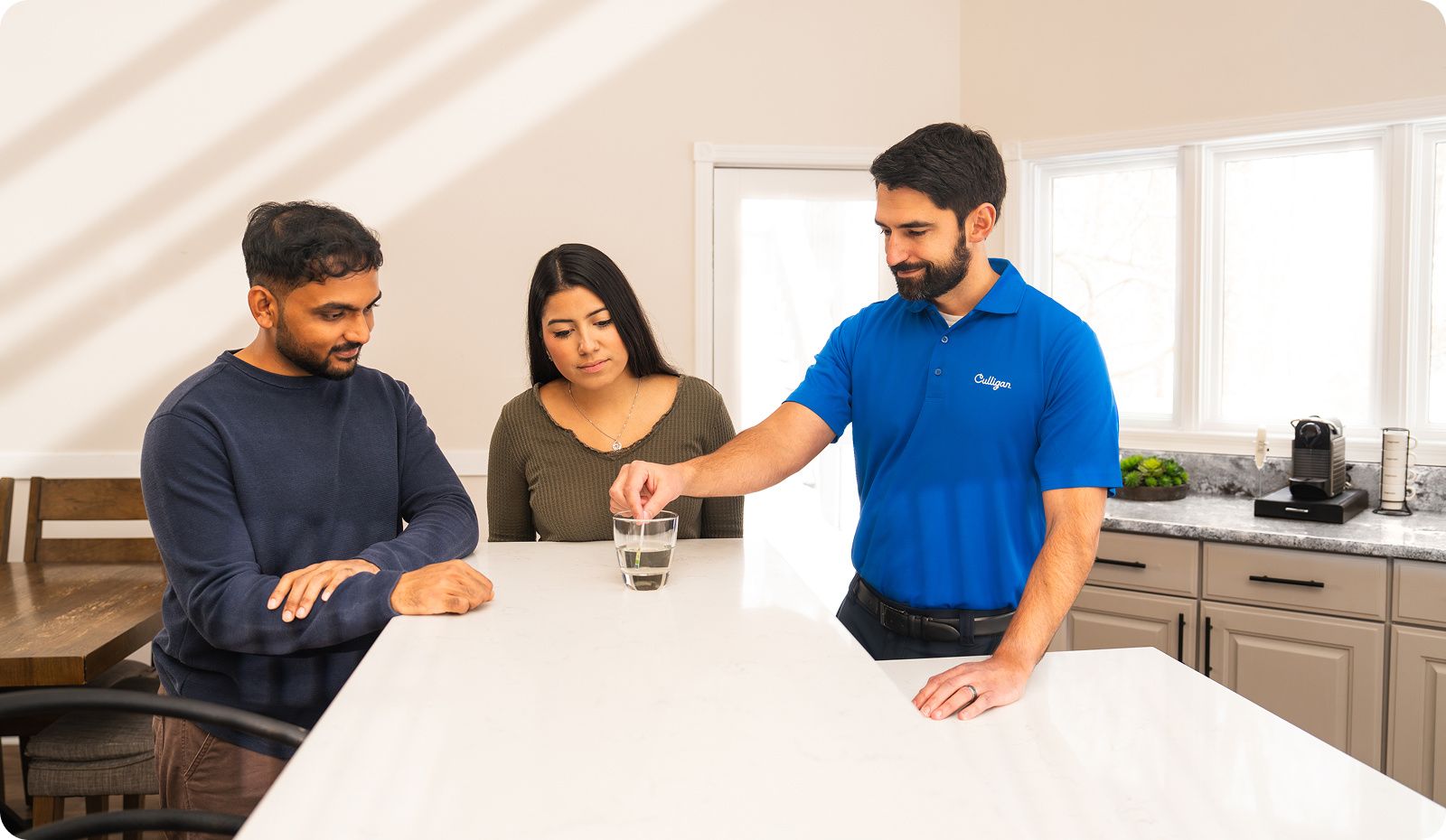
Test it where you use it. This is the only method that produces a number for your house, since hardness changes with the plant blend, the distance through the mains and, for wells, from one property to the next. Culligan of Port St. Lucie’s free in-home test reads hardness along with chlorine, total dissolved solids, pH and iron in about 20 minutes. If you are on a well, UF/IFAS recommends testing for iron and manganese before buying a softener, because both reduce how well the resin works; we check at the same visit.
Learn more about water softeners from Culligan of Port St. Lucie, see what the free in-home water test covers, or browse our filtration and well water solutions.
FAQs about hard water in Port St. Lucie
How hard is Port St. Lucie water in grains per gallon?
Port St. Lucie Utility Systems does not publish a finished-water hardness figure, and neither do Fort Pierce Utilities Authority or Martin County Utilities. The city blends lime-softened surficial water with Floridan reverse osmosis water, so hardness changes with the blend. A free in-home test gives you the grains-per-gallon reading for your own tap.
Does Port St. Lucie soften its water?
Partly. The Prineville plant uses lime softening on surficial aquifer water, and the two reverse osmosis plants remove nearly all hardness from Floridan water. The finished product is a blend of the two, and the city does not report its hardness. Homeowners who see scale and spotting still have enough hardness to treat.
Will a refrigerator or pitcher filter soften Port St. Lucie water?
No. Carbon filters remove taste and odor compounds and some chlorine; they do not exchange calcium and magnesium. Softening the whole house requires an ion-exchange softener at the main line. For drinking water alone, a reverse osmosis system at the sink does remove hardness along with sodium and other dissolved solids.
Is well water in Palm City and White City hard?
Usually, because the surficial aquifer sits in shell and limestone and the water is untreated. The level varies from well to well, and iron and hydrogen sulfide often come with it. Testing determines whether a plain softener or a combined softener and iron filter is the right equipment.
Start with a free hard water test from Culligan of Port St. Lucie
Culligan of Port St. Lucie has worked on Treasure Coast water for decades, from the condos of Hutchinson Island and Jensen Beach to the ranchettes outside Okeechobee. Our technicians see blended city water from Port St. Lucie, Fort Pierce and Martin County every day, and what untreated wells do to plumbing in White City, Indiantown and Palm City.
Your visit starts with a test at your own tap and a plain explanation of the results. If a softener makes sense, you get a written quote with rental and purchase options, and salt delivery can be scheduled for any softener we install.
Ready for better water? Schedule your free in-home water test and consultation with Culligan of Port St. Lucie today.