Quick answer: Yes, with the usual qualifications. The City of Port St. Lucie’s 2025 Water Quality Report shows no violations of any federal or state standard, and Fort Pierce Utilities Authority and Martin County Utilities report the same for their systems. The reports also show what “meets standards” leaves in the glass: chloramine averaging 3.14 ppm, sodium above 90 ppm from the brackish Floridan aquifer, and PFOS at 3.3 parts per trillion in Prineville plant water against a federal limit of 4.0 ppt. Those numbers are measured where water leaves the plant, not at your faucet. Your household’s answer depends on your plumbing, your health concerns and your taste.
Many of the people turning on a tap in Tradition, St. Lucie West or Torino moved here from somewhere with very different water, and the city’s own report acknowledges that new customers notice the taste. Here is what homeowners across St. Lucie and Martin counties should know about what is in the water, what the utilities test for and what they do not, and how to find out what is coming out of your own tap.
What the annual water quality report tells you, and what it leaves out
Under the Safe Drinking Water Act, the EPA sets enforceable limits on more than 90 contaminants, and every utility publishes a Consumer Confidence Report each year showing how its water measured against them. Port St. Lucie, Fort Pierce and Martin County all passed for the latest reporting year.
Three things limit what that tells you. The limits weigh cost and treatment feasibility, not safety alone, which is why the federal PFOS limit is 4.0 ppt and not zero. Sampling happens at the plant and a handful of monitoring points, not in the 1,400-plus miles of pipe Port St. Lucie maintains or in the copper and brass inside a 1980s house in Sandpiper Bay. And the reports cover health-based standards: hardness, chloride, total dissolved solids and taste are not in them, and no local utility publishes a hardness figure at all.
City water or well water in Port St. Lucie?
About 269,000 St. Lucie County residents are on a public water system, according to USGS county data; roughly 18,600 more, about one in sixteen, have their own well. Martin County’s self-supplied share is around 3.6 percent, concentrated in Palm City Farms, Indiantown and the western acreage; in Okeechobee County it is about two in five. A utility customer gets treated, disinfected, tested water, while a well owner gets the aquifer, and the Florida Department of Health strongly recommends that owners test for bacteria and nitrate at least once a year. Our well water page covers private wells in detail; the rest of this article is about municipal supply.
Where Port St. Lucie’s drinking water comes from
Two aquifers at two depths. The East Coast surficial aquifer, about 100 feet down, feeds the city’s 8 million-gallon-a-day lime softening plant at Prineville, where lime, a polymer coagulant and multi-media filters remove much of the hardness and the water is disinfected with chloramine. The Floridan aquifer, about 1,350 feet down, is brackish under the Treasure Coast; the USGS has measured chloride from 2,000 to 8,000 mg/L in the southern coastal zone of Martin and St. Lucie counties. That water is desalted at two reverse osmosis plants rated 11.15 and 22.5 million gallons a day, then blended with the lime-softened stream, pH-adjusted and disinfected. A third RO plant, the Discovery Water Treatment Facility, is planned for late 2029 with six new Floridan wells.
Fort Pierce Utilities Authority follows the same model, surficial wells about 100 feet deep to lime softening and Floridan wells about 1,000 feet deep to reverse osmosis, and St. Lucie County Utilities resells that water on North Hutchinson Island. Martin County Utilities treats brackish Floridan water with RO and surficial water with iron filtration at its Tropical Farms and Jensen Beach plants for Palm City, Port Salerno and Hobe Sound. Okeechobee Utility Authority is the exception, drawing surface water from Lake Okeechobee. After decades of testing Treasure Coast homes, these are the issues that come up most once the water is in the house.
1. Chloramine taste and odor
What you notice: A swimming-pool smell in the shower, a chemical edge to coffee and tea, and a sharper version of both for two weeks every July.
What causes it: Port St. Lucie, Fort Pierce and Martin County all disinfect with chloramine, chlorine bonded to ammonia, because it lasts longer in a large distribution system. Port St. Lucie’s 2025 average was 3.14 ppm (range 2.6 to 3.5); Fort Pierce ran 3.8 ppm and Martin County 3.5 ppm, against a 4.0 ppm limit. Each July the city runs free chlorine for about two weeks while flushing hydrants (July 6 to 17 in 2026); Martin County does the same twice a year.
Why it matters: Chloramine is a legitimate public health tool, but it is harder to remove than free chlorine, and ordinary pitcher filters do little with it.
How to fix it: A reverse osmosis system such as the Aquasential® Smart Reverse Osmosis at the kitchen sink for drinking and cooking water; a whole-house Aquasential® Smart HE Water Filter or Select Series whole-house filter with catalytic carbon for showers and laundry.
2. Sodium and the brackish-source taste
What you notice: Water that tastes flat, heavy or faintly salty, especially to people who moved from a surface-water city.
What causes it: The Floridan aquifer under Port St. Lucie is salty, and reverse osmosis followed by blending does not take sodium to zero. The city’s latest report lists 93.2 ppm at Prineville and 92.1 ppm at James E. Anderson, below the 160 ppm limit shown in the report. Fort Pierce reported 34.8 ppm and Martin County 46.6 ppm.
Why it matters: For most people it is a taste issue. For anyone on a low-sodium diet, 90-plus milligrams per liter in every glass and pot of rice adds up.
How to fix it: Reverse osmosis at the point of use. The Aquasential® Smart RO or the compact Aquasential® Tankless RO removes most of the sodium along with other dissolved solids.
3. PFAS
What you notice: Nothing. PFAS have no taste, odor or color.
What causes it: Decades of use in coatings, foams and consumer products, reaching groundwater through soil. Port St. Lucie’s March 2025 sampling found PFOS at 3.3 ppt, PFOA at 1.8 ppt, PFHxS at 1.25 ppt and PFBS at 1.1 ppt in Prineville water; James E. Anderson water showed no detections. St. Lucie County Utilities reported PFOS averaging 8.9 ppt on North Hutchinson Island in 2023. Martin County’s 2025 sampling found nothing above reporting levels. In Stuart, state funding records show the EPA identified PFOA and PFOS at 180 ppt in 2016 and that all 24 of the city’s raw-water wells carried some, which is why Stuart has pursued a Floridan aquifer reverse osmosis supply.
Why it matters: The federal limits for PFOS and PFOA are 4.0 ppt each. Prineville’s PFOS result is under that, but not by much, and it describes plant water, not the blend at your tap.
How to fix it: Culligan’s Aquasential® Smart Reverse Osmosis with Total Defense is certified to reduce total PFAS by more than 99.99%. For every tap in the house, the Whole Home PFAS Water Filter is certified to reduce total PFAS by more than 99%.
4. Lead from household plumbing
What you notice: Nothing; lead is invisible and tasteless.
What causes it: Port St. Lucie’s service-line inventory found no lead or galvanized lines, and its 90th-percentile result was 4.6 ppb against a 15 ppb action level. One sampled home still exceeded it, which is the point: the utility controls the mains, not the brass and solder in individual houses, particularly older homes in Fort Pierce and Stuart. Fort Pierce’s 90th percentile was 1.1 ppb and Martin County’s 4.0 ppb.
Why it matters: Lead affects infants and children most, and the only way to know your own number is to test water from your own tap.
How to fix it: The Aquasential® Smart Reverse Osmosis System is certified to reduce lead by 99.7%.
5. Hardness and scale
What you notice: Spots on glassware, film on the shower door, white crust on faucets, a water heater that rumbles.
What causes it: Calcium and magnesium. Lime softening removes some, reverse osmosis removes nearly all, and blending brings some back. No local utility publishes the hardness of its finished water, though Martin County’s report acknowledges that blending adds hardness.
Why it matters: Not a health concern, but a steady cost in appliance life, cleaning time and detergent.
How to fix it: An Aquasential® Smart High Efficiency Water Softener or Aquasential® Select Series softener at the main line, sized from the hardness reading in your own home.
How to check the water in your own home
Read the report. Port St. Lucie’s current and past Water Quality Reports are posted on the city’s Utility Systems page; Fort Pierce Utilities Authority and Martin County Utilities post theirs as well. Remember what they measure: plant water, health-based contaminants, and no hardness.
Pay attention to the signs. A chlorine smell in the shower, a salty or flat taste, spots on glass, scale on fixtures, or a rotten-egg odor from a tap that has sat unused (the city attributes this to bacteria in stagnant lines or a water heater) are all worth a closer look.
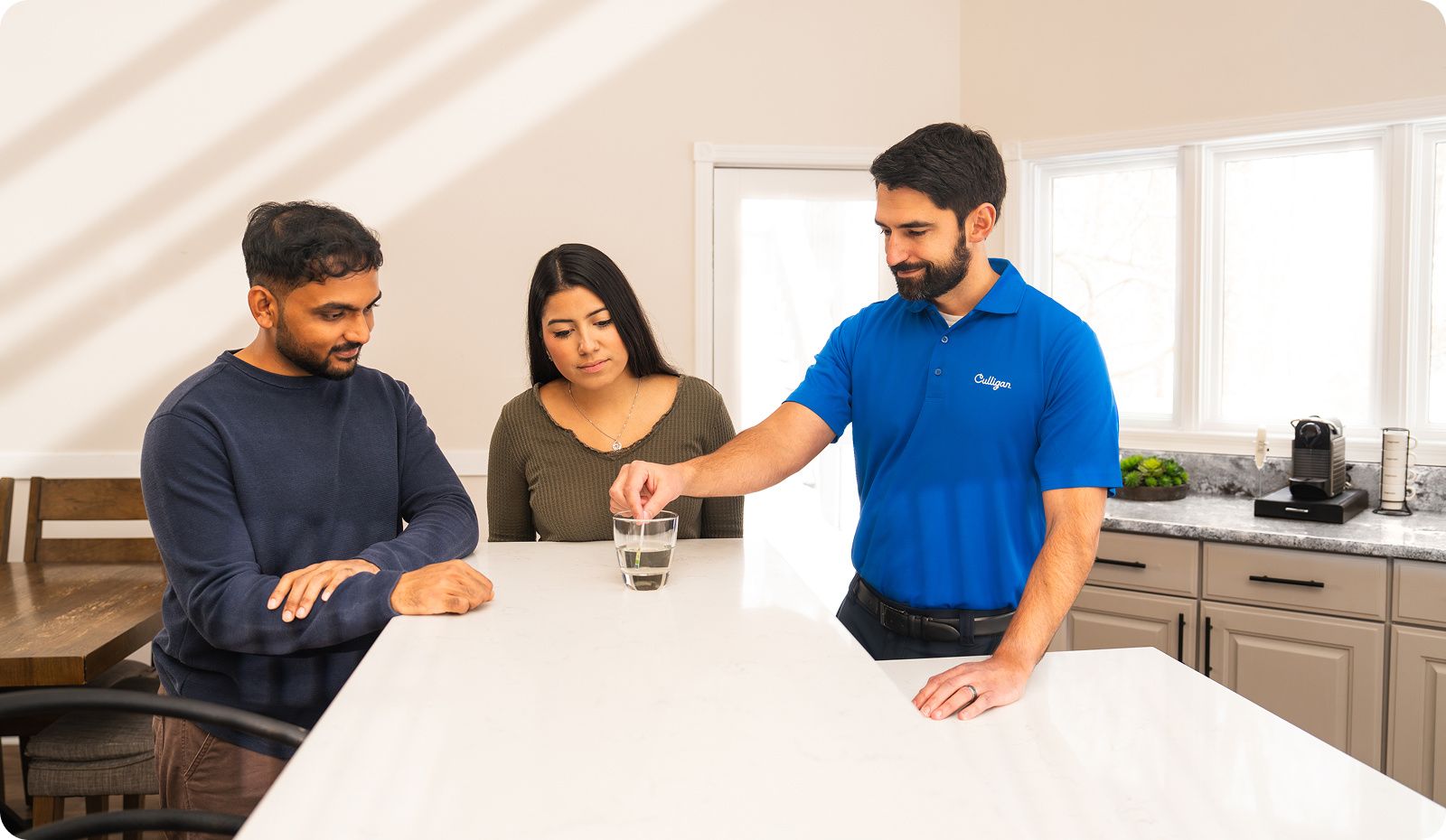
Test it. Culligan of Port St. Lucie’s free in-home water test reads hardness, chlorine or chloramine, total dissolved solids, pH and iron at your sink in about 20 minutes. For lead, bacteria, nitrate, arsenic or PFAS, we collect samples for a certified laboratory and walk you through the results. Testing is especially worthwhile in an older home, on a sodium-restricted diet, with an infant in the house, or when you want a PFAS number for your tap rather than the plant.
See the water filtration options and water softeners available from Culligan of Port St. Lucie.
Frequently asked questions about Port St. Lucie tap water
Is Port St. Lucie tap water safe to drink straight from the faucet?
The city’s 2025 Water Quality Report shows no violations, so by federal and state standards it is. The same report lists chloramine at 3.14 ppm, sodium above 90 ppm, PFOS at 3.3 ppt in Prineville water and one home over the lead action level, all of which are legal and all of which some households choose to treat.
Why does Port St. Lucie water taste different from where I used to live?
Most likely the sodium, 92 to 93 ppm in the city’s finished water because the deep Floridan source is brackish, and the chloramine disinfectant. The city’s own report tells new customers to expect a different taste. A reverse osmosis system at the kitchen sink addresses both.
Does Port St. Lucie use chlorine or chloramine?
Chloramine for most of the year, averaging 3.14 ppm in 2025. For about two weeks each July the city converts to free chlorine and flushes hydrants, which is when residents notice the strongest chlorine taste and occasional cloudy water. Fort Pierce and Martin County use chloramine as well.
Is there PFAS in Port St. Lucie’s water?
At low levels in part of the supply. The 2025 report shows PFOS at 3.3 ppt and PFOA at 1.8 ppt in Prineville plant water and none detected at the James E. Anderson plant. The federal limit for each is 4.0 ppt. An RO system with Total Defense is certified to reduce total PFAS by more than 99.99%.
Schedule your free water test with Culligan of Port St. Lucie
You should not have to read a 20-page report to know what is in your glass. Culligan of Port St. Lucie has served homes and businesses across St. Lucie, Martin, Indian River and Okeechobee counties for decades, from Fort Pierce and Hutchinson Island to Stuart, Palm City, Hobe Sound, Vero Beach and Okeechobee, and our technicians know what the blended Floridan and surficial supply does at the tap.
A technician tests at your sink, explains each reading in plain language and, if treatment makes sense, gives you a written quote with rental and purchase options. If nothing needs treating, we say so.
Ready for better water? Schedule your free in-home water test with Culligan of Port St. Lucie today.