Quick answer: Yes. Water across Ventura County and the Santa Barbara south coast is hard to very hard. The City of Oxnard’s 2023 Consumer Confidence Report lists total hardness from 103 to 557 ppm, averaging 319 ppm, which is roughly 6 to 33 grains per gallon and about 19 gpg on average. Oxnard Plain groundwater from United Water Conservation District tested 540 ppm, about 32 gpg, in 2025. Imported Calleguas water supplying Thousand Oaks and Simi Valley is about 8 gpg, and Santa Barbara’s surface water runs 21 to 27 gpg. Private wells in the Ojai Valley and along the Santa Clara River are often harder still. A home test is the only way to know your own number.
Most people in Oxnard, Camarillo and Ventura do not think of their water as hard until they move here from somewhere it was not. Then the signs pile up: a white crust on the kitchen faucet, cloudy spots on glasses out of the dishwasher, a shower door that films over a day after it is cleaned, and a water heater that pops and rumbles. All of that is calcium and magnesium left behind whenever water dries or is heated.
What makes Ventura County unusual is how far hardness swings from one town to the next. The county blends imported State Water Project water with some of the most mineral-rich groundwater in Southern California, and the proportions change by city, pressure zone and season. Here is where the hardness comes from, how to check it, and what a softener does about it.
Is municipal or well water harder in Oxnard and Ventura County?
Local groundwater is the hard part of the equation; the more of it a city uses, the harder its tap water. According to the City of Oxnard’s 2023 Consumer Confidence Report, the city’s supply that year was 32.8 percent imported water from Calleguas Municipal Water District, 33 percent regional groundwater from United Water Conservation District and 34.2 percent water from the city’s own wells, part of which passes through the city’s reverse osmosis desalter. The imported third arrives at about 140 ppm hardness (roughly 8 gpg) according to Calleguas’s 2025 water quality report. The groundwater thirds arrive much harder: United’s 2025 report lists 540 ppm from its El Rio wells. Blended, that produces Oxnard’s wide 103 to 557 ppm range.
The same pattern repeats across the county. Camarillo mixes Calleguas water with its own Fox Canyon Aquifer wells, which the city’s 2021 report put at 101 to 350 ppm, and Camrosa Water District reported one Santa Rosa Valley-area well at 572 ppm in 2025. Thousand Oaks gets nearly all of its supply from Calleguas and lands near the bottom of the county range. Ojai runs on local wells that Casitas Municipal Water District reported at 412 ppm, or 24.1 gpg, in its 2025 report. Ventura County Public Works summarized the spread in a 2022 article: Camarillo 6 to 18 gpg, Ojai about 17, Fillmore 27 to 52, Santa Paula 30 to 32, Ventura 17 to 53.
On the Santa Barbara south coast the story is surface water. The City of Santa Barbara’s report on 2025 water lists Lake Cachuma and Gibraltar Reservoir water at 360 to 464 ppm, or 21 to 27 grains per gallon, with the desalination plant contributing a much lower-hardness stream to the blend. Goleta Water District lists a district-wide softener setting of 21 gpg, Carpinteria Valley reported 388 ppm, and Montecito’s wells ranged up to 940 ppm, over 50 gpg.
None of these utilities soften the water. Hardness is not a health standard, so public systems are not required to remove it, and the reports publish it mainly so homeowners can set their own softeners. Private wells in the Ojai Valley, Santa Rosa Valley, Somis and the Santa Clara River valley are not monitored after Ventura County certifies them, and they draw from the same basins that make the public wells hard.
Hard water problems Ventura County homeowners run into
Hard water will not make you sick. It costs money and time in small increments every day. These are the three complaints we hear most.
1. Scale in water heaters and appliances
What homeowners notice: A water heater that rumbles or recovers slowly, higher energy bills, a dishwasher that needs descaling, reduced flow at showerheads.
What causes it: Heating hard water drives calcium and magnesium out of solution, where they harden into scale. At 30 gpg, the level United Water’s groundwater reaches, a tank water heater can accumulate a visible layer in a single year.
Why it matters: Scale on a heating element works like insulation, so the heater runs longer to do the same job, and inside valves and dishwasher jets it restricts flow. It is one of the main reasons water heaters and dishwashers here wear out early.
2. Spots, film and soap scum
What homeowners notice: Cloudy spots on glassware, a white haze on shower doors and tile, chalky rings around faucet bases, and soap scum that needs real scrubbing to remove.
What causes it: Calcium and magnesium react with soap to form a sticky curd rather than a lather, and the same minerals are left as deposits when droplets dry. On the Oxnard Plain, high total dissolved solids add to the residue.
Why it matters: Households with hard water use more detergent and shampoo for the same result, and glass and fixtures etch permanently over time.
3. Dry skin and dull hair
What homeowners notice: Skin that feels tight or itchy after a shower, and hair that feels coated or never fully rinsed.
What causes it: Hard water keeps soap from rinsing cleanly, so a film of minerals and product stays on skin and hair.
Why it matters: That film blocks moisture. Many customers notice their skin and hair improve within a couple of weeks of softening.
A whole-home softener such as Culligan’s Aquasential® Smart High Efficiency Water Softener removes the calcium and magnesium where water enters the house, so every shower, appliance and tap gets softened water. It adjusts regeneration to actual use and sends a salt alert to your phone. Compare models on our Ventura County water softeners page.
Softener rules in Fillmore, Santa Paula and Simi Valley
Salt is the one local wrinkle. Several Ventura County sewer systems discharge to the Santa Clara River or Calleguas Creek, where chloride limits protect downstream farms. The Los Angeles Regional Water Quality Control Board’s salt and nutrient management plan for the Lower Santa Clara River records that Fillmore prohibits self-regenerating softeners from discharging brine to the sewer and that Santa Paula bars replacing or enlarging equipment that raises the mineral content of its wastewater. Simi Valley’s sewer-use code prohibits regeneration waste from unpermitted softeners, so check with the City first. In those cities we recommend Culligan’s Portable Exchange Tank service: a softening tank installed like a conventional unit but regenerated at our facility and swapped on a schedule, so no salt is stored at the house and no brine goes down your drain. Oxnard, Camarillo, Ventura, Thousand Oaks and the Santa Barbara south coast have no residential restriction we are aware of.
How to check your home’s water hardness in Ventura County
Three steps, from general to specific.
Read your utility’s report. Oxnard publishes its hardness range and conversions on its water quality page, and every other utility in the area prints hardness in its annual Consumer Confidence Report; Santa Barbara and Goleta print a grains-per-gallon figure specifically for setting a softener. Those numbers describe the system, not your tap.
Look for the signs. Scale on the showerhead, spots that survive the dishwasher, soap that will not lather, a water heater that has started making noise. Two of those together almost always mean hard water here.
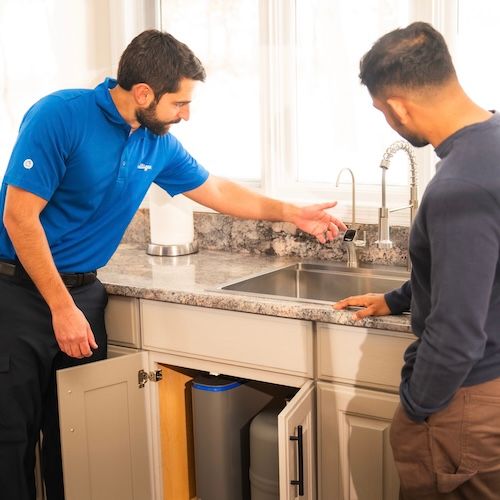
Test at your tap. Because the blend changes by zone and season, two Oxnard homes can be 15 gpg apart on the same day. Culligan of Oxnard/Ventura’s free in-home test takes about 20 minutes and measures hardness along with chlorine or chloramine, total dissolved solids, pH and iron. That number determines the size of softener your home needs. Details are on our water testing page.
FAQs about Ventura County water hardness
How hard is the water in Oxnard, CA?
The City of Oxnard’s 2023 report lists 103 to 557 ppm, averaging 319 ppm, which is about 6 to 33 grains per gallon and roughly 19 gpg on average. United Water Conservation District groundwater that makes up about a third of the supply tested 540 ppm in 2025. Anything over 10.5 gpg is classified as very hard.
Will a pitcher filter soften water in Camarillo?
No. Pitcher filters address taste and certain drinking-water contaminants, not calcium and magnesium, and they treat only the water you pour through them. Scale forms in the water heater, dishwasher and shower, which a pitcher never touches. Softening the whole house takes an ion-exchange softener or a Portable Exchange Tank.
Does Oxnard or Calleguas soften the water?
No. Both treat water to meet drinking water standards, which do not include hardness. Oxnard’s desalter lowers hardness in the portion of city well water that passes through it, and blending with imported water helps, but the finished supply is still hard. Homeowners who want soft water install their own system.
Start with a free hard water test from Culligan of Oxnard/Ventura
Culligan of Oxnard/Ventura has been softening Ventura County and south coast water for decades from our office on South Rose Avenue in Oxnard. Our technicians work on Oxnard and Camarillo city water, Calleguas water in Thousand Oaks and Simi Valley, Cachuma water in Santa Barbara, Goleta and Carpinteria, and private wells in Ojai, Somis and the Santa Rosa Valley every week, so we know the hardness patterns in each area and how local sewer rules affect the choice of system.
When you schedule a free in-home test, a local specialist measures your water at the tap, explains the results plainly and, if a softener or Portable Exchange Tank makes sense, lays out rental and purchase options with a written quote. No obligation.
Ready for better water? Schedule your free in-home water test and consultation with Culligan of Oxnard/Ventura today.