Quick answer: Yes, well water in Horry and Georgetown counties can be safe to drink, provided it is tested and, where the results call for it, treated. No utility or agency does that for you; the SC Department of Environmental Services permits well construction but states that it does not regulate private well water quality. Groundwater on the Grand Strand ranges widely. The U.S. Geological Survey found shallow wells here running from acidic, iron-rich and nearly mineral-free to very hard, while deeper Black Creek wells carry naturally high fluoride, sodium and, in places, chloride. Clemson Extension recommends a comprehensive test when you acquire a well and coliform, nitrate and total dissolved solids every year after.
On the beach, everyone from Little River to Pawleys Island is on Grand Strand Water & Sewer Authority or a city system. Twenty minutes inland toward Longs, Aynor, Loris or Bucksport, or south into Plantersville and the Carvers Bay side of Georgetown County, wells are still ordinary. Statewide, SC DES reports that slightly more than 20 percent of South Carolinians depend on individual wells, and the rural halves of these two counties are where that figure lives locally. GSWSA’s rural water program has extended public water to more than 3,000 rural Horry County homes, but many remain on their own supply.
Municipal water vs. private well water: what is the difference?
Public systems are bound by federal standards, tested on a schedule and required to report results. Private wells are not covered by the Safe Drinking Water Act. South Carolina’s rules govern how a well is drilled and by whom, a certified driller, but once the water is flowing, testing and treatment belong to the homeowner.
Groundwater quality here changes over short distances. The Grand Strand sits on layered sediments: a shallow system of sand, shell and limestone 60 to 400 feet thick in the Peedee and Black Mingo formations and younger deposits, then 200 to 300 feet of clay, then the deep sands the state now calls the Crouch Branch and McQueen Branch aquifers, long known locally as the Black Creek and Middendorf. A 150-foot well and a 700-foot well on the same road drink from different worlds.
Quality also changes over time. Heavy rain and the river flooding this county knows well can carry bacteria into a wellhead. A pump or casing that ages lets sediment in. Pumping across the region has lowered water levels in every aquifer under both counties, according to SC DES’s 2023 groundwater evaluation, which also cites saltwater intrusion into wells near North Myrtle Beach as one reason the state created the Waccamaw Capacity Use Area. Culligan of Myrtle Beach has treated well water across both counties for decades; these are the issues that matter most here.
Common well water problems around Myrtle Beach
1. Iron
What homeowners notice: Orange-brown stains in toilets, tubs and the washing machine, a metallic taste, and water that pours clear but turns rusty in a glass left out.
What causes it: Iron dissolves out of the sand and sediment that make up the shallow aquifers. USGS sampling across the Grand Strand found iron from 5 to 35,000 micrograms per liter, generally under 2,000, with many parts of the aquifers above the 300 microgram secondary standard. The agency’s statewide review calls the iron standard the one most commonly exceeded in South Carolina’s shallow wells.
Why it matters: Iron is a nuisance rather than a health hazard, but it stains everything it touches, fouls softener resin and feeds iron bacteria that leave slime in toilet tanks.
How to fix it: An Aquasential® Smart High Efficiency Iron-Cleer® filter or an Iron-OX5 system, sized to the iron level and pH. When hardness comes along with the iron, as it often does, the Softener-Cleer treats both in one unit.
2. Acidic water
What homeowners notice: Blue-green stains in sinks and tubs, a metallic taste, pinhole leaks in copper lines.
What causes it: Shallow groundwater with little dissolved mineral has nothing to buffer the carbon dioxide it absorbs from soil. USGS measured pH from 5.2 to 6.9 in Grand Strand shallow wells with dissolved solids under about 200 mg/L, below the 6.5 floor of the secondary standard.
Why it matters: Acidic water dissolves copper pipe and, in older homes, the lead in solder and brass. Clemson Extension flags low pH as a direct cause of lead and copper in well water.
How to fix it: A neutralizing filter on an Aquasential® Smart High Efficiency Water Filter raises pH before the water reaches your plumbing. It goes first in line, ahead of any softener or iron filter.
3. Hard water
What homeowners notice: Scale on fixtures and in the water heater, spotted dishes, soap that will not lather.
What causes it: Where the shallow aquifer contains shell and limestone, water dissolves calcium carbonate. USGS found Grand Strand shallow-well hardness from 5 to 470 mg/L as calcium carbonate, with hardness and alkalinity tracking each other, the signature of dissolving calcite. The top of that range is about 27 grains per gallon, far into the very hard class.
Why it matters: Scale shortens the life of water heaters, tankless units and appliances and raises energy use; it is the most expensive nuisance on this list.
How to fix it: An Aquasential® Smart High Efficiency Water Softener sized to your hardness and household, or a Softener-Cleer if iron is present.
4. Fluoride, sodium and chloride in deep wells
What homeowners notice: Usually nothing. High sodium or chloride can taste flat or faintly salty.
What causes it: The deep Black Creek sands hold sodium-rich clays and incompletely flushed ancient seawater. USGS reports that fluoride in the Black Creek aquifer exceeds the primary standard throughout the Grand Strand, that chloride exceeds the secondary standard in parts of it, and that sodium runs to several hundred mg/L in parts of the lower Coastal Plain. Public systems on these wells show the same pattern: Georgetown County WSD’s Carvers Bay, Red Hill and Kilsock systems exceeded the 2 ppm fluoride notification level in 2025, with sodium up to 280 ppm, and Horry County’s own planning documents note that Bucksport’s Black Creek wells exceed the state fluoride limit.
Why it matters: Fluoride above 2 ppm can mottle children’s developing teeth. Sodium matters on restricted diets. Rising chloride near the coast is the signature of saltwater intrusion, which the state has documented in the North Myrtle Beach area.
How to fix it: An Aquasential® Smart Reverse Osmosis System reduces fluoride, sodium and chloride for drinking and cooking water. Whole-house treatment for high sodium or chloride is a larger project that starts with a lab test.
5. Bacteria
What homeowners notice: Nothing. Coliform bacteria have no taste or smell, which is why annual testing exists.
What causes it: Surface water and septic effluent reaching the well through a cracked casing, a loose cap, a shallow or poorly sealed well, or flooding. Clemson recommends at least 75 feet between a well and a septic tank, 100 feet from a drain field and 150 feet from livestock or pet waste.
Why it matters: Total coliform signals a pathway for disease-causing organisms; E. coli signals human or animal waste. If E. coli is found, stop drinking the water until the well is disinfected and retested.
How to fix it: Correct the source, shock-chlorinate the well and retest. For ongoing protection, UV disinfection treats the whole house, and the Aquasential® Smart Reverse Osmosis System with the Advanced Post Tank Filter is certified under NSF P231 to reduce bacteria by more than 99.9999 percent at the kitchen tap.
6. Nitrate
What homeowners notice: Nothing; nitrate is invisible and tasteless.
What causes it: Fertilizer, septic systems and livestock operations, which describes much of rural Horry County’s tobacco and row-crop country around Aynor, Loris and Green Sea. Shallow wells are more exposed than deep ones.
Why it matters: Nitrate above 10 mg/L is a health risk for infants, and Clemson notes that boiling concentrates it rather than removing it.
How to fix it: The Aquasential® Smart Reverse Osmosis System for drinking water, or a Nitrate Reduction Conditioner for whole-house treatment.
Two more that come up: grit from a worn well screen, handled by a whole-house sediment filter, and rotten-egg odor from hydrogen sulfide, which a Sulfur-Cleer® or Sulfur-OX3 system treats when testing confirms it is in the well rather than the water heater.
How to check your well water quality
Watch for signs. Orange or blue-green stains, grit, scale, odors and any change after a storm all deserve a test.
Use the state’s resources. SC DES sells a coliform bacteria kit and a metals-and-minerals kit covering alkalinity, calcium, chloride, copper, hardness, iron, lead, magnesium, manganese, nitrate, pH and zinc, with fluoride, sodium and total dissolved solids as add-ons, through its regional offices and county health departments. It also runs a PFAS assessment program for private wells by application. Clemson’s Home and Garden Information Center explains what each result means.
Test on a schedule and after events. Clemson’s guidance: a comprehensive panel when you take over a well or have no recent results, then coliform, nitrate and total dissolved solids every year, and a bacteria and nitrate retest after flooding, well repairs or any change in taste, color or odor. Test sooner if an infant or a pregnant household member will drink the water.
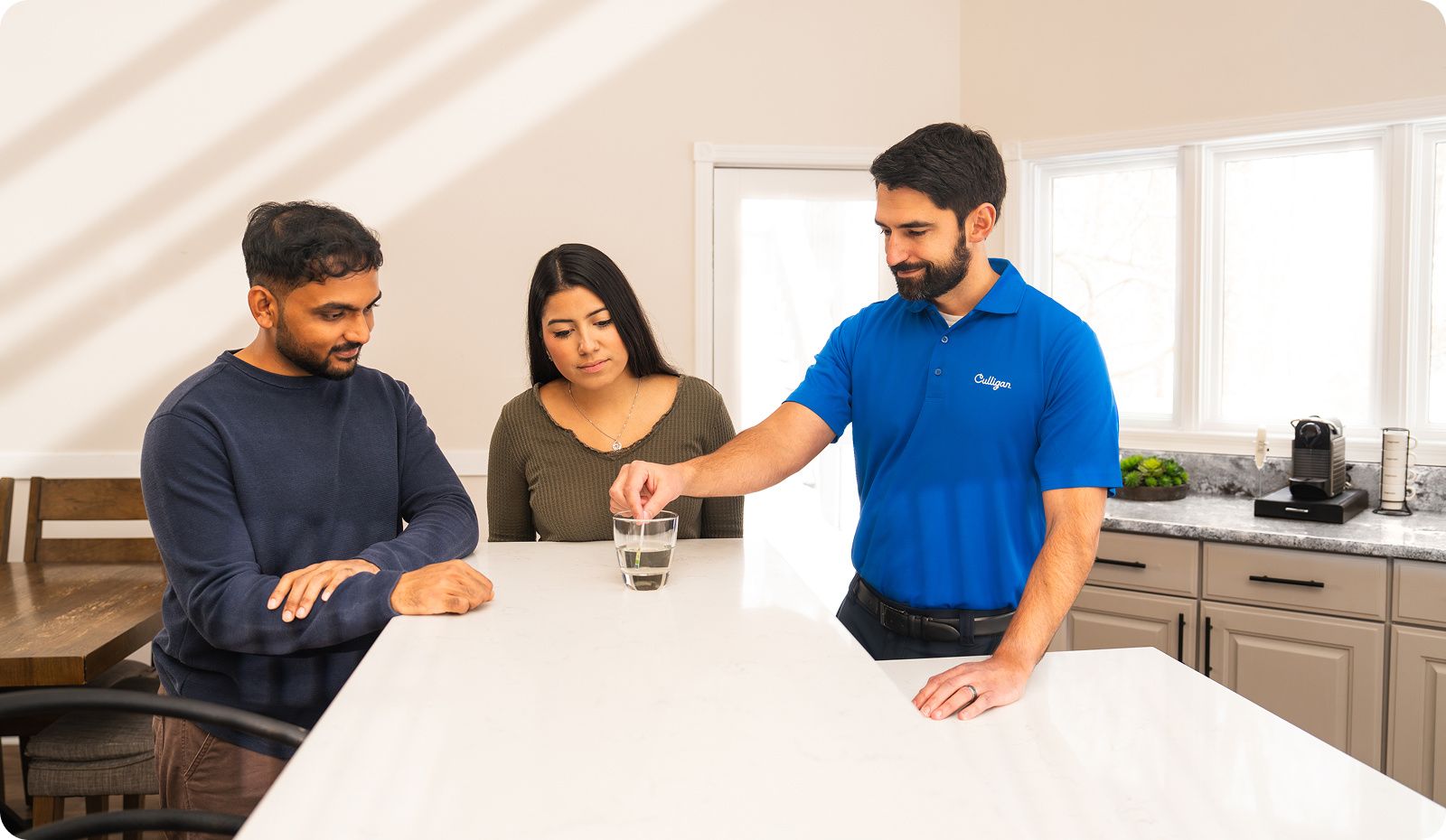
Get a professional read. Our free in-home test measures hardness, iron, pH, total dissolved solids and chlorine on the spot, and we collect samples for certified lab analysis of bacteria, nitrate, lead, arsenic and PFAS. We will also sit down with a state lab report and translate it into a treatment plan.
Local well water expertise from Culligan of Myrtle Beach
Every well is its own case. For decades, Culligan of Myrtle Beach has treated wells across rural Horry and Georgetown counties, in Longs, Loris, Aynor, Bucksport, Conway’s outskirts, the Highway 90 and 905 corridors, Plantersville and the Carvers Bay side of Georgetown, as well as the occasional older well still in service near the beach.
Our technicians read your results, tell you which problems are cosmetic and which are health-related, and recommend treatment in the right order: neutralize acidity first, then remove iron and hardness, then disinfect and polish drinking water. Rental and purchase options are both available, and we handle installation, salt delivery, filter changes and service afterward. Our well water page has more on the equipment.
Ready for better well water? Schedule your free in-home water test and consultation with Culligan of Myrtle Beach today.
Frequently asked questions about private wells in the Myrtle Beach area
What aquifer do Myrtle Beach-area wells draw from?
Shallow wells tap sand, shell and limestone of the Peedee and Black Mingo formations and younger deposits, typically within the top 400 feet. Deeper wells reach the Crouch Branch aquifer, long called the Black Creek, and below it the McQueen Branch, or Middendorf. Depth decides the chemistry: shallow water trends acidic and iron-rich, deep water trends alkaline with high fluoride and sodium.
How often should I test a well in Horry or Georgetown County?
Every year for coliform bacteria, nitrate and total dissolved solids, per Clemson Extension, plus a full panel when you take over a well and a bacteria and nitrate retest after flooding or well work.
Why does my well water turn orange after it sits?
Dissolved iron oxidizes on contact with air and falls out as rust-colored particles. USGS found iron above the 300 microgram per liter standard across much of the Grand Strand’s shallow aquifers. An iron filter sized to your test result stops the staining.
Can saltwater get into my well near the coast?
It can. SC DES cites saltwater intrusion into wells near North Myrtle Beach as a reason the Waccamaw Capacity Use Area was created, and USGS notes chloride above the standard in parts of the Black Creek aquifer and in shallow wells near filled channels and the Intracoastal Waterway. Rising chloride or total dissolved solids on an annual test is the early warning.