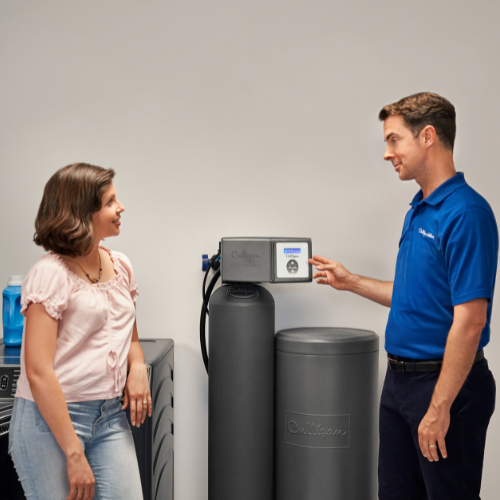
Quick summary: A water softener leaking from the bottom is not always caused by a cracked tank. Water around the base can result from condensation, a leaking brine tank, drain line issues or valve connection leaks. Putting the system in bypass and identifying the source of the leak can help prevent additional water damage while arranging service.
Water on the floor around a water softener can feel urgent, especially when it looks like it is coming from the base of the tank. But a water softener leaking from the bottom is not always a cracked resin tank. Condensation, a cracked resin tank, a brine tank issue, a drain line problem or a leak near the control valve can all leave water at the base and make the softener look like it is leaking from the bottom.
If the water softener system appears to be the source, the safest first step is to put the unit on bypass using the bypass valve, then arrange service. Putting the system on bypass may help reduce additional leaking while you arrange service because it stops the flow of water through your softener.
This guide explains what water around a water softener might mean, what to check for and when to contact your local Culligan water expert.
Why your water softener may look like it is leaking from the bottom
Water at the base does not always mean the tank itself is leaking. A leak may start higher on the unit and run down the tank. It may come from the brine tank, the drain line or a nearby floor drain. In humid spaces, condensation can also collect on the tank or copper pipe and drip to the floor.
The true source may be:
- Condensation on the tank or nearby pipes
- Water from the brine tank or salt tank
- A drain or drain line issue, including a clogged drain line or a backed-up drain
- A leaking connection near the valve area
- Less commonly, a cracked tank
Understanding the parts of a water softener
To better understand if and/or why your water softener is leaking, you’ll need to know the different parts of the system.
Most water softeners include:
- Resin tank: The main tank where resin beads capture the calcium and magnesium minerals that cause hard water minerals
- Brine tank: The tank that holds salt and water solution used for regeneration
- Control valve: The valve assembly that manages water flow through the softener
- Drain line: The hose or line that flushes the hardness minerals away during regeneration
- Bypass valve: The valve that stops water flow through the softener when soft water isn’t required or when service is needed
In a typical water softener system, water enters the resin tank first. Resin beads attract the calcium and magnesium that cause hard water, then the system rinses the resin beads with the brine solution so they can continue effectively softening your water.
Common causes of water around the base of a water softener
If you’re noticing water pooling near your system, several common issues could be the cause.
Condensation on the tank or nearby pipes
Condensation is one of the first possibilities to consider, especially if your softener is in a basement, garage or humid utility area. Cold water entering the tank can cool the outside surface. When warm, humid air contacts that surface, moisture can form on the tank or nearby pipes. This moisture can collect at the base of the unit and be mistaken for a leak.
If the tank exterior, nearby pipe or surrounding plumbing feel damp but you do not see a steady drip from the unit, condensation may be the reason.
Condensation on the tank or nearby pipes
Condensation is one of the first possibilities to consider, especially if your softener is in a basement, garage or humid utility area. Cold water entering the tank can cool the outside surface. When warm, humid air contacts that surface, moisture can form on the tank or nearby pipes. This moisture can collect at the base of the unit and be mistaken for a leak.
If the tank exterior, nearby pipe or surrounding plumbing feel damp but you do not see a steady drip from the unit, condensation may be the reason.
A leaking brine tank
Sometimes, a leaking water softener is actually a brine tank issue. The brine tank, or salt tank, sits next to the resin tank and stores the salt and water used during regeneration.
If water is coming from the brine tank, you may notice white salt residue or buildup on the floor after the water evaporates. A punctured brine tank, loose fittings, a float valve problem or an unusually high water level may all contribute to water around this area.
A drain line or nearby drain issue
The drain line carries water away from the softener during regeneration. If the hose is loose, kinked, blocked or positioned incorrectly, water may collect near the unit. A clogged drain line or overflowing floor drain can also make it look like the bottom of the water softener is leaking.
You should avoid disconnecting or rerouting the drain line yourself. Try to clear or reroute the drain line by disconnecting the system. A professional can inspect the setup and determine whether the issue is with the softener, the hose, the drain or another part of the plumbing system.
A leaking connection near the control valve
Some leaks happen near the control valve, where the valve assembly meets the tank or connects to nearby plumbing. Moisture near the top of the unit may run downward, making it appear as though the softener is leaking from the bottom.
In some cases, valve-area leaks, seals or loose fittings may be repairable by a technician. However, this is not an area to take apart on your own. Water pressure and plumbing connections can turn a small leak into a larger problem.
A cracked tank
A cracked tank is less common, but it is more serious. If the resin tank itself is leaking, replacement is usually required. A cracked tank may happen after freezing and thawing, unusually high pressure or physical impact.
A cracked resin tank typically requires replacement rather than repair. If moisture seems to be coming from the body of the tank itself, place the softener on bypass and contact a professional for evaluation.
How to identify the source of water
You do not need to disconnect parts or open the softener to gather helpful information. Instead, look for signs you can relay to your service provider:
- The tank or nearby pipes are wet, which may point to condensation.
- White salt residue appears near the brine tank.
- Water is collecting near a drain, hose or nearby appliance.
- Moisture seems concentrated near the valve area.
- Water continues to collect after you have dried the area.
- The softener appears to be leaking even when nearby plumbing is dry.
Also check whether another appliance may be involved. A water heater, washing machine connection, water filter, sump area or other plumbing system component can create water around the softener.
What to do first if your water softener is leaking
If the water softener appears to be the source of the leak, put the unit on bypass. The bypass valve allows water to move around the softener instead of through it. This can help limit additional leaking while you arrange service.
Bypassing the system does not repair the issue. It is a temporary step that may reduce the chance of further water damage while a professional determines the cause.
After activating bypass mode, contact the installer, a plumber or your local Culligan water professional. Avoid disconnecting the water softener from the plumbing, removing the valve assembly or attempting to patch the tank. These steps can make the leak worse and may create a larger water damage issue.
Can you repair a leaking water softener?
Because water softener repair involves plumbing connections and water pressure, avoid taking the system apart or attempting a DIY repair. A technician can inspect the softener, test the relevant connections and determine whether water softener repair or replacement makes more sense.

Explore water softening solutions.
When to call a professional
Call for service when the water softener appears to be the source of the leak or the source is unclear. You should also contact a professional if:
- You have placed the unit on bypass.
- Water continues to collect around the base.
- The brine tank, drain line or valve area appears to be leaking.
- You see signs of a cracked tank or damaged hose.
- The leak may be connected to high pressure or a plumbing issue.
- You are unsure whether the problem is the softener or a nearby appliance.
Water softeners are connected to your home’s water supply, so even a small leak deserves attention. Prompt service can help protect the surrounding flooring, walls and nearby water-using appliances from damage.
Water softener leaking FAQs
Why is my water softener leaking from the bottom?
Your water softener may look like it is leaking from the bottom because water is collecting around the base. The source may be condensation, the brine tank, a drain line issue, a leaking valve connection, nearby plumbing or a cracked tank.
How much does it cost to fix a leaking water softener?
The cost depends on the source of the leak, the age of the softener and whether parts can be serviced or the tank needs replacement. A professional can inspect the unit and explain whether repair or replacement is the best option.
Should I put my water softener on bypass if it is leaking?
Yes. If the softener appears to be leaking, putting it on bypass can help limit additional leaking while you arrange professional service. Bypass is a temporary step, not a repair.
Find your local Culligan water professional
Not every apparent bottom leak means your water softener has failed completely. The issue may be condensation, a brine tank problem, a drain line issue or a serviceable connection near the valve. The safest next step is to put the system on bypass and schedule professional service.
Your local Culligan water expert can inspect your system, help determine the source of the leak and recommend the right next step, whether that means service, maintenance or choosing a new water softener.
Schedule your water softener service appointment to get started, or explore water softener replacement options.