Quick answer: It depends on where your water comes from, and in the Copper Country that is almost always a well. The Village of South Range, the Adams Township Water Authority (which supplies Hancock), the City of Houghton and the Village of Lake Linden all pump groundwater, and none publishes a finished-water hardness figure. Hardness varies by well field and by what happens between the plant and your tap, so the utility report will not give you your number. Private wells are clearer: Michigan Geological Survey testing in Baraga County found most Jacobsville Sandstone wells above 100 mg/L (about 6 grains per gallon), and Ontonagon County groundwater ranged from 65 to 650 mg/L, which the state called hard to very hard. A free in-home test gives your own tap’s number in about 20 minutes.
If you are asking whether the water is hard in South Range, Houghton or Hancock, look at your own house first. A film on the shower door that comes back a day after you scrub it. A chalky ring at the base of the kitchen faucet. Spotted glasses out of the dishwasher. Skin that feels tight after a shower once the furnace runs from November through April. Each is calcium and magnesium left behind as water evaporates, and each is what a softener stops.
Is municipal or well water harder in the Copper Country?
Across the Keweenaw the usual rule, that well water is harder than city water, is only half true, because most of the city water is well water too.
The Village of South Range pumps from three wells, each more than 200 feet deep. Hancock buys its water from the Adams Township Water Authority, whose three wells near Painesdale are also more than 200 feet deep. The City of Houghton draws groundwater from beneath the old copper stamp sands along Portage Lake and runs it through a treatment plant that removes iron and manganese before chlorinating it. Lake Linden’s village wells reach 207 to 227 feet. None of these systems softens. Whatever calcium and magnesium the aquifer carries goes straight into the mains and on to your water heater.
The exceptions are on the big water. L’Anse and Baraga treat Keweenaw Bay water, and Ontonagon has used a Lake Superior intake since the mid-1960s. Those utilities do not publish a hardness number either, so the answer for a home in L’Anse or Ontonagon is the same as everywhere else here: check the utility’s annual report for system data, and test your own tap for your home’s number.
Private wells are where hardness runs highest, and they serve a large share of the region. USGS county water-use data put self-supplied households at about one in five Houghton County residents, nearly half of Baraga County, a third of Ontonagon County and four in five Keweenaw County residents. Glacial drift supplies roughly half of the wells in Baraga County and about 40 percent in Ontonagon County; the rest go into bedrock, most often the Jacobsville Sandstone that underlies the Keweenaw shore and southern Ontonagon County, or fractured volcanic and metamorphic rock in the Trap Range and around L’Anse. The longer and deeper groundwater sits in those formations, the more calcium and magnesium it dissolves. The Michigan Geological Survey’s Baraga County groundwater study found Jacobsville wells ranging up to 520 mg/L, with most above 100 mg/L; its Ontonagon County study found 65 to 650 mg/L and noted that deeper volcanic-bedrock wells were often very hard and high in iron.
No utility treats or monitors a private well. Hardness, iron and everything else in it are the owner’s to measure, and two wells on the same road can test very differently depending on depth and formation.
Hard water problems we see in South Range, Houghton and Hancock
Hardness is not a health issue, which is why utilities are not required to report it. It is a maintenance and comfort issue, and where the water heater runs hard six months a year it is an expensive one. These are the three complaints we hear most.
1. Scale in water heaters and appliances
What homeowners notice: A water heater that pops and rumbles, longer recovery after a shower, a dishwasher that leaves grit, and a coffee maker that needs descaling monthly.
What causes it: When hard water is heated, dissolved calcium and magnesium fall out of solution and bond to the hottest surfaces: heating elements, tank bottoms, boiler coils and hot-water lines.
Why it matters: Scale is an insulator. It makes a water heater or boiler burn more energy for the same hot water, shortens the life of elements and tanks, and narrows hot-water lines. Homes in Houghton and Hancock heated with hot-water boilers feel this most.
2. Film, spots and soap scum
What homeowners notice: Spotted glassware, a white haze on the shower door, chalky crust around faucets and showerheads, and soap scum that needs an acid cleaner to move.
What causes it: Calcium and magnesium react with soap to form an insoluble curd instead of lather, and they crust wherever water evaporates.
Why it matters: Hard water makes you use more soap, detergent and shampoo for the same result, and the residue is what you spend Saturday morning scrubbing.
3. Dry skin and dull hair
What homeowners notice: Skin that feels tight and itchy after bathing, hair that is dull or hard to rinse clean, and winter dryness that flares when the heat is on.
What causes it: Soap does not rinse cleanly in hard water, so a film of soap and mineral stays on skin and hair. In a Keweenaw winter, when indoor humidity is already low, that film makes dryness worse.
Why it matters: People blame the soap or the weather and never connect it to the water. A softened shower is usually the first thing a new softener owner notices.
A whole-house softener such as Culligan’s Aquasential® Smart High Efficiency Water Softener removes calcium and magnesium where water enters the home, so every fixture and appliance downstream gets soft water. For well homes that also have iron, common in the drift and the Jacobsville Sandstone, the Softener-Cleer handles both in one system. See softener options for South Range and the Keweenaw.
How to check your home’s water hardness
Read the utility report, knowing what it will not tell you. South Range, Adams Township, Hancock, Houghton Township and Ontonagon publish annual water quality reports, and Portage Township’s report carries the City of Houghton’s data. They are worth reading for chlorine, lead, arsenic and PFAS. None lists hardness, because hardness is not a regulated contaminant.
Look for the signs. Scale on the showerhead, spots on glassware, crust at the faucet base and a noisy water heater all point the same direction.
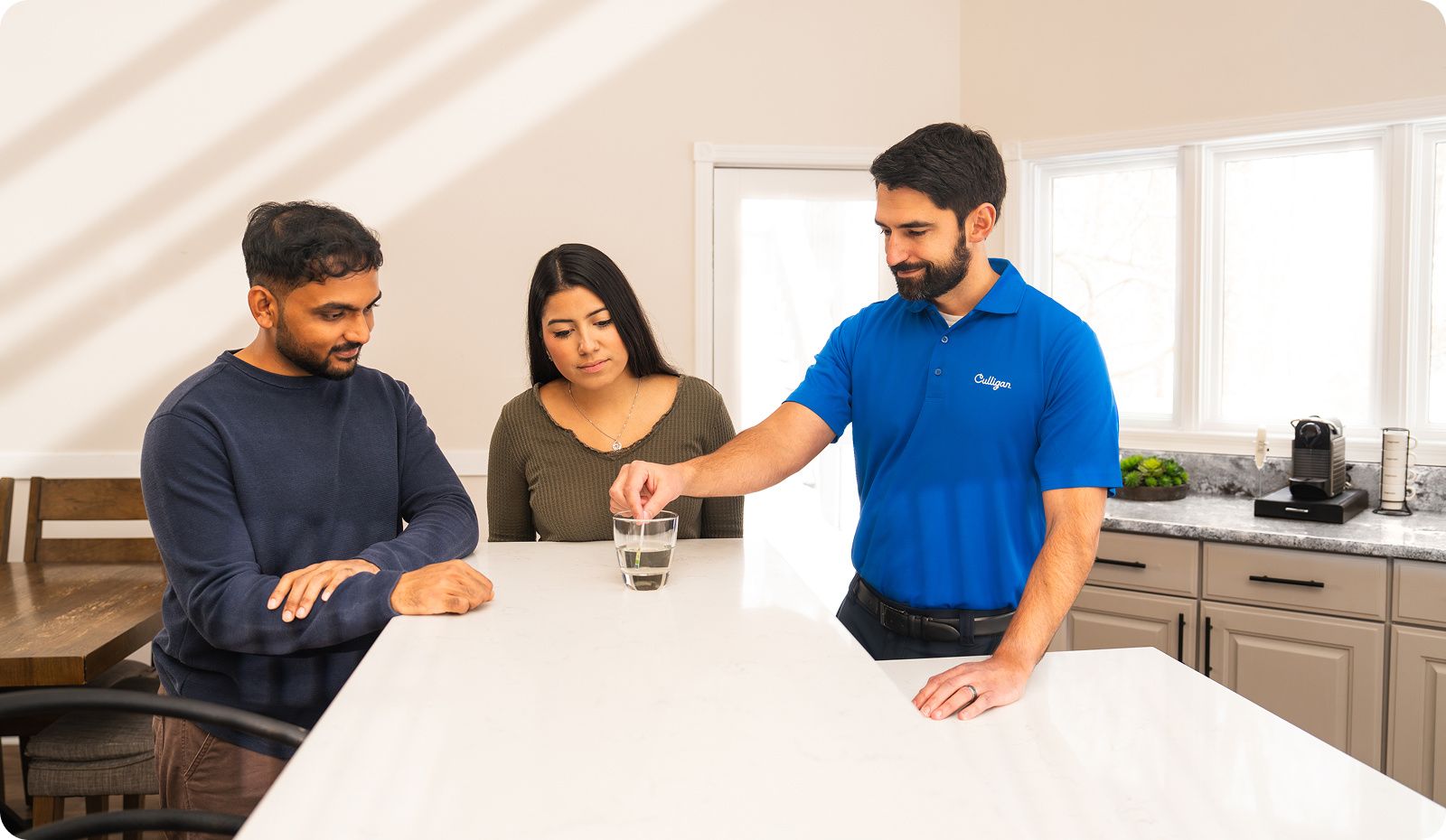
Test the tap. This is the only way to get a number for your house. Our free in-home test measures hardness in grains per gallon on the spot, along with iron, chlorine, pH and total dissolved solids, and we explain whether a softener is worth it for your household. If the answer is no, we say so.
Frequently asked questions about hardness in South Range and the Copper Country
How hard is the water in South Range, Michigan?
The village does not publish a finished-water hardness figure, and neither do Adams Township, Hancock or Houghton. Private wells in the Jacobsville Sandstone commonly test above 6 grains per gallon according to Michigan Geological Survey data, and some run much higher. A free in-home test gives your home’s number.
Will a pitcher filter soften water in Houghton or Hancock?
No. Pitcher filters are carbon units that improve taste and reduce chlorine. They do not remove calcium or magnesium, and they only treat drinking water. Scale in the water heater and spots on dishes need a whole-house softener.
Does the City of Houghton or South Range soften the water?
No. Houghton treats for iron and manganese and chlorinates; South Range and Adams Township chlorinate. None removes hardness minerals.
Is well water in Baraga or Ontonagon County usually hard?
Often. The Michigan Geological Survey found most Jacobsville Sandstone wells in Baraga County above 100 mg/L (about 6 grains per gallon), some over 500 mg/L, and described Ontonagon County groundwater as hard to very hard. Drift wells vary widely.
How do I know if hard water is damaging my appliances?
Listen to the water heater: popping or rumbling means scale on the bottom. Check the dishwasher spray arm for white crust and the kettle for flakes. If the showerhead needs vinegar twice a year, your appliances see the same deposit inside.
Start with a free hard water test from Culligan Water of South Range
Culligan Water of South Range, part of Culligan of Upper Michigan, has been solving hard water for homeowners across the Copper Country for decades, from South Range, Painesdale and Chassell to Houghton, Hancock, Dollar Bay, Lake Linden, Calumet and Laurium, up to Eagle River and Copper Harbor, and over to Baraga, L’Anse and Ontonagon.
Our technicians work every week with homes on South Range, Adams Township, Hancock and Houghton water and with private wells in the drift and the Jacobsville Sandstone. That is how we know which wells tend to bring iron along with hardness and how to size a softener for a household here.
When you schedule a free in-home water test, a local specialist measures your hardness, iron, chlorine, pH and TDS and explains the results. If a softener makes sense, we walk through the Aquasential® Smart High Efficiency, Select Series and Advantage options, rental and purchase, with salt delivery and service if you want them, and you get a written quote before you decide.
Ready for better water? Schedule your free in-home water test and consultation with Culligan Water of South Range today.