Quick answer: There is no official hardness number for LaGrange city water. The City of LaGrange draws from West Point Lake on the Chattahoochee River, and its 2025 water quality report covers the contaminants federal rules regulate. Hardness is not one of them, so the report does not list it. Hardness varies by source and by what happens between the plant and your tap, and the roughly 20,000 Troup County residents on private wells draw from fractured Piedmont rock that changes from one property to the next. The city’s own guide to water concerns does talk about calcium and magnesium scale in pipes and mineral deposits in water heaters. The reliable way to know your number is a test at your own sink.
Most people around LaGrange do not start by asking about grains per gallon. They start with a showerhead that sprays sideways, a white ring in the toilet bowl, glasses that come out of the dishwasher cloudy, or a water heater that pops and rumbles. Those are the everyday signs of minerals in water, and they are the reason a hardness test is usually the first thing our technicians run.
This guide explains what the city does and does not publish, how lake water and well water differ across Troup County, what minerals do inside a house, and how to get a real number for your home in LaGrange, Hogansville, West Point, Mountville or Pine Mountain.
What the City of LaGrange reports, and what it leaves out
The City of LaGrange Utilities publishes an annual Consumer Confidence Report. The 2025 edition covers every sample taken from January through December 2025 and lists no violations. It reports chlorine, fluoride, nitrate, disinfection byproducts, lead, copper, iron, manganese, sodium and several PFAS compounds. It does not report hardness or alkalinity.
That is common. Hardness is an aesthetic and plumbing concern rather than a health standard, so the Environmental Protection Agency does not set a limit for it and utilities are not required to print it. A missing number is not a sign of a problem or of the absence of one. It simply means the answer has to come from somewhere else.
A few figures in the report are still worth knowing. Sodium was measured at 24.2 parts per million in October 2025. Iron was below detection on average. Manganese averaged 0.80 parts per billion, though one reading reached 100 parts per billion, above the 50 parts per billion secondary guideline that relates to staining and taste. None of these is hardness, but they all add to the total dissolved solids that leave marks on fixtures.
The city’s Guide to Common Water Quality Concerns fills in part of the picture. It explains that calcium and magnesium carbonate, which it calls pipe scale, can collect inside plumbing and flake loose after the water is shut off and turned back on for a repair. It also notes that water heaters gather sand-like mineral deposits and recommends flushing the tank at least once a year.
Lake water, river water and well water in Troup County
Water in the LaGrange area reaches homes three ways, and each can test differently.
LaGrange city water. The city pumps from West Point Lake, then disinfects, purifies and filters it. The state’s source water assessment rated the system’s overall susceptibility to contamination as low. Lake chemistry shifts with the seasons, rainfall and how much water is moving down the Chattahoochee, so the mineral content at your tap is not a fixed value.
Neighboring systems. Hogansville’s 2025 report says the city buys its water from LaGrange and from the Coweta County Water Authority, so a Hogansville home may receive a blend. West Point treats surface water taken directly from the Chattahoochee River at its own plant. Neither publishes a hardness figure.
Private wells. According to USGS estimates of water use in Georgia, Troup County had 69,763 residents in 2015, and about 20,000 of them, nearly three in ten, supplied their own water. Those wells are drilled into the crystalline rock of the Piedmont, where water moves through fractures rather than a single uniform aquifer. Georgia EPD’s 2021 groundwater monitoring of Piedmont wells found pH from 4.81 to 8.39, iron above the secondary guideline at nine wells and manganese up to 310 micrograms per liter. Hardness from these wells varies just as widely, which is why a neighbor’s result tells you little about your own. The Georgia Department of Public Health’s well water page covers the bacteria and chemical testing every well owner should keep up with.
What minerals do inside a LaGrange home
When calcium and magnesium are present, they leave a trail through the house.
Scale on fixtures and in appliances
Heat drives minerals out of water. That is why the first and worst scale shows up in water heaters, coffee makers, kettles and dishwashers. A layer of scale on a heating element acts like insulation, so the appliance burns more energy to do the same job and wears out sooner.
Spots, film and soap that will not lather
Minerals react with soap and form a sticky curd. It clings to shower doors and tubs, dulls glassware and leaves laundry feeling stiff. Skin can feel tight after a shower and hair can look flat.
How to find your home’s hardness in LaGrange
You have three practical options.
Call the utility. The City of LaGrange lists contacts for its water and sewer operations in the annual report. Ask whether they have system data on hardness or alkalinity, keeping in mind that a plant measurement does not account for what happens in the pipes on the way to your house.
Use a test strip. Hardware-store strips give a rough range but say nothing about iron or pH.
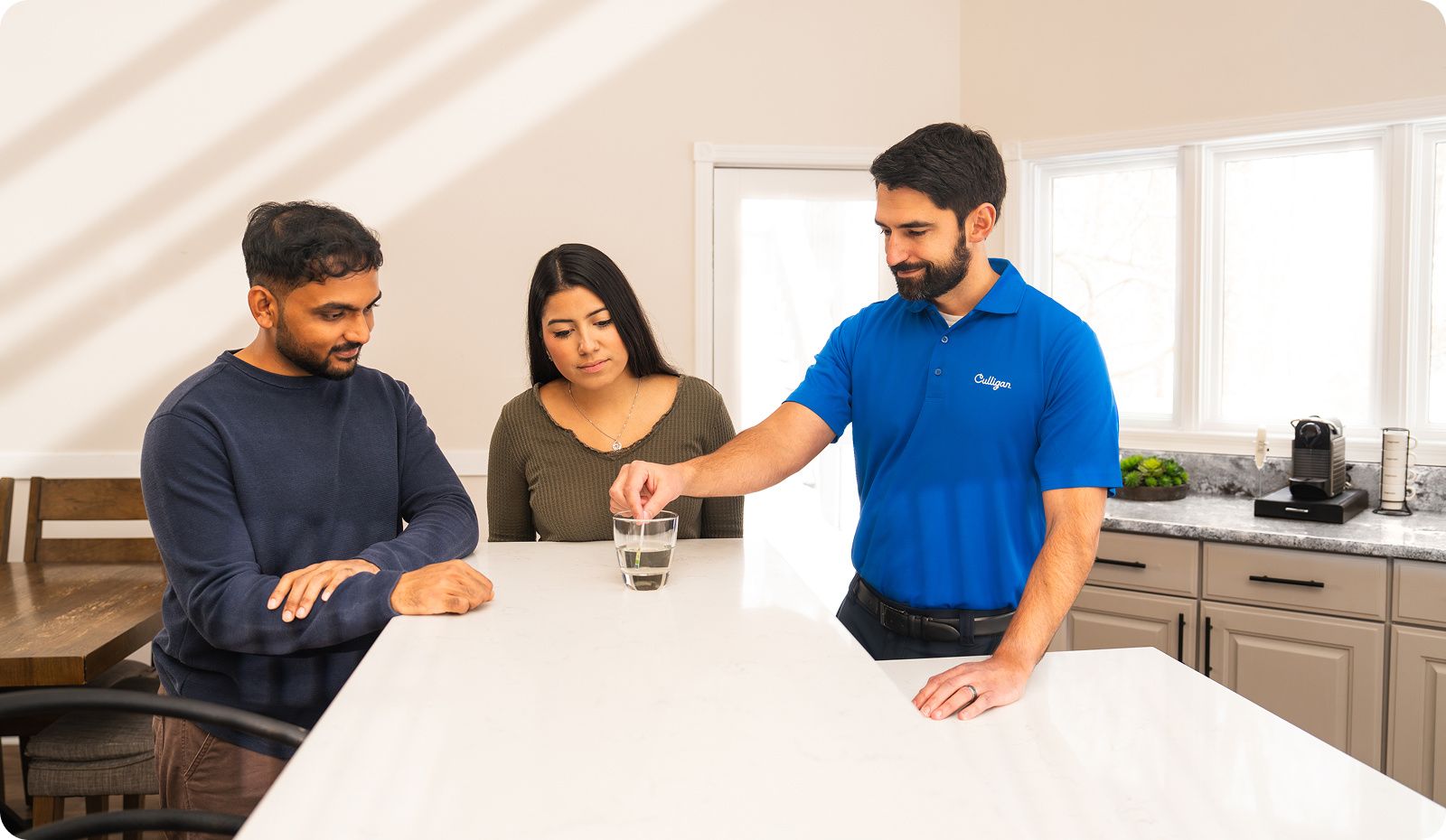
Schedule a free in-home test. A Culligan of LaGrange technician measures hardness, chlorine, total dissolved solids, pH and iron at your sink in about 20 minutes and explains the results. For wells, we can add a certified lab panel.
When you have a number, UGA Cooperative Extension’s guide to private water systems uses these bands: 3.5 to 7 grains per gallon is moderately hard, 7 to 10.5 is hard, and anything over 10.5 is very hard. To convert a reading in milligrams per liter, divide by 17.1.
What a water softener changes
A water softener uses ion exchange. Water passes through a bed of resin beads that hold sodium or potassium, and the beads trade those for calcium and magnesium. When the beads are full, the softener rinses them with brine and starts again. Where hardness is present, the result is less scale in appliances, cleaner glassware, better lather and softer-feeling laundry.
For most city homes we recommend the Aquasential® Smart High Efficiency Water Softener, which adjusts how often it regenerates to the water you actually use and alerts you when salt runs low. The Aquasential® Select Series Water Softeners cover a range of sizes and budgets, and the Aquasential® Advantage Whole Home Water Softener suits larger households. Wells with iron or manganese usually need an Iron-Cleer® or Iron-OX5 filter ahead of the softener so the resin is not fouled.
We also deliver softener salt across LaGrange, Hogansville, West Point and Pine Mountain on a schedule that matches your usage, so no one has to haul bags from the store.
FAQs about hard water in LaGrange
Why doesn’t the City of LaGrange list hardness in its report?
Hardness is not a regulated contaminant, so federal rules do not require it in the annual report. The city publishes the regulated results plus a handful of secondary and unregulated measures, including iron, manganese and sodium. For a hardness number, ask the utility for system data or test at your own tap.
Is Hogansville water the same as LaGrange water?
Not always. Hogansville buys from both the City of LaGrange and the Coweta County Water Authority, so the mix arriving at a given home can vary. A tap test in Hogansville gives you the number for your house.
Will a water softener make my water taste salty?
Not noticeably for most people. A softener adds a small amount of sodium in proportion to the hardness it removes. Households watching sodium often add a reverse osmosis system at the kitchen sink, which removes it from drinking and cooking water.
Does a softener remove the earthy taste LaGrange water has in late summer?
No. That taste comes from geosmin, released by algae in West Point Lake, and it is handled by carbon filtration or reverse osmosis rather than softening. Many homes pair a softener with a drinking water filter.
Get a free hard water test from Culligan of LaGrange
Culligan of LaGrange has served homes and businesses in LaGrange, Hogansville, West Point, Mountville, Pine Mountain and across rural Troup County for decades. We work with West Point Lake city water and Piedmont wells every week, so we know what normal looks like here and when a reading is out of line.
Your free in-home test covers hardness, chlorine, TDS, pH and iron, and if a softener makes sense you will get a written quote with both rental and purchase options. We also offer drinking water and whole-house filtration, in-home and certified lab water testing and well water treatment for homes outside the city systems.
Ready for better water? Schedule your free in-home water test and consultation with Culligan of LaGrange today.