Quick answer: Yes. Every public water system in the Daytona Beach area pumps from the Floridan Aquifer, a limestone formation that loads groundwater with calcium and magnesium. Where that water is delivered unsoftened, as it is by Deltona Water, hardness runs 12 to 17 grains per gallon, which the USGS classifies as very hard. The City of Daytona Beach, Port Orange, Ormond Beach and Edgewater soften at their treatment plants, which lowers the number but does not take it to zero, and none of them publishes a finished-water hardness figure. Private wells across Volusia and Flagler counties get the aquifer as-is. The only way to know the hardness at your own tap is to test it.
Most people in Daytona Beach meet hard water before they hear the term: the film that returns to the shower door a day after you squeegee it, the white crust on the faucet aerator, dusty-looking glasses out of the dishwasher, a water heater that has started to rumble. Each is a mineral deposit, and the minerals came up out of the ground with the water.
How much mineral depends on who treats your water. A home on Deltona Water, a home on Daytona Beach city water and a home on a private well outside DeLand can show three different hardness readings on the same afternoon. Here is why the water is hard, how the utilities handle it, how to find your own number and what a softener does about it.
Is city water or well water harder in the Daytona Beach area?
Well water, in almost every case, because nobody has softened it. But both start from the same place. The City of Daytona Beach draws from 24 wells more than 200 feet deep in the Floridan Aquifer. Port Orange runs 40 wells to roughly 300 feet into the same formation. Ormond Beach, Edgewater, DeLand and Deltona each have their own well fields, and Volusia County Water Resources and Utilities says plainly that all of its plants pump groundwater from the aquifer. There is no river or reservoir in the mix anywhere in the county.
Rain takes years to percolate through sand and limestone into the aquifer, and limestone is calcium carbonate. Water that has spent that long in contact with it comes up carrying calcium, magnesium and a dose of hydrogen sulfide. On the USGS hardness scale, anything above 180 milligrams per liter, about 10.5 grains per gallon, is very hard. Deltona’s published 12 to 17 gpg works out to roughly 205 to 290 mg/L, comfortably inside that band, and it is the best public indicator of what untreated Floridan water looks like in this part of the county.
The coastal cities do something about it at the plant. Daytona Beach lists softening as a step between ozonation and filtration at the Ralph Brennan Water Treatment Plant. Port Orange describes its Garnsey plant as a conventional lime softening facility. Ormond Beach uses lime softening and reverse osmosis, and Edgewater’s report says its water is softened to lower total hardness and alkalinity. Central softening reduces hardness but is not designed to deliver fully soft water, so customers of these systems still see film and scale, just more slowly. Deltona Water, the City of DeLand and Volusia County’s Southwest plant near DeBary do not list softening at all, while the county’s Halifax Plantation and Spruce Creek Fly-In plants use nanofiltration membranes, which do reduce hardness.
Private wells are a separate world. The USGS counted about 64,500 Volusia County residents, close to one in eight, supplying their own water, mostly in West Volusia around DeLand, De Leon Springs, Pierson and Lake Helen, and in Oak Hill and rural Flagler County. Those wells deliver raw aquifer water with no softening, aeration or monitoring unless the owner arranges it, and hardness can differ sharply between wells a quarter mile apart depending on depth. A test is the only honest answer.
Hard water problems Daytona Beach homeowners deal with
Hardness is not a health concern and no utility is required to remove it, which is why it falls to homeowners. Three complaints bring most of our Volusia County customers to us.
1. Scale in water heaters, dishwashers and washing machines
What homeowners notice: A water heater that rumbles, recovers slowly and costs more to run; a dishwasher that needs descaling; a tankless heater throwing error codes; fixtures with weaker flow than they used to have.
What causes it: Heating hard water forces calcium and magnesium carbonate out of solution. They settle on the hottest surface available, which is the heating element or the bottom of the tank.
Why it matters: Scale on an element insulates it from the water, so the heater burns more energy for the same shower, and over years the deposits shorten the life of every appliance that heats water. In a 17 gpg home that happens quickly.
2. Film on glass, spots on dishes, crust on faucets
What homeowners notice: A gray haze on shower doors and tile, spotted glassware, a white ring at the base of faucets and around the aerator, and soap scum that needs a scraper rather than a sponge.
What causes it: Calcium and magnesium bind with soap to make a sticky curd instead of lather, and they are left behind as a chalky residue when droplets evaporate.
Why it matters: Hard-water homes use more detergent, dish soap and shampoo for the same result, and the residue dulls fixtures and glass over time.
3. Dry skin, dull hair, stiff laundry
What homeowners notice: Skin that feels tight after a shower, hair that never seems fully rinsed, towels that come out of the dryer stiff and dingy.
What causes it: The same soap-and-mineral residue that coats the shower door coats skin, hair and fabric, and hard water keeps shampoo and detergent from rinsing clean.
Why it matters: That film blocks moisture, which is why many customers notice a change in skin and hair within weeks of softening. Laundry lasts longer when detergent can actually rinse out.
A whole-home softener such as Culligan’s Aquasential® Smart High Efficiency Water Softener exchanges the calcium and magnesium out of the water where it enters the house, so every fixture and appliance downstream gets soft water. For Daytona Beach, Port Orange, Edgewater and Deltona customers, who all receive chloramine-disinfected water, we typically pair the softener with a chloramine-rated filter stage to protect the resin. Smaller homes and condos often fit the Aquasential® Advantage Whole Home Water Softener or the Select Series. You can compare them on our Daytona Beach water softeners page.
How to check your water hardness in Daytona Beach
Three ways, from least to most useful.
Read your utility’s report. Daytona Beach publishes an annual water quality report on daytonabeach.gov, and Volusia County posts one per system. None of the coastal utilities prints a hardness figure; the reports describe the softening step but not the result. Deltona is the exception, with 12 to 17 gpg posted in its utility FAQ.
Look at your house. Scale on the showerhead, spots the dishwasher cannot beat, soap that will not lather, a noisy water heater. Two of those together is hard water.
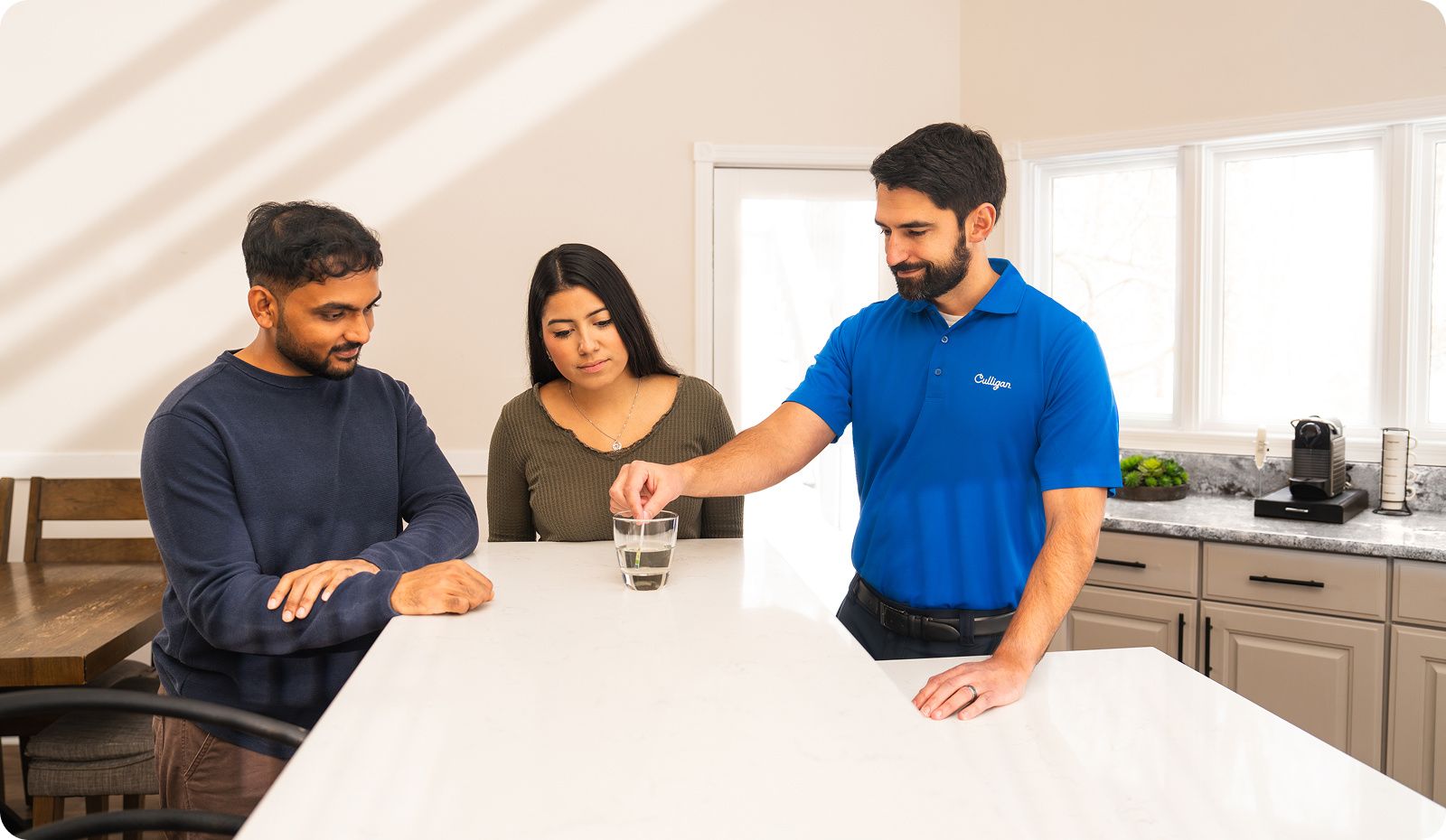
Test at the tap. This decides softener sizing. Because the cities soften to different degrees and wells vary by depth, only a measurement at your kitchen sink gives your number. Culligan of Daytona Beach’s in-home test is free, takes about 20 minutes and reads hardness along with chlorine or chloramine, total dissolved solids, pH and iron. Book it through our water testing page.
FAQs about Daytona Beach water hardness
How hard is the water in Daytona Beach, FL?
Hard to very hard, depending on your supplier. Unsoftened Floridan Aquifer water in the area runs 12 to 17 grains per gallon according to Deltona Water’s published range. Daytona Beach, Port Orange, Ormond Beach and Edgewater soften at the plant and deliver something lower, but they do not publish the number. Private wells are usually at the top of the range.
Does the City of Daytona Beach soften the water?
Partly. The city’s treatment process includes a softening step at the Ralph Brennan plant on LPGA Boulevard. That reduces hardness but is not meant to produce fully soft water, so homeowners who want to stop scale and spotting entirely add their own softener.
Will a filter pitcher fix hard water in Daytona Beach?
No. Pitchers are built for taste, not calcium and magnesium, and treat only the water you pour through them. Hardness does its damage in the water heater, dishwasher and shower, which takes a whole-home ion-exchange softener.
Is well water in West Volusia harder than Daytona Beach city water?
Usually, yes. Wells around DeLand, Pierson and De Leon Springs draw the same aquifer with no softening, and they commonly add iron and hydrogen sulfide. A Softener-Cleer combination unit, which handles hardness and iron together, is the typical fix on those properties.
Start with a free hard water test from Culligan of Daytona Beach
Culligan of Daytona Beach has been softening Floridan Aquifer water for homes in Daytona Beach, Ormond Beach, Port Orange, New Smyrna Beach, Edgewater, DeLand, Deltona, DeBary, Orange City, Palm Coast and Flagler Beach for decades. Our technicians work on city water and private wells every week and know how much hardness each utility leaves behind.
Schedule a free in-home water test and a local specialist measures your water at the tap, explains the numbers and, if a softener makes sense, lays out rental and purchase options in a written quote. Salt delivery is available to any softener customer. No obligation, and the test answers the question this article started with.
Ready for better water? Schedule your free in-home water test and consultation with Culligan of Daytona Beach today.