
Hard water could be costing your household more than you realize. Culligan estimates that hard water-related expenses can cost the average North American household over $600 a year. Yet, many households never install a water softener because they aren’t aware of the problem: hard water looks perfectly clear coming out of the tap.
The clues that you have hard water show up elsewhere, like mineral buildup around faucets, spots on shower doors and glassware, stiff laundry, or skin and hair that feel dry after a shower. While you might try a stronger laundry detergent, more fabric softener or another cleaning product, they won’t solve the root cause of the issue—the water.
This guide will help you recognize the signs of hard water, understand how to test your hardness level and decide whether you need a water softener, a filter or both.
What is hard water?
Hard water is defined by the presence and level of dissolved calcium and magnesium. As groundwater moves through limestone, chalk and other mineral-rich rock, it dissolves these minerals and carries them into wells and municipal supplies. Hardness levels vary by region and can differ even between nearby homes, especially if they have private wells.
Hardness is commonly measured in grains per gallon (gpg) but also may be reported in milligrams per liter (mg/L) or parts per million (ppm). The table below pairs the Water Quality Association’s hardness classification levels with Culligan’s recommendation for each level.
| Classification | Grains per gallon (gpg) | Culligan recommendation |
|---|---|---|
| Soft | Less than 1.0 | Not needed |
| Slightly hard | 1.0 to 3.5 | Optional |
| Moderately hard | 3.5 to 7.0 | Recommended |
| Hard | 7.0 to 10.5 | Highly recommended |
| Very hard | More than 10.5 | Highly recommended |
How does a water softener work?
A water softener treats water as it enters your home, removing the calcium and magnesium that cause hardness. Inside the system, water flows through a bed of resin beads that capture these minerals and exchange them for sodium ions—a process called ion exchange. The softened water then flows to the taps and appliances throughout your home.
7 signs you need a water softener
The more calcium and magnesium in your water, the more noticeable the effects around your home become. While a water test is the only way to know the exact hardness, here are some signs that a softener would help.
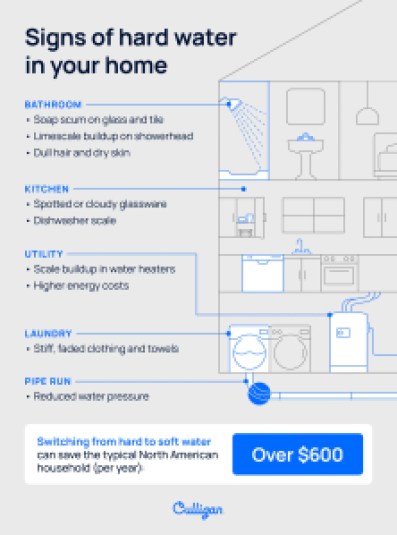
1. Spots and film on dishes and glassware
Spotted glassware is one of the first signs of hard water you might notice. Those spots are mineral deposits left behind as the water dries, with calcium and magnesium forming a chalky white residue on the surface. (And running a second cycle won’t help, since the rinse water carries the same minerals as the first.)
2. Soap scum and buildup on fixtures
Buildup in the bathroom can appear in multiple forms. Soap scum on shower doors forms when soap reacts with hard water to form a sticky residue that clings to tubs and sinks instead of rinsing away. On fixtures and showerheads, a hard, white substance called limescale builds up from mineral deposits that are left behind when hard water heats up or evaporates. Both can be difficult to remove (and return regardless of how frequently you’re cleaning).
3. Dry skin and hair
The same residue that collects on your tub and fixtures also collects on your hair and skin. When you shower, soap and shampoo combine with calcium and magnesium to create buildup that doesn’t completely rinse off. This buildup can leave your skin feeling dry or itchy and your hair stiff or dull. Solutions do matter; in fact, 9 in 10 water softener owners surveyed noticed an improvement in their hair and skin.
4. Stiff or dingy laundry
Towels that feel stiff or scratchy after a full wash and dry cycle are a common sign of hard water. Calcium and magnesium bind to the detergent before it can lift dirt from fabric, so more detergent is often needed to achieve the same result.
This hard water residue also settles into the fibers, which can leave your clothes and towels feeling rough and cause colors to look dull and faded over time. Culligan data shows that 50% less detergent is needed for laundry when using soft water over hard water.
5. Scale buildup in appliances
Each cycle that runs on hard water can leave behind a small amount of limescale inside dishwashers and washing machines, with the buildup accumulating over time. A dishwasher that leaves residue on dishes and interior surfaces may also have scale inside the machine.
Descaling may provide temporary relief, but the buildup can recur as long as hard water continues entering the machine. Culligan data shows homeowners can see up to a 50% increase in washing machine lifespan when using soft water instead of hard water.
6. Reduced water pressure
If your shower pressure has decreased over time, limescale from hard water is a likely reason. Clogged faucets and showerheads are one of the first noticeable signs of hard water, since their openings are the smallest. Soaking a showerhead in vinegar can dissolve the buildup, though scale typically reforms if the water supply remains hard.
The same process occurs inside your pipes, but it takes more time for the effects to be noticeable.
7. Higher energy and replacement costs
Hard water can make your water heater less efficient, increasing your utility costs. In a gas tank water heater, scale can collect at the bottom of the tank and interfere with heat transfer, requiring more energy to heat the water. Culligan data shows that using soft water versus hard water can reduce gas water heater energy use by up to 23%.
Scale buildup can also shorten a water heater’s lifespan. According to Culligan data, water heaters using soft water may last up to 33% longer than those using hard water, helping delay the expense of replacement.
How to test your water hardness
Water softeners are sized by grain capacity, so knowing your hardness level is an important factor in determining which system fits your household. The testing methods below vary in precision:
- The soap test. Fill a clear bottle partway with tap water, add a drop of dish soap and shake it with the lid on. Abundant suds and clear water suggest softer water. Minimal suds and a cloudy, filmy appearance may indicate hardness. The test provides a clue about the presence of hard water but does not measure it.
- Test strips. Dip a hard water test strip in a glass of tap water and match the color against the chart on the package. This method is cheap and fast, though the reading is approximate and guidance on next steps isn’t provided.
- Your municipal water quality report. In the U.S., community water systems are required to publish an annual water quality report, often called a Consumer Confidence Report. In Canada, reporting approaches vary by province, territory and municipality. These reports can be a good starting point, but they reflect system-wide sampling rather than conditions at your tap. Many also omit hardness, since it’s considered an aesthetic issue and isn’t subject to federal limits. Homes supplied by private well water aren’t covered by municipal reports, so owners need to arrange their own testing.
- A professional water test. A local Culligan expert can test your water at home and provide an exact hardness measure, along with an assessment of other water quality concerns. The test is free, and it concludes with a recommendation based on your results, your home’s plumbing and your household’s water usage.
- Laboratory testing. If your water expert identifies a concern beyond hardness, a water sample can be sent to Culligan’s IL EPA-certified lab for more in-depth testing at an additional cost. This also applies if you’re concerned about possible specific contaminants like lead, arsenic or PFAS.
When filtration may be needed
Hardness may be only part of the issue or not your main water concern. Testing can identify other issues that call for filtration, whether you need it on its own or alongside a water softener.
A water softener reduces the calcium and magnesium that cause hardness, while different filtration systems target specific contaminants or other nuisance issues like odor or staining. Your test results help determine which treatment, or combination of treatments, fits your home.

Find out for sure with a water test
The signs covered above can indicate hard water in your home, but they can’t show you how hard your water is or whether other water quality issues are present. During a free in-home consultation, a local Culligan water expert will test your water, review your plumbing and discuss your household’s water usage and concerns. From there, they’ll recommend a water softener system or other system based on your specific needs.
Schedule your free water test and consultation with your local Culligan expert to help find the right solution for your home.
Get water tips &
special offers.
FAQs
What hardness level requires a water softener?
Culligan recommends a water softener for water that measures at least 3.5 grains per gallon (gpg), which the Water Quality Association classifies as moderately hard water. It’s highly recommended to have a water softener for water with a gpg of 7.0 or higher, which is classified as hard or very hard water.
Do I need a water softener if I’m on city water?
In many cases, yes. Hardness is common in both municipal and well water across North America. Municipal water treatment is designed to meet drinking water standards, and because hardness is considered an aesthetic issue instead of a health concern, many utilities don’t soften their water. As a result, city water can reach your home with much of its natural hardness intact.
Do I need a salt or salt-free water softener?
A salt-based softener is the right fit for most homes, since it’s the only one of the two that actually reduces the calcium and magnesium that cause hard water. Salt-free systems are conditioners rather than softeners, but they’re worth looking at if your area has brine restrictions.
How much does a water softener cost?
Typical pricing for a Culligan water softener ranges from about $1,999 to $5,999, though pricing can vary. The price you end up paying depends on your hardness level, household size and the features you want, with a more advanced system typically on the higher end of the range above. Flexible payment options, which may include rental or financing plans, are available.
Is softened water safe to drink?
Yes, softened water is safe to drink for most people (providing the source water itself has received any necessary treatment). During ion exchange, a water softener exchanges calcium and magnesium for sodium ions, so softened water contains some added sodium. The amount depends on how hard the water was before softening (the harder the water, the more sodium was added). People on sodium-restricted diets should ask their doctor about whether softened water is right for them.


